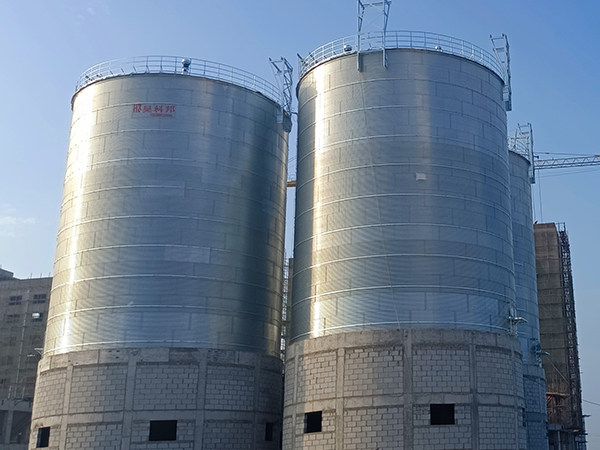
The Development History of Steel Silo: A Century of Evolution in Warehousing Revolution
The history of steel plate silos can be traced back to over a hundred years ago. Early steel silo mainly adopted riveted structures, which were complex to construct and had limited efficiency. With the advancement of industrial technology, prefabricated steel silos, welded steel silos and spiral edge-rolled steel silos have emerged one after another, which has continuously improved the safety, sealing performance and construction efficiency of grain steel silos.
Steel silos were first widely applied in Europe and America, especially in the US grain industry, where steel plate silos have almost replaced traditional brick-concrete silos and concrete silos. At present, over 95% of grain storage facilities in the United States adopt steel silo structures. This trend has also driven the rapid spread of steel silo technology worldwide.
In contrast, the development of grain steel silos in our country started relatively late. In the early 1980s, galvanized corrugated plate prefabricated steel silos were first introduced to China, and then entered a period of rapid development in the 1990s. Nowadays, steel plate silos have been widely used in grain reserve depots, port transfer depots and the grain and oil processing industry, becoming the mainstream choice for modern grain storage.
The Importance of Steel Silo: Core Equipment for Modern Grain Storage
The reason why steel silos have been rapidly popularized worldwide lies in their obvious comprehensive advantages. Compared with traditional silo types, grain steel plate silos are lighter in self-weight, have lower foundation requirements, shorter construction periods, smaller floor space, and have more competitive overall investment costs.
More importantly, steel silos have performed outstandingly in achieving mechanization and automation in grain storage. Whether it is grain receiving, transportation, unloading from silos, or ventilation and cooling, electronic temperature measurement, grain condition monitoring and circulation fumigation, steel silos can all be efficiently accomplished through supporting equipment. This highly integrated design significantly reduces labor costs and also enhances the safety and stability of grain storage.
Today, with food security receiving increasing attention, steel silos are not only storage tools but also important infrastructure for ensuring food quality and reducing losses.

Key Points for Installation and Maintenance: Ensure the long-term safe operation of the steel silo
The performance of steel silos not only depends on design and materials, but also on scientific installation and standardized maintenance, which are equally crucial. During the installation stage, on-site geological exploration is a key link that cannot be ignored. The bearing capacity of the foundation, underground structure, wind load and seismic conditions will all directly affect the long-term stability of steel silos.
For areas prone to earthquakes, it is usually more suitable to choose short and stable steel silo structures to reduce structural risks. In daily use, regular inspection of the warehouse roof, ventilation openings, bolt connection parts and ladder facilities can effectively prevent rust and structural hazards.
In the process of grain loading and unloading, reasonable feeding and discharging methods are equally important. The adoption of central feeding and central discharging can prevent uneven force distribution on the silo body and reduce structural damage to the steel silo. These seemingly detailed operations are actually of great significance for extending the service life of grain steel plate silos.
Service Life of Steel Silo: From “The longer, the Better” to Rational Choice
In the past, people often believed that the longer the service life of grain silos, the better. However, with the acceleration of technological updates, this perception is changing. Nowadays, the design life of steel silos is usually determined comprehensively based on the usage scenario, stored materials and turnover frequency, generally ranging from 20 to 50 years.
Prefabricated steel silos have obvious advantages in terms of service life management. When the farm planning is adjusted or the storage demand changes, the steel plate silo can be disassembled, relocated and rebuilt as a whole to avoid waste of resources. By adopting high-standard galvanized steel plates, composite coatings or corrugated forming processes, thin-walled steel silos can meet long-term usage requirements while ensuring strength.
Extensive Application of Steel Silo in Farms: Standard Equipment for High-Efficiency Agriculture
In modern farm systems, steel silos have almost become a standard configuration. Take American farms as an example. After the grain is harvested, it can be directly sent to the steel silos through the conveying system, achieving full-process mechanized operation. The process of grain entering, storing and leaving the warehouse requires almost no human intervention, significantly enhancing operational efficiency.
This efficient model is also being adopted by an increasing number of countries. Whether it is a large-scale grain planting farm, a feed processing plant, a flour mill or an oil processing enterprise, steel silos have become the preferred solution for raw material storage due to their high turnover rate and stable performance.
Conclusion
From the initial riveted grain silos to today’s intelligent steel silos, the development history of grain steel plate silos has witnessed the continuous evolution of agricultural modernization. With advantages such as structural safety, flexible use, convenient maintenance and high degree of automation, steel silos are playing an increasingly important role in the global grain storage field. It can be foreseen that with the continuous advancement of material technology and intelligent control systems, the application prospects of grain steel silos will be even broader.