

Chicken Feed Silo
COBAN grain silos are designed to ensure safe storage, stable ventilation, and long-term grain preservation under different climate conditions. Each silo system can be customized based on capacity, grain type, and project requirements for optimal storage performance and reliability.

Chicken Feed Silo
Chicken feed silo are a closed device designed for chicken feed storage, which is commonly found in laying hen and broiler farms. Its structure is mostly made of metal or high-strength plastic materials, with good moisture-proof, rodent-proof and mildew-proof properties, and is suitable for long-term storage of granular or powdered feed.
- Customized Capacity Design
- High Strength Galvanized Steel
- ISO Certified Manufacturing
- Global Installation Support
Applications
Corn Storage
Wheat Storage
Rice Storage
Soybean Storage
Feed Storage
Commercial Grain Storage
Product Details & Technical Information
In modern farms, the storage method of chicken feed plays a decisive role in feeding efficiency and feed quality. As an efficient, sealed and highly automated feed storage solution, chicken feed silo have gradually replaced traditional storage methods and become standard equipment for large-scale chicken farms. This article will introduce the structural composition, functional characteristics, application scope and selection recommendations of chicken feed silos in detail to help users systematically understand and reasonably purchase such products.
What is a chicken feed silo?
Chicken feed silo are a closed device designed for chicken feed storage, which is commonly found in laying hen and broiler farms. Its structure is mostly made of metal or high-strength plastic materials, with good moisture-proof, rodent-proof and mildew-proof properties, and is suitable for long-term storage of granular or powdered feed. The silo discharges by gravity and is connected to the automatic feeding system to achieve automated feeding, effectively improving feeding management efficiency.
In the breeding system, the role of chicken feed silos is not only to store feed, but also to undertake the important functions of feed distribution, inventory management and hygiene control. It is one of the important links in realizing automated breeding.
Structural composition of chicken feed silo
A standard chicken feed silos system usually consists of the following core parts:
Barrel structure
The barrel is the main load-bearing structure of the silo, generally made of galvanized steel plate, aluminum-zinc alloy plate or polyethylene. The outer wall is corrosion-resistant, and the top is designed with a rain cap to prevent rainwater from seeping in.
Discharge system
The discharge port is mostly located at the bottom of the silo, connected to a screw conveyor or a flexible conveying pipeline to achieve automatic discharge. Some models are equipped with a flow regulator to facilitate accurate control of the feed amount.
Feeding port and ladder
The top of the silo is equipped with a feed port, which is used with feeding equipment such as a hoist or bulk truck to achieve efficient loading. At the same time, it is equipped with a safety ladder and guardrail for easy maintenance and inspection.
Level monitoring device
Most chicken feed silo are equipped with high and low level sensors to monitor the feed residue inside the silo in real time, which is convenient for automatic feeding of the breeding management system.
Bracket base
The bottom of the silo adopts a thickened steel frame structure to ensure overall stability and can adapt to different terrains and load requirements.
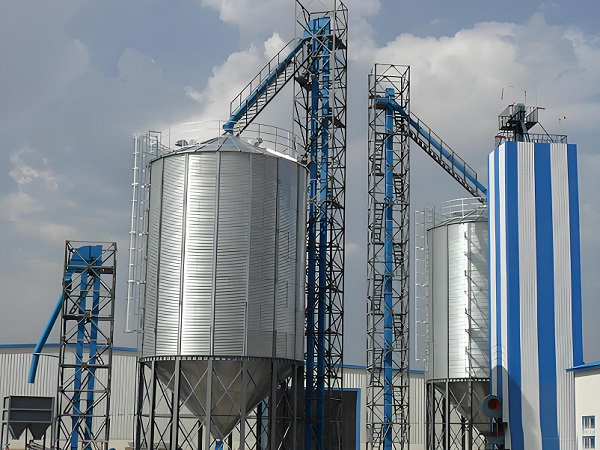
Main features of chicken feed silo
Compared with traditional feed storage methods, modern chicken feed silos have the following significant advantages:
Strong sealing, moisture-proof and mildew-proof
The silo structure has good sealing performance, which can effectively prevent the feed from getting damp and caking, suitable for long-term storage, and significantly reduce the possibility of feed waste and deterioration.
High degree of automation
Seamless connection with the automatic feed line system can achieve timed and quantitative delivery, greatly reducing the burden of manual work.
Stable structure and long life
Silos are usually made of hot-dip galvanized or aluminum-zinc alloy steel, with excellent corrosion resistance. Under normal use conditions, their service life can exceed 10 years.
Easy maintenance, clean and efficient
The inner wall of the cylinder is smooth, not easy to hang material, easy to clean and prevent epidemics regularly, and effectively improve the sanitation level of the breeding environment.
Customizable capacity and strong adaptability
Common capacity ranges from 1 ton to 20 tons, and users can flexibly choose according to the scale of the chicken farm.
Application scope of chicken feed silo
Chicken feed silos are widely used in the following scenarios:
Laying hen farms
Can be matched with automatic feeding systems to improve the daily feeding efficiency of laying hens.
Broiler breeding bases
Large-capacity silos can meet the feed needs of broilers in the rapid fattening stage.
Feed processing plants
Used for temporary storage and transportation of semi-finished feed to improve logistics efficiency.
Agricultural cooperatives
As a transit equipment for centralized distribution and management of feed.
Whether it is a new chicken house or a renovation project, chicken feed silos can be integrated into the overall breeding system as one of the core equipment.
How to choose a suitable chicken feed silo?
To choose a suitable chicken feed silo, you need to consider the scale of breeding, feed type, automation requirements and budget:
Determine the capacity according to the scale of breeding
It is recommended to use 2-5 ton capacity silos for small chicken houses, and large and medium-sized farms should be equipped with large-capacity silos of more than 10 tons to reduce the frequency of feeding.
Confirm the material and anti-corrosion level
In hot and humid areas, hot-dip galvanizing or aluminum-magnesium-zinc alloy materials should be used first. Such materials have stronger weather resistance and corrosion resistance, and better environmental adaptability.
Consider material compatibility
Powder and granular materials have different requirements for the discharging system. It is necessary to ensure that the bottom structure of the silo is compatible with the existing feed types.
Match with automatic feeding line system
If an automatic feeding system is required, it is recommended to choose a silo model that can match the automatic feeding device to ensure smooth system connection and stable operation.
Check the manufacturer’s qualifications and services
It is recommended to give priority to manufacturers or brands with experience, on-site installation and after-sales service capabilities to ensure product quality and delivery efficiency.
Summary
As the poultry farming industry develops towards automation and intensiveness, chicken feed silo are becoming key equipment to improve farming efficiency and reduce feed loss. It not only improves the safety and management efficiency of feed storage, but also saves a lot of labor and operating costs for farms. During the selection process, we should combine the actual breeding needs and choose silo products with reasonable structure, matching capacity and excellent material to maximize the breeding benefits.
Request A Quote
Tell us your capacity, grain type, and project location. We will design a turnkey solution for you.


