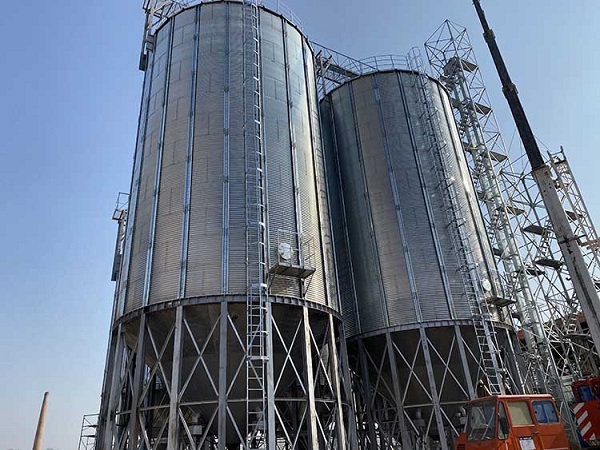
Quick Answer: Why Does Grain Heat Up in a Silo?
Grain usually heats up because biological activity or moisture accumulation creates a localized area where heat cannot be removed fast enough.
The main causes include:
- Grain entering the silo with excessive moisture
- Moisture migration caused by temperature differences
- Poor or insufficient silo aeration
- Insects feeding and reproducing inside the grain
- Mold and fungal activity
- Uneven grain distribution and accumulation of fines
- Hot grain entering storage after drying or harvesting
- Solar heating around the silo roof and upper grain layer
- Poor temperature monitoring
- Long-term storage without proper grain conditioning
The important point is that these causes are often connected.
For example:
High grain moisture → biological activity → heat generation → moisture migration → more localized moisture → mold/insect activity → further heating.
Once this cycle starts, simply opening the silo or waiting for the grain to cool naturally is usually not enough.
1. High Grain Moisture Is One of the Biggest Causes
The first question we ask when investigating a grain heating problem is:
What was the grain moisture content when it entered the silo?
Grain that is too wet is much more difficult to store safely.
Moisture provides favorable conditions for microbial activity, while warmer grain accelerates insect and fungal activity. High moisture and warm temperatures can therefore create a self-reinforcing storage problem.
The problem becomes more serious when moisture is not evenly distributed.
For example, imagine a silo containing maize:
| Grain Condition | Potential Storage Risk |
|---|---|
| Dry and uniformly conditioned | Lower risk |
| Slightly excessive moisture | Increased monitoring required |
| High moisture pockets | High risk of localized heating |
| Wet grain mixed with dry grain | Very high risk |
| Wet fines accumulated in one area | Potential hot spot |
This is why grain moisture content should be checked before grain enters the silo, rather than waiting until a temperature alarm appears.
A grain silo is a storage system, not a substitute for proper grain drying.

grain heating inside a silo
2. Moisture Migration Can Create a Hot Spot Even When the Grain Was Dry
This is one of the most misunderstood causes of grain heating inside a silo.
A customer may tell us:
“The grain was dry when we loaded it. Why is the top of the silo becoming wet and hot?”
The answer can be moisture migration.
Grain is a good insulator. When there is a significant temperature difference between the grain mass and the surrounding environment, natural convection currents can develop inside the grain bulk.
Warm air moves upward through the center of the grain mass, while cooler air moves downward along the silo wall. As warm, moisture-carrying air reaches cooler grain near the top, moisture can condense and accumulate.
The result may look like this:
Temperature difference → internal air movement → moisture migration → condensation → wet grain → mold/insects → heating
This explains why a silo can develop a hot spot even though the original grain moisture looked acceptable.
3. Poor Grain Silo Aeration Allows Heat to Accumulate
A properly designed grain silo aeration system is one of the most important tools for controlling stored grain temperature.
Aeration moves controlled amounts of air through the grain bulk to reduce temperature differences and limit moisture migration. It is primarily used for grain cooling and conditioning, not as a replacement for a high-capacity grain dryer.
A common mistake is to install a fan but not properly consider:
- Silo diameter
- Grain depth
- Grain type
- Bulk density
- Static pressure
- Perforated floor or duct arrangement
- Required airflow
- Fan capacity
- Ambient temperature
- Relative humidity
- Operating schedule
For a tall commercial silo, simply selecting a large fan does not automatically mean the grain will be cooled uniformly.
The airflow must pass through the grain mass effectively.
What happens when aeration is inadequate?
The grain near the airflow path may cool while another area remains warm.
That creates a temperature difference inside the grain mass.
The greater the temperature difference, the greater the possibility of moisture migration and condensation.
Therefore, when designing a grain storage silo, we recommend treating the silo body, aeration system, temperature monitoring system and grain handling equipment as one integrated system.
4. Insects Can Make Grain Heat Up
Insect activity is another common reason for increasing grain temperature in a silo.
Insects consume grain and release heat and moisture. When insect populations become concentrated in one area, their activity can create a localized temperature increase.
That area then becomes more favorable for further biological activity.
This can produce a cycle:
Insects → heat + moisture → favorable conditions → more insects → more heat
Stored-grain pests are strongly affected by temperature. Cooling grain is therefore an important part of grain storage management and insect control.
If the temperature monitoring system shows that one sensor is continuously increasing while surrounding sensors remain relatively stable, the area around that sensor deserves immediate investigation.
5. Mold and Fungal Activity Can Generate More Heat
Mold does not simply appear after grain has already spoiled.
Under favorable moisture and temperature conditions, fungal activity can become part of the heating process.
This is why grain heating and mold growth should be treated as related problems rather than two independent problems.
Once moisture accumulates in a localized area, fungal activity may increase. The resulting biological activity can contribute to further temperature increases.
A practical warning pattern is:
Moisture increase → temperature increase → odor/change in grain condition → mold development
If grain has developed a musty smell, visible mold, crusting or an unusual temperature increase, the problem should be investigated immediately.
6. Hot Grain Entering the Silo Can Start the Problem
Another issue we frequently see in grain storage projects is loading grain into a silo while it is still too warm.
This can happen after:
- Harvesting
- Mechanical drying
- High-temperature grain drying
- Long-distance transportation
- Temporary storage
Drying removes moisture, but grain drying and grain cooling are not the same process.
After drying, grain may still contain considerable heat. If warm grain is placed into a large silo and left without adequate cooling, the center of the grain bulk may remain warmer than the surrounding grain.
This creates the temperature difference that drives internal convection and moisture migration.
For this reason, a complete grain storage project should consider:
Cleaning → Drying → Cooling → Conveying → Silo Storage → Aeration → Temperature Monitoring
rather than viewing the silo as an isolated piece of equipment.
7. Solar Heat Can Warm the Top of the Silo
Customers sometimes assume that a steel silo protects the grain from outside temperature changes.
It does not completely eliminate the effect of the environment.
The silo roof and upper wall sections are exposed to solar radiation. During hot weather, the metal roof can become significantly warmer than the grain below it.
Heat can therefore transfer into the upper grain layer.
If the upper part of the silo is already close to a moisture accumulation zone, this additional heat can increase the risk of grain quality problems.
Research and extension recommendations specifically identify roof solar heat as a reason to ventilate the upper silo area during hot weather.
For hot-climate grain storage facilities, this becomes particularly important.
8. Uneven Grain Distribution Can Create Localized Problems
The way grain enters and fills a silo also affects storage performance.
If fines, broken kernels, dust and foreign material accumulate in specific areas, airflow resistance can become uneven.
These areas may not receive adequate aeration.
The result can be:
Fines accumulation → restricted airflow → poor cooling → moisture retention → hot spot
This is why grain cleaning and proper grain distribution are not merely housekeeping issues.
They directly influence the performance of the grain storage system.
A properly designed storage project should consider grain flow, filling method, fines management, unloading arrangement and aeration together.

grain storage system
9. Why Does the Top Center of the Silo Often Become Hot?
This is one of the most common questions we receive.
The top center is vulnerable because warm air inside the grain mass tends to move upward.
When this warm, moisture-containing air reaches cooler grain near the surface, it can lose its ability to hold moisture efficiently. Condensation and moisture accumulation may then occur in the upper grain layer.
You may notice:
- Higher temperature near the center
- Damp grain near the surface
- Grain crusting
- Musty odor
- Mold growth
- Insect activity
- Temperature increasing at only one or two sensor locations
This is why silo temperature monitoring should not rely on a single temperature measurement.
Multiple monitoring points provide a much clearer picture of what is happening inside the grain mass.
10. How to Detect Grain Heating Before It Becomes Serious
The best time to solve a grain heating problem is before visible spoilage appears.
We recommend monitoring several indicators.
Grain Temperature
Install temperature sensing cables at appropriate positions inside the silo.
Regular temperature measurements allow the operator to identify changes rather than simply looking at one absolute temperature.
Canada’s grain storage guidance recommends checking silo temperature regularly and using permanent temperature sensing cables where available.
Grain Moisture
Temperature alone cannot explain every storage problem.
A temperature increase combined with increasing moisture is much more significant than temperature variation alone.
Grain Odor
A musty or unusual smell can be an early warning of grain quality deterioration.
Grain Surface
Look for:
- Crusting
- Condensation
- Discoloration
- Mold
- Caking
- Wet areas
Insect Activity
Use appropriate inspection and monitoring methods to determine whether insects are developing inside the grain mass.
11. What Temperature Increase Should You Be Concerned About?
There is no single temperature number that can be applied safely to every grain, climate and storage period.
The trend is often more important than one isolated reading.
For example:
| Temperature Monitoring Result | What It May Indicate |
|---|---|
| Stable temperature | Storage conditions may be stable |
| Small uniform change | Normal environmental response may be occurring |
| One sensor gradually increasing | Possible localized problem |
| Several sensors increasing | Wider storage condition problem |
| Rapid temperature increase | Possible active heating |
| Temperature + moisture increase | High risk of spoilage |
| Temperature + insects/mold | Immediate investigation required |
As an engineering practice, we recommend establishing a baseline after grain is loaded and cooled, then comparing subsequent readings against that baseline.
Some storage guidance recommends checking grain at least every two weeks, with more frequent monitoring under warmer or higher-risk conditions.
12. What Should You Do When Grain Is Already Heating?
Do not immediately assume that increasing fan operation is the complete solution.
First identify the cause.
Step 1: Confirm the Temperature
Check the temperature at multiple monitoring points.
Determine whether the increase is:
- Localized
- Moving
- Uniform
- Concentrated near the top
- Concentrated near the wall
- Concentrated near the center
- Associated with a particular grain layer
Step 2: Check Grain Moisture
Take representative samples where practical.
A hot spot with high moisture requires a different response from a temperature increase caused primarily by environmental heating.
Step 3: Check for Insects and Mold
Inspect for:
- Live insects
- Mold
- Musty odor
- Caking
- Crusting
- Discolored grain
- Wet grain
Step 4: Start Appropriate Aeration
If conditions are suitable, aeration can be used to move the cooling front through the grain and reduce temperature differences.
However, aeration must be matched to the grain condition and outside air conditions.
Aeration with unsuitable air can potentially increase grain moisture rather than solve the problem.
Step 5: Continue Monitoring
Do not stop monitoring simply because the fan has been turned on.
The important question is:
Is the hot spot temperature actually decreasing?
If the temperature continues increasing during aeration, the operator should reassess the situation and consider whether the grain needs to be moved or unloaded to break up the affected area.
For serious heating conditions, professional grain-storage advice should be obtained before personnel enter a silo.
13. Can Aeration Prevent Grain Heating?
Yes, properly designed and operated grain silo aeration can significantly reduce the risk of grain heating, but it cannot compensate for badly conditioned grain.
Aeration is primarily designed to:
- Cool stored grain
- Equalize grain temperature
- Reduce temperature differences
- Reduce moisture migration
- Limit condensation
- Help control insect activity
- Maintain grain quality
It should not be confused with a high-capacity grain drying system.
This distinction is important when selecting equipment.
If grain enters the silo too wet, the correct solution may require a grain dryer, followed by cooling and controlled silo storage.
14. Grain Dryer vs. Grain Silo Aeration: What Is the Difference?
Many new grain storage operators confuse these two systems.
| Equipment | Main Function | Typical Purpose |
|---|---|---|
| Grain Dryer | Remove excess moisture | Reduce grain moisture before storage |
| Grain Cooler | Reduce grain temperature | Cool grain after drying |
| Silo Aeration Fan | Condition stored grain | Maintain temperature and reduce migration |
| Temperature Monitoring System | Detect changes | Find hot spots early |
| Grain Silo | Store conditioned grain | Protect grain during storage |
A good grain storage system does not ask the silo aeration system to perform the job of a grain dryer.
The equipment should work as a sequence.
Dry correctly → Cool correctly → Store correctly → Monitor continuously → Aerate when required

15. How COBAN Approaches Grain Heating Problems
When we design a grain storage project, we do not look at the silo body alone.
The actual storage performance depends on the relationship between:
Grain condition + silo capacity + grain depth + aeration + temperature monitoring + handling + local climate
For example, a 1,000-ton silo in a dry climate and a 1,000-ton silo in a hot and humid climate may require very different storage management strategies.
The same principle applies to different commodities.
Maize, wheat, rice, soybean, barley and other grains have different moisture and storage requirements.
From our engineering experience, we normally evaluate the following before recommending a storage configuration:
Grain Information
- Commodity type
- Initial moisture
- Target storage moisture
- Bulk density
- Expected storage period
- Harvest temperature
Site Conditions
- Ambient temperature
- Relative humidity
- Seasonal temperature changes
- Solar radiation
- Local climate
Silo Conditions
- Storage capacity
- Silo diameter
- Grain height
- Flat bottom or hopper bottom
- Filling method
- Unloading method
Aeration Conditions
- Required airflow
- Fan capacity
- Static pressure
- Aeration floor or duct arrangement
- Air inlet/outlet configuration
- Operating strategy
Monitoring
- Temperature cable quantity
- Sensor positions
- Temperature data collection
- Alarm strategy
- Inspection frequency
This engineering approach is much more reliable than choosing a silo capacity first and trying to add an aeration system afterward.
16. A Practical Grain Heating Prevention Checklist
Before putting grain into long-term storage, check the following:
Before Filling the Silo
☐ Grain is properly dried
☐ Grain moisture is measured
☐ Grain is cleaned
☐ Broken kernels and fines are controlled
☐ Grain temperature is checked
☐ Silo is clean and dry
☐ Aeration equipment is operational
☐ Temperature sensors are working
After Filling
☐ Grain temperature is recorded
☐ Grain is cooled when conditions are suitable
☐ Temperature differences are monitored
☐ Moisture migration risks are considered
☐ Grain surface is inspected
☐ Insect activity is monitored
☐ Aeration fans are operated according to conditions
During Long-Term Storage
☐ Temperature trends are recorded
☐ Hot spots are investigated immediately
☐ Moisture changes are monitored
☐ Mold or odor is checked
☐ Aeration is adjusted according to season
☐ Roof and upper grain heating are considered
17. The Most Important Rule: Do Not Wait for Visible Mold
By the time mold becomes clearly visible, the storage problem may already have existed for some time.
A temperature monitoring system can detect changes much earlier.
For example:
Day 1: Grain temperature = stable
Day 7: One sensor rises slightly
Day 14: Same sensor continues rising
Day 16: Moisture is found around the same area
Day 18: Grain begins to cake
Day 20: Mold becomes visible
The objective of a good grain storage management system is to identify the problem around Day 7 rather than Day 20.
This is why temperature monitoring, aeration and regular inspection should work together.
18. How to Reduce Grain Heating Risk in a New Silo Project
If you are planning a new grain storage silo, preventing heating should start during the design stage.
A complete solution may include:
Grain Cleaner
↓
Grain Dryer
↓
Grain Cooler
↓
Bucket Elevator / Conveying System
↓
Grain Silo
↓
Aeration System
↓
Temperature Monitoring System
↓
Central Grain Storage Management
This configuration allows the grain to enter the silo in a condition suitable for storage instead of relying on the silo to correct problems afterward.
For larger commercial grain storage facilities, the aeration system, silo size and temperature monitoring arrangement should be calculated according to the actual grain type, storage depth and site conditions.