Note: If you’re still in the early stages of planning your site, start with our [Ultimate Technical Selection Guide for Metal Grain Silos] to see which material and engineering standards fit your local climate.
Why has the hopper bottom silo become the new standard for grain storage?
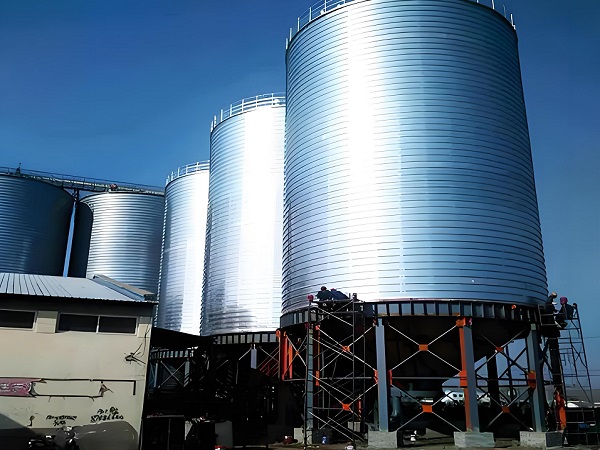
In the field of grain processing and storage, hopper bottom silo are gradually replacing traditional flat-bottom silos and becoming the standard configuration of large and medium-sized grain depots. This innovative design achieves gravity self-flowing discharge through the bottom conical structure, which significantly improves the operating efficiency while ensuring the quality of grain.

Understanding hopper bottom silo
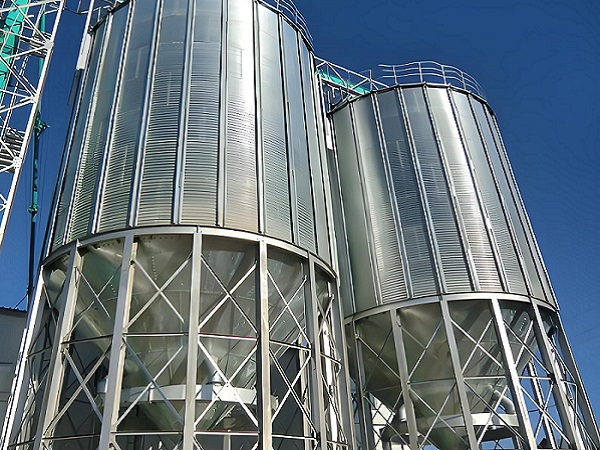
The hopper bottom silo is a vertical storage container with a conical or pyramidal bottom. Its core feature is the 60°-65° inclination angle design. This structure allows the grain to slide naturally to the bottom discharge port under the action of gravity, completely solving the problem of mildew caused by residues in the flat-bottom silo. The standard capacity ranges from 50 tons to 5,000 tons, and the materials are mostly galvanized steel plates or food-grade stainless steel.
Analysis of the three major technical advantages of the hopper bottom silo
Zero residue discharge system
The conical bottom is combined with a vibration arch breaking device to ensure that the grain in the silo is completely cleared and the residue is less than 0.3%. The actual measurement data of a flour mill shows that it can reduce 6-8% of grain loss compared with flat-bottom silos.
Intelligent ventilation system
Multi-layer annular ventilation ducts are combined with humidity sensors to achieve precise temperature control. After a grain depot in Jiangsu used it, the storage period of rice was extended by 40%, and the rate of increase of fatty acid value was reduced by 62%.
Modular combination design
Supports multi-warehouse parallel connection to form a storage matrix, and the installation period of a single 2,000-ton silo only takes 72 hours. An agricultural cooperative in Xinjiang uses an 8-unit configuration to achieve classified storage of wheat.
Which types of grains are suitable for hopper bottom silo
Staple grain crops
Grains with good fluidity such as wheat, rice, and corn
Oil crops
Soybeans, rapeseed (anti-static treatment is required)
Special grains
Small grains such as quinoa and buckwheat (anti-shatter devices are recommended)
Note
Operators need to install additional fluidization devices for glutinous grains (such as glutinous rice), and dry grains with a moisture content of over 16% before storage.
Five reasons for choosing hopper bottom silo
Significant economic benefits
Comparative data from a grain company in Hebei Province show that the average storage cost per ton of a 500-ton hopper bottom silo is 34% lower than that of a room-type silo, and the equipment investment recovery period is about 2.3 years.
Quality assurance upgrade
The closed structure effectively blocks rodent pests and insects, and the nitrogen storage technology can control the storage loss within 0.5%. An experiment conducted by the China National Grain Reserves Corporation demonstrated the long-term effectiveness of wheat storage. After 2 years of storage, the gluten retention rate of the wheat remained at 91%.
Revolution in operating efficiency
The automatic discharging system increases the unloading speed to 80 tons/hour and reduces the labor demand by 60%. A grain depot at a port in Shandong Province has achieved all-weather mechanized operation.
Doubled space utilization
With the same floor space, the vertically designed grain storage capacity is 2.8 times that of a flat warehouse. It is particularly suitable for areas with tight land resources.
Environmental compliance advantages
The fully enclosed structure effectively prevents dust from spilling out. Meanwhile, the noise is controlled below 65 decibels, easily meeting the “Grain Storage Industry Pollutant Emission Standards”.
Conclusion
With the implementation of the “Grain Saving Action Plan”, the demand for efficient storage solutions has increased. As a result, the hopper bottom silo has become the preferred choice for the construction of modern grain depots. Its modular characteristics are also compatible with future IoT upgrades, reserving technical interfaces for the construction of smart grain depots.