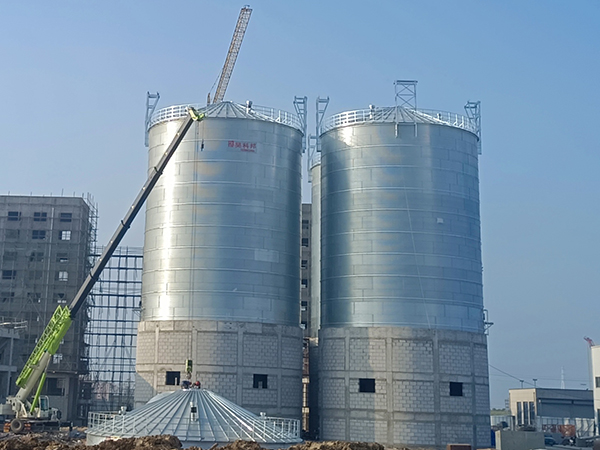
The following content, in combination with industry practice, explains from multiple dimensions why silos are no longer the default choice.

1. Technological progress: Storage and conveying systems no longer “can only choose silos”
The popularity of early silos was largely due to the limited technical conditions. At that time, there were not many options for closed storage, and the level of automation was also low. Silos had obvious advantages in moisture-proofing, pollution prevention and centralized storage.
But now the situation is completely different:
- The maturity of modular warehousing systems (such as warehouse clearance + automatic scraper and chain plate systems) has been significantly enhanced
- The bulk material conveying equipment has been significantly improved in terms of sealing performance, measurement accuracy and continuous operation stability
- Digital monitoring (material level, temperature, pressure) no longer relies on the silo structure itself
In actual projects, many functions that were previously “could only be achieved through silos” can now be accomplished through equipment combination, and the significance of the structure itself has been weakened.
2. Cost consideration: The cost pressure throughout the entire life cycle is becoming increasingly evident
From the perspective of individual construction costs, silos themselves are not a “cheap” solution, and the real problems often arise during the long-term usage stage.
The common cost pain points in the industry include:
- High foundation construction cost (deep foundation, anti-settlement design)
- Long-term maintenance costs for steel structures or concrete cylinders
- Production needs to be halted during inventory clearance and maintenance, resulting in high hidden costs
In contrast, flat or modular warehousing systems are more controllable in terms of initial investment, expansion flexibility, and later maintenance. For foreign trade clients, especially small and medium-sized factories, the efficiency of capital utilization has become an important factor in decision-making, and the “heavy asset attribute” of silos is gradually becoming unpopular.

3. Operational efficiency: Not all materials are suitable for “vertical stacking”
From an operational perspective, silos are not the most efficient structures but have very strict requirements for material conditions.
In practical use, common problems include:
- The discharge of materials that are prone to arching and adhesion is unstable
- It is difficult to switch between multiple product categories and the clearance time is long
- The adjustment range of the discharge rate is limited
With the fragmentation of orders and the increase in SKUs, many factories are more concerned about “switching efficiency” rather than the maximum single storage capacity. The flexibility of silos in this regard is obviously insufficient, especially for the production mode of multiple varieties and small batches.
4. Space utilization rate: Height does not equal “effective space”
On the surface, the silo extends upwards and seems to save a lot of floor space. However, in real factory planning, the situation is often the opposite.
The main reasons include:
- Height limit: Some industrial parks have clear upper limits on the height of buildings
- Supporting space: Additional equipment platforms, maintenance access and safety distances are required
- Effective volume loss: The cone bucket and the structural reinforcement area cannot be fully utilized
In contrast, the low but spliced storage solution is actually more likely to achieve the optimal spatial solution in the overall factory layout, especially in foreign trade factory projects that require reserved expansion space.
5. Regulatory and environmental factors: Compliance costs have risen significantly
In recent years, the supervision of industrial safety and environmental protection in various countries has been continuously tightened, and silos are often the key objects of supervision.
Common compliance pressures include:
Dust explosion risk assessment
Safety Specifications for Operations in Confined Spaces
Emission and cleanliness standards
In the European and American markets, silo projects often require additional explosion-proof designs, dust removal systems and certification processes, which directly increase the project cycle and compliance costs. After assessment, some enterprises choose alternative solutions with lower structural risks and simpler approval processes.
6. Industry-specific changes: The demand structure has changed
It should be emphasized that silos are not being “phased out” in all industries; rather, their applicable scenarios are narrowing.
For example:
- Silos are still widely used in the grain and feed industries
- The chemical, composite materials and new energy powder industries have decreased significantly
The reason lies in the fact that the material characteristics of emerging industries are more complex, and they have higher requirements for temperature control, mixing, and batch traceability. However, these demands may not necessarily be met through silos. The changes in the industry itself determine the evolution direction of storage structures.
7. Innovation in material handling: Systematic thinking is replacing single equipment
In the past, projects often designed systems around “one silo”, but now it is more popular to start from the perspective of overall material flow.
For example:
- Integrated design for storage, transportation and metering
- A flexible system with multi-point feeding and multi-point discharging
- It is linked with the automatic packaging and automatic loading systems
Under this systematic thinking, silos are just one of many possible solutions and no longer the default option.
Alternative solution examples (Common Industry Practices)
In actual projects, the following solutions are being widely adopted:
- Modular warehouse closing + automatic scraper/chain plate conveying
- Mobile or expandable silo systems
- Containerized bulk material storage unit
- A combination of small vertical silos with multiple silos connected in parallel
The common features of these solutions are: flexibility, scalability, and maintainability, which better meet the current demands for rapid delivery and long-term operation of foreign trade projects.
Summary
Silos are not an “outdated technology”, but rather a return from a “general solution” to a “scenario-specific solution”. In today’s industrial environment, enterprises pay more attention to return on investment, operational flexibility and compliance risks rather than simply pursuing maximum reserves.
For this reason, we see an increasing number of new projects proactively avoiding silos during the planning stage and choosing alternative solutions that are more suitable for their business models. This trend will continue in the coming years.