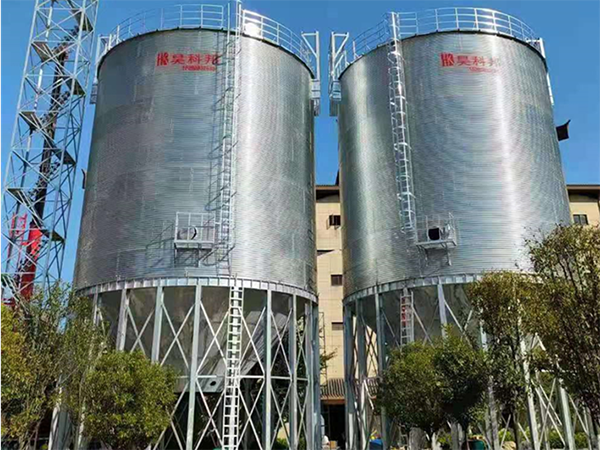
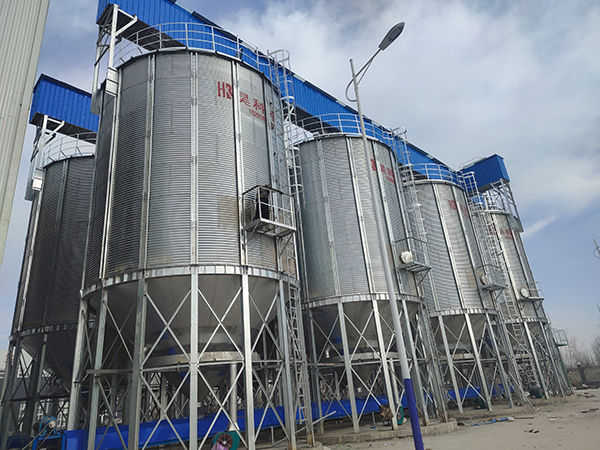
A newly installed grain silo may appear neat, with an intact roof and all bolts in place, but this does not guarantee its suitability for safe grain storage.
For the purchaser, the truly important questions are: Can this grain silo be loaded, stored, and unloaded normally according to its design capacity? Are there any potential long-term safety hazards left during installation?
Some installation problems are difficult to detect when the silo is empty. For example, uneven joints in the silo walls, misalignment between the unloading equipment and the silo floor center, partial blockages in ventilation ducts, or even improper sealing in certain areas. These problems may only surface after the first loading, at which point the difficulty and cost of rework will significantly increase.
Therefore, regardless of whether a flat-bottomed or hopper-bottomed grain silo is purchased, a phased inspection should be conducted before formal delivery.
The following content, from the perspective of a grain silo installation engineer, explains what should be inspected, how to assess it, and how to handle any problems discovered, following the actual on-site acceptance sequence.

First, confirm: Does installation completion equate to acceptance?
Grain silo projects typically go through several distinct phases.

For newly constructed Steel Grain Silo projects, it is recommended to separate mechanical installation acceptance from final operational acceptance.
Especially for large flat-bottom silos, if the site is not yet ready for grain loading, empty silo acceptance can be completed first, but this does not mean that all full-load operational performance has been verified.
Second, the first inspection item: Is there any settlement, cracks or installation deviations in the foundation of the grain silo?
The foundation of a grain silo is the part that should be checked first during acceptance testing.
The weight of a grain silo is usually much less than the weight of a full silo of grain. The load that the foundation of a 5,000-ton steel silo needs to withstand when fully loaded is completely different from that when empty.
Therefore, the fact that the foundation appears normal when empty does not necessarily prove that the settlement after being fully loaded will meet the requirements.
Four key locations to check
| Inspection Items | On-site Inspection Methods | Handling of Problems Found |
|---|---|---|
| Foundation Elevation | Re-measure the elevation of the silo support position using a level instrument. | Check against allowable deviations in construction and design. |
| Concrete Cracks | Inspect the ring beam, foundation, and area around anchor bolts. | Record the location, width, and changes in cracks; the structural engineer will determine the cause. |
| Anchor Bolts | Check the quantity, specifications, exposed length, and tightening condition. | Handle according to the approved plan; do not weld or enlarge holes arbitrarily. |
| Foundation-Silo Wall Contact Surface | Inspect the bottom support, grouting, and sealing. | Repair discontinuous contact or areas that do not conform to design specifications. |
Special attention should be paid to whether there are any areas of unsupported space at the bottom of the silo.
For steel silos supported by concrete ring beams, gaps between the bottom of the silo wall and the foundation that do not meet design requirements may cause abnormal local load transfer.
Installation personnel sometimes use sealant to fill surface gaps, but sealant cannot replace structural support or a qualified grouting layer.
During acceptance, foundation construction records, concrete strength reports, foundation treatment data, and settlement observation records should also be checked.
For large-capacity Flat Bottom Silos, it is recommended to retain initial settlement measurement data for comparison during initial loading and subsequent operation.
Third, the second inspection item: Do the steel plates and bolt connections of the silo wall conform to the design?

Bolted steel silos typically consist of walls constructed from multiple layers of galvanized corrugated steel sheets. The wall thickness, reinforcement arrangement, and bolt specifications must be compatible with the design load.
During acceptance testing, it’s crucial to examine not only the surface shine of the steel sheets but also the quality of the connections.
1. Check if the steel plates in the warehouse walls are installed in the wrong position.
The lateral pressure on grain varies depending on the height of the silo walls.
Some grain silos use a combination of wall panels of varying thicknesses. If, during installation, a thicker steel plate is mistakenly installed on top and a thinner plate on the bottom, it may not be visually apparent, but it will alter the original design’s load-bearing capacity.
Inspection Method:
- Verify the specifications of each layer of panels against the approved warehouse wall panel layout plan.
- Check the panel markings, installation records, and material list.
- For panels with questionable specifications, verify the thickness at appropriate locations, considering the impact of the galvanized layer on the measurements.
Do not judge the thickness of a steel plate based solely on its appearance.
2. Check if any bolts are missing, loose, or of mixed specifications.
For Bolted Grain Silo Installation, bolt inspection is a labor-intensive and easily overlooked step.
During acceptance, at least the following should be confirmed:
- No bolts are missing from the circumferential and vertical connections of the silo walls.
- The bolt strength grade, size, and washer configuration conform to the drawings.
- There is no obvious misalignment or abnormal deformation at the connection surfaces.
- The fastening process and sampling results meet the manufacturer’s requirements.
It’s important to note that not all bolts can be tightened to the same torque.
Different bolt grades, diameters, surface finishes, lubrication conditions, and gasket configurations may require different tightening torques.
Torque should not be increased indefinitely to make the connection appear stronger. Overtightening can damage threads, gaskets, or sealant.
3. Check if the reinforcing ribs are connected continuously.
Silo stiffeners play a crucial structural role, especially in large-capacity steel silos.
During inspection, the connections, splices, bottom supports, and fixing bolts of the stiffeners should be checked along the silo’s height to ensure they conform to the design specifications.
If localized bending of the stiffeners, significant misalignment of connection holes, or instances where installers forcibly tighten bolts to eliminate large assembly deviations are found, the cause should be investigated first, rather than accepting the situation immediately.
Fourth, the third inspection item: Is the silo body vertical? Is there any abnormal deformation on the top of the silo?

After the grain silo is installed, its verticality, roundness, and key dimensions should be re-measured.
These dimensional deviations cannot be judged simply by visual inspection.
For example, when observing a 20-meter-high grain silo from the ground, even if there is some tilt, it may not be clearly visible.
It is recommended to use a total station or other suitable measuring equipment to re-measure the silo from multiple angles and compare the results with the approved drawings and project acceptance standards.
The following also needs to be checked on the silo roof:
| Silo Roof Location | Issues Requiring Confirmation |
|---|---|
| Top Cover Connection | Are there any obvious warping, misalignment, or missing fasteners? |
| Silo Roof Support Structure | Are the support rods, connecting plates, and fasteners complete? |
| Grain Inlet | Is it correctly aligned with the conveyor equipment outlet? |
| Ventilation Openings | Are they configured as designed? Are rain and insect protection measures complete? |
| Maintenance Manhole | Can the cover close and seal properly? |
| Silo Roof Platform and Guardrails | Do the connection and load-bearing capacity meet the approved design? |
For Grain Storage Silo systems equipped with top conveyors, special attention must be paid to the support method of the conveyor equipment.
If the conveyor load was originally intended to be borne by a separate steel structure, it should not be arbitrarily transferred to the silo roof on the installation site.
The silo roof structure should be used according to the design load; no equipment should be added or the support positions changed without proper calculation.
Fifth, the fourth inspection item: Are there any leaks or sealing defects in the new grain silo?
After the grain silo is installed, even if there is no grain immediately, a sealing inspection should be conducted as soon as possible.
The losses caused by leaks in the grain silo are usually far greater than the cost of repairing several leaking seals.
Especially in tropical rainy season regions, if there is seepage in the silo roof, wall joints, or manholes, rainwater can enter the silo along the steel plate seams.
Grain that becomes damp in certain areas is prone to clumping, heating up, or mold growth.
The most vulnerable areas to leakage.
 | Overlap joints of the warehouse roof Check the sealant for continuity, missing parts, misalignment, and localized lifting. Pay special attention to the connection between the roof panel and the central roof and eaves. |
 | Inspection of manholes and equipment access ports Check the tightness of gaskets and cover plates, as well as the waterproofing treatment at the access points, to ensure that rainwater will not enter through the equipment interfaces. |
 | Connection between the silo wall and the foundation Check the continuity of the bottom seal, the external drainage slope, and whether there are any low-lying areas around the foundation that are prone to water accumulation. |
How to conduct a sealing acceptance test?
An internal visual inspection can be conducted first, followed by localized water spraying or other approved leak detection methods based on project requirements.
For grain silos that are designed to be airtight and require fumigation, the inspection should be conducted according to the corresponding airtightness test plan.
Ordinary rainproof sealing and fumigation airtightness requirements are not the same thing.
A grain silo that does not leak does not necessarily mean that it meets the airtightness requirements for phosphine fumigation.
High-pressure water spraying or pressure testing of the entire silo without prior assessment is not recommended, as this may introduce loads not considered in the design.
XI. Fifth inspection item: Can the ventilation system actually deliver air into the grain pile?
For Grain Silo Aeration Systems equipped with ventilation systems, it is not sufficient to simply confirm that the fans are running.
Normal fan operation does not guarantee that every area within the silo receives adequate ventilation.
Flat bottom warehouse needs to be carefully inspected
1. Are there any blockages in the ventilation floor or ductwork?
During installation, bolts, welding slag, concrete debris, and packaging materials may be left inside the ductwork.
If these debris block local air outlets, the ventilation effect in that area may significantly decrease after grain is loaded.
2. Is the connection between the fan and the ductwork sealed?
Inspect the fan outlet, connecting joints, duct flanges, and access ports to confirm there are no obvious air leaks.
3. Does the actual operating point of the fan match the design?
During acceptance, record the fan operating current, static pressure, and measurable airflow, and verify them against the design requirements and fan performance curves.
Simply confirming that the motor rotation direction is correct is not enough.
An Easily Overlooked Acceptance Issue
Airflow resistance differs when the storage silo is empty compared to when it’s filled with grain.
Therefore, empty silo ventilation tests primarily verify equipment installation, airflow connectivity, and basic functionality.
The actual effectiveness of grain storage ventilation is also affected by grain variety, grain layer height, impurity content, and actual system resistance.
For large-scale storage projects, it’s best to schedule appropriate operational verification after the initial grain loading, rather than relying solely on empty silo tests to confirm that ventilation performance fully meets standards.
XII. Item 6: Are the grain feeding and unloading equipment compatible with the warehouse structure?
The acceptance inspection of newly built grain silos should not be limited to the steel silo body itself.
If a Complete Grain Storage System is purchased, the conveying and unloading equipment must also be inspected.
Flat-bottomed silos: Focus on inspecting the unloading center and cleaning equipment.
For flat-bottom silos using a central discharge port and a silo sweep auger, the following needs to be confirmed:
- Does the location of the central unloading port conform to the design?
- Can the grain outlet gate open and close normally?
- Does the operating trajectory of the cleaning auger match the bottom structure of the silo?
- Are the drive, protection, and control logics of the cleaning equipment normal?
- Do the opening sequence of multiple grain outlets meet the design requirements?
Special attention should be paid to the fact that some grain silos only allow operation according to a prescribed unloading sequence.
If operators arbitrarily open the eccentric unloading port, it may cause uneven pressure distribution on the grain side.
For silos not specifically designed for eccentric unloading, such operation may cause abnormal stress on the silo walls.
Conical bottom silos: Focus on inspecting the conical hopper and supporting structure.
The inspection focus for Hopper Bottom Grain Silo differs from that of flatbed silos.
The cone-bottom hopper needs to be carefully checked:
| Inspection Areas | Key Acceptance Points |
|---|---|
| Conical Bucket Plate | Plate connections, local deformation, and fastening quality |
| Conical Bucket to Cylinder Connection | Whether connecting rings, reinforcing parts, and bolts meet design specifications |
| Support Columns | Verticality, support connections, and bottom anchoring condition |
| Diagonal Braces | Integrity and secure connection |
| Grain Discharge Outlet | Valve dimensions, location, and sealing performance |
| Lower Conveying Equipment | Alignment and presence of any undesigned additional loads |
When fully loaded, the weight of the grain in a cone-bottom silo is transferred to the foundation through the cone hopper and support system.
Therefore, the support legs and diagonal braces should not only be visually inspected, but their installation location, connection method, and foundation anchorage conditions should also be verified.
XIII. Item 7: Are temperature monitoring, material level detection, and electrical protection effective?
Modern grain silos are typically equipped with Grain Silo Temperature Monitoring Systems, level sensors, and blower control cabinets.
Even if these devices are already installed, problems such as wiring errors, signal anomalies, or incorrect control logic may exist.
It is recommended to conduct item-by-item functional testing before delivery.
| System | Recommended Test Content | Pass/Fail Criteria |
|---|---|---|
| Temperature Monitoring | Check sensor number, readings, and communication status | Correct point correspondence, reasonable readings, and identifiable abnormal signals |
| High Level Alarm | Simulate or trigger level signals according to specified methods | Control system correctly alarms and executes designed actions |
| Conveying Equipment | Check steering, operating current, and interlocks | Operating status and protection functions conform to design |
| Fan Control | Start/Stop, Overload, and Fault Feedback | Control and protection actions are normal |
| Emergency Stop System | Perform functional tests under safe conditions | Controlled equipment safely stops as designed |
| Grounding and Lightning Protection | Check connection continuity and test records | Compliant with local regulations and approved design |
For areas where flammable grain dust is present during transport and cleaning, it should also be confirmed whether the suitability of electrical equipment, dust control measures, and related explosion-proof protection meet the project risk assessment and local requirements.
Here, it is important to emphasize an acceptance principle:
The fact that a sensor can display numbers does not mean that the monitoring system has passed acceptance testing.
For example, if temperature cables are installed inside the warehouse, but the measurement point numbers displayed in the control cabinet do not match the actual locations, operators may misjudge the area of heat generation in the grain pile.
Therefore, acceptance testing should verify the measurement point layout diagram, numbering, and system display, not just confirm that the equipment is powered on.
IX. Item 8: Are the conditions for initial grain loading met?
Most of the initial inspections are completed in an empty state.
However, the grain silo only begins to bear the storage load from the initial loading.
For large Steel Grain Silos, the initial loading should not be treated as a routine operation.
It is recommended that the owner, installation manager, and relevant engineering technicians conduct the initial loading according to the approved plan.
What are the key observation points during the initial grain loading?

Grain loading should follow the methods and sequence approved in the design. Unauthorized practices such as asymmetrical stacking, loading at speeds exceeding the design limits, or temporarily changing the grain loading location are prohibited to shorten acceptance time.
If abnormal settlement, significant deformation of the silo walls, or unusual structural noises are detected, operations should be suspended, the hazardous area isolated, and a qualified engineering team should assess the situation and determine the next steps.
Do not allow personnel to enter a loaded grain silo to inspect or handle any abnormalities. Grain movement, bridging collapses, and oxygen-deficient environments can all cause serious accidents.
X. Which problems discovered during grain warehouse acceptance must be rectified before delivery?
Not all acceptance problems are of the same severity.
For example, minor scratches on the galvanized surface or missing critical connecting parts to the warehouse body obviously cannot be handled using the same methods.
The table below is suitable for the purchaser to refer to during on-site acceptance.
| Problems Found | Suggested Handling Methods | Acceptance Judgment |
|---|---|---|
| Missing critical connecting bolts in the silo wall | Replace and re-inspect as required | Re-inspect after rectification |
| Abnormal cracks or settlement in the foundation | Assess the cause and impact by a structural engineer | Do not load grain until safety is confirmed |
| Significant water leakage from the silo roof | Identify and repair the leakage path | Re-perform relevant sealing tests |
| Abnormal temperature monitoring points | Check wiring, sensors, and serial numbers | Repair and re-test |
| Local scratches on the galvanized layer of the silo wall | Repair according to regulations and record the damage | Accept after meeting corrosion protection requirements |
| Abnormal vibration in the unloading equipment | Check the installation, alignment, and drive system | Try operation after troubleshooting |
| Difference between actual dimensions and design drawings | Verify if the deviation is within the allowable range | Review the design if necessary |
The procuring entity should not rely solely on verbal promises from installation personnel regarding subsequent maintenance.
For issues discovered during acceptance, a rectification list should be compiled, including at least the location of the issue, photos, responsible party, corrective measures, completion time, and re-inspection results.
Issues involving structural safety, critical equipment interlocks, or grain storage safety should be addressed before formal commissioning. Whether non-critical legacy items can be conditionally transferred should be determined jointly by the contract, applicable regulations, and the project manager.
XI. What documents should the customer receive upon delivery of the COBAN grain warehouse project?
After completing the Grain Silo installation, in addition to the physical equipment, the customer needs sufficient technical documentation to commence subsequent operation and maintenance.
For grain storage systems provided by COBAN, project delivery documentation should be compiled according to the actual scope of supply and contractual agreements.
It is recommended that the purchaser at least verify the following documents:
Grain Silo Delivery Document Checklist
- Approved general layout drawings, foundation drawings, and silo structure drawings;
- As-built drawings and approved design change records during installation;
- Material or quality certificates for silo wall panels, bolts, and major structural components;
- Foundation inspection, settlement monitoring, and related construction records;
- Bolt tightening, dimensional re-measurement, and sealing inspection records;
- Commissioning records for fans, conveyors, and unloading equipment;
- Temperature monitoring, material level, electrical, and safety interlock test records;
- Initial grain loading trial run record (if implemented);
- Equipment operating instructions, maintenance plan, and spare parts list;
- List of unresolved issues, warranty terms, and after-sales contact information.
As-built drawings are particularly important.
During installation, the location of some equipment, pipeline routes, or auxiliary structures may be adjusted based on site conditions. Subsequent maintenance personnel need to know the final, actual installation, and cannot rely solely on the initial design.
Accurate as-built data is also crucial for future engineering design if the customer plans to add conveyors, silo top equipment, or expand other grain silos.
XII. Several Acceptance Issues of Greatest Concern to Customers
1. Can grain be loaded immediately after the new grain silo is installed?
It is not recommended to load grain immediately after installation. The foundation, structure, sealing, equipment, and safety systems should be inspected first to confirm that the conditions for grain loading are met before the initial loading is carried out according to the approved plan.
2. How long does Grain Silo Acceptance Inspection typically take?
It depends on the capacity and number of grain silos, the configuration of auxiliary equipment, and the scope of testing. The workload for acceptance is significantly different between a single small conical-bottom silo and a storage project containing multiple large flat-bottom silos, conveyor systems, and electrical automation. If an initial full-load test or settlement observation is involved, the timing should be scheduled in conjunction with the actual grain loading plan.
3. Are scratches on the surface of a newly installed galvanized steel silo considered a quality issue?
It should be determined based on the depth, area, and whether the galvanized layer is damaged. Minor surface marks may not necessarily affect use, but if the base material is exposed, it should be treated according to the applicable galvanized layer repair requirements to prevent corrosion after long-term exposure.
4. Can the entire Grain Silo Commissioning be completed without grain?
A significant portion of the no-load commissioning can be completed, including equipment rotation, interlocks, sensors, electrical protection, structural and sealing checks. However, actual grain loading and unloading capacity, full-load operating conditions, and grain storage ventilation effectiveness still require further verification when conditions permit.
5. Who is responsible if installation defects are found after acceptance?
This needs to be determined based on the scope of supply, installation responsibility, acceptance conditions, and warranty terms in the contract. It is recommended to clarify any unresolved issues and their handling responsibilities before signing the final acceptance documents to avoid future disputes.
What should be checked during final acceptance?
For a newly installed Grain Storage Silo, the purchaser truly needs to confirm not just whether the steel silo has been erected, but rather three results:
Structural Reliability: The foundation, walls, roof, reinforcing ribs, support system, and connectors all meet the approved design requirements.
Equipment Usability: The grain feeding, unloading, ventilation, temperature monitoring, and safety control systems have completed relevant tests and can operate as designed.
Complete Documentation: Installation and commissioning records, rectification results, as-built drawings, and operation and maintenance documents support subsequent use.
During the grain silo installation and project delivery, COBAN’s on-site engineers should verify each item against the design drawings, equipment configuration, and actual construction conditions, and assist the client in confirming the installation quality and operating conditions.
For the purchaser, the purpose of acceptance is not to quickly sign delivery documents, but to identify and resolve problems that will have higher maintenance costs and greater risks later, before the first batch of grain enters the silo.
A grain silo may be used continuously for many years, and the initial acceptance is the stage where the owner has the best opportunity to comprehensively inspect its installation quality.