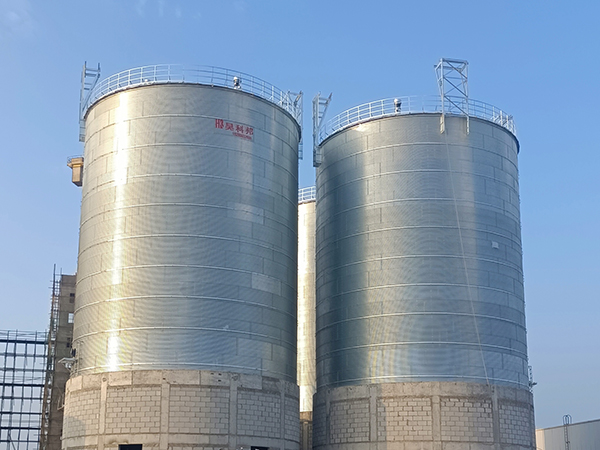
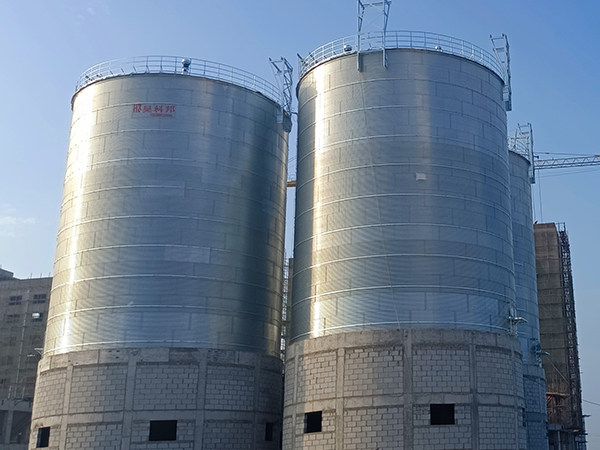
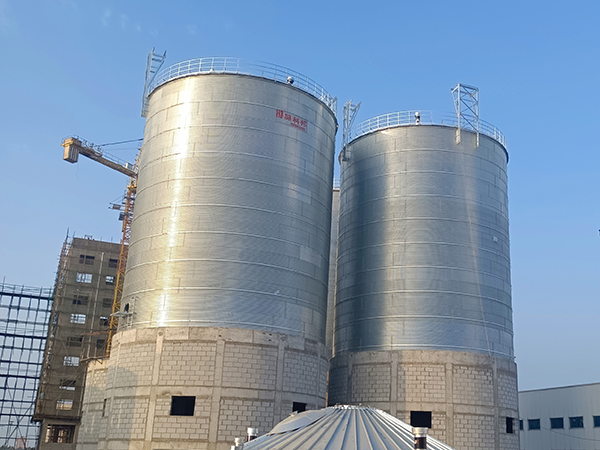
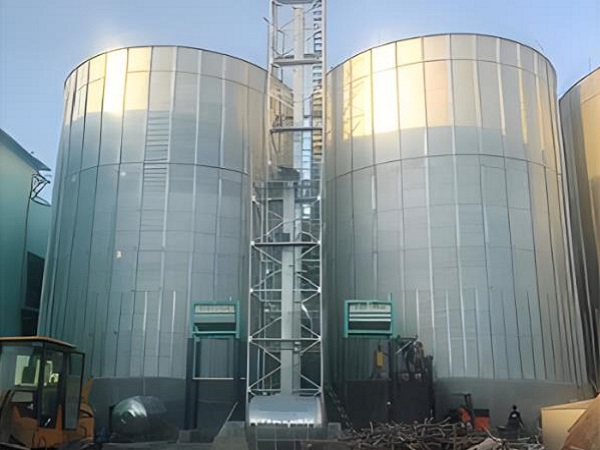
To help overseas purchasers understand the selection methods of silos more efficiently, this article systematically sorts out common specifications from aspects such as capacity, size, structural materials, engineering factors, and capacity calculation formulas.
Classification by capacity: Specifications of steel grain silos commonly used in the international market
The capacity of steel grain silos usually ranges from tens of tons to tens of thousands of tons. According to international mainstream manufacturing standards (such as ASAE and ISO standards for grain storage equipment), the common capacity ranges are as follows:
| Category | Typical Capacity | Application |
|---|---|---|
| Small Silos | 50–1,000 tons | Farms, small feed plants, grain buffering before processing |
| Medium Silos | 1,000–5,000 tons | Grain depots, transfer stations, regional purchasing centers |
| Large Silos | 5,000–15,000 tons | Grain logistics hubs, large feed mills, ports |
| Extra-Large Silos | 15,000–25,000+ tons | National reserves, major port terminals, large food-processing plants |
The difference in capacity is mainly determined by the Diameter and the Height/Sidewall Height.
The mainstream international silo diameter range is 3.6m to 32m
The common range of side wall height is 5m to 30m
These sizes can all be found in the product catalogues of major global manufacturers such as Sukup, GSI, Symaga, and Frame.
Reference Table for Capacity of Galvanized Steel Grain Silo (Metric Units)
The following data are calculated based on the industry-common filling densities (such as 720-750 kg/m³ for corn and 770-800 kg/m³ for wheat) and typical silo sizes, and can be widely verified in engineering practice.
Metric capacity reference (estimated based on wheat density of 0.78 t/m³)
| Diameter (m) | Sidewall Height (m) | Effective Volume (m³) | Approx. Capacity (tons) |
|---|---|---|---|
| 6.4 | 10 | ~320 | ~250 |
| 12.8 | 18 | ~2,300 | ~1,800 |
| 18.3 | 20 | ~5,200 | ~4,000 |
| 27.4 | 25 | ~14,700 | ~11,500 |
| 32.0 | 28 | ~22,500 | ~17,500 |
This capacity table adopts the most common specification range in the global silo manufacturing industry. Users can convert it according to the density of different grain varieties.
Reference Table for Capacity of Galvanized Steel Grain Silo (Imperial Units)
The imperial system is still widely used in international trade, especially in North America, South America and the Middle East.
The following adopts:
Density conversion: 1 cubic foot ≈ 0.0283 cubic meters
Reference density of wheat: 48-50 lb/ft³ (approximately 770-800 kg/m³)
| Diameter (ft) | Sidewall Height (ft) | Volume (bushels) | Approx. Capacity (tons) |
|---|---|---|---|
| 21 ft | 32 ft | ~8,500 bu | ~230–240 t |
| 42 ft | 60 ft | ~68,000 bu | ~1,850–1,950 t |
| 60 ft | 70 ft | ~210,000 bu | ~5,700–6,000 t |
| 90 ft | 85 ft | ~690,000 bu | ~18,500–19,200 t |
The above data is consistent with the parameters in the public manuals of mainstream silo enterprises in the United States, and is traceable and industry-wide applicable.
Classification by structural materials: The mainstream types of silos worldwide
Grain silos are mainly classified into three types based on their structural materials:
Galvanized steel plate silo (the most common)
- Anti-corrosion is achieved by applying a hot-dip galvanized coating (275 g/m² or 450 g/m²)
- High strength, convenient transportation, and modular installation
- It is applicable to most scenarios from farms to ports
Stainless steel silo
- It is mostly used in food-grade, chemical materials, and special environments (highly corrosive)
- The cost is significantly higher than that of galvanized steel sheets
Concrete silo
- It is commonly seen in large ports and national reserve depots
- The one-time investment is large and the construction period is long
- It has strong wind and earthquake resistance and is suitable for super-large long-term storage
Key Factors Affecting Silo Dimensions and Specifications
When choosing silos, purchasers need to consider the following key parameters:
Grain variety density
The density of different grains varies by 30% to 60%, which directly determines the tonnage capacity.
For example:
- Corn: ~720 kg/m³
- Wheat: ~780 kg/m³
- Soybeans: ~740 kg/m³
- Rice: ~880 kg/m³
Terrain and wind and snow load standards
Different countries implement different building codes (such as the European EN standard and the American ASCE).
The higher the wind load and snow load, the thicker the steel plate and the more reinforced the structure are required.
Loading and unloading methods
- Self-flowing Hopper Bottom
- Flat Bottom with Sweep Auger grain unloading
Due to different structures, the overall height of the silo, the bottom Angle, and the requirements for steel structures also vary accordingly.
Design life
The common design life is 20 to 30 years, and the high anti-corrosion grade can reach over 40 years.
Ventilation, temperature control and monitoring configuration
Configuration will affect the height of the silo, foundation layout and power supply requirements.
Capacity Calculation Formula (Industry General)
The calculation of silo capacity adopts the geometric volume model, and the formula can be found in the ASAE engineering manual and related mechanical engineering textbooks.
Cylindrical part
Vcyl=π×(2D)2×H
Conical roof and the conical structure for grain storage inside the silo
Vcone=31π×(2D)2×h
Total volume
Vtotal=Vcyl+Vcone
Tonnage conversion
Tonnage=Vtotal×Density
This calculation method is the standard engineering formula adopted by all international silo designs.
Customization: The Core Advantage of Foreign Trade Procurement
Global purchasers are highly concerned about customization capabilities, especially in applications such as ports, processing plants, and large logistics bases. Typical customization contents include:
Customizable sizes are available
- Diameter: 3-32 meters
- Cylinder wall height: 5-30 meters
- The roof Angle and the inner cone Angle can be customized according to the fluidity of the material
- Outrigger height (for conical bottom silos)
Optional plate thickness
0.8mm – 4.0mm (adjusted according to wind load, snow load and seismic requirements)
Customized attachments
- Ventilation system: Floor ventilation, fan machine, hot air drying
- Temperature and humidity monitoring system
- Arch-breaking device and warehouse cleaning machine
- Explosion-proof air valve
- Feeding and discharging conveying equipment (bucket elevator, screw conveyor, scraper conveyor)
Cross-border engineering design support
Many manufacturers can provide:
- Eu CE standard
- American ASCE/ANSI standards
- Middle East wind load/Dust anti-corrosion standards
- High humidity environment solution for Southeast Asia
International Market Outlook
With the increase in the scale of global food production and the frequency of cross-regional circulation, steel silo have become an important infrastructure of the food security system.
From 2024 to 2030, the international market is expected to maintain a compound annual growth rate of 5% to 7%, especially with a significant increase in demand in emerging markets such as Southeast Asia, Africa, and the Middle East.
With advantages such as modularization, short construction period, convenient transportation and strong adaptability, galvanized steel grain silos will play an increasingly important role in the global grain storage system in the future.