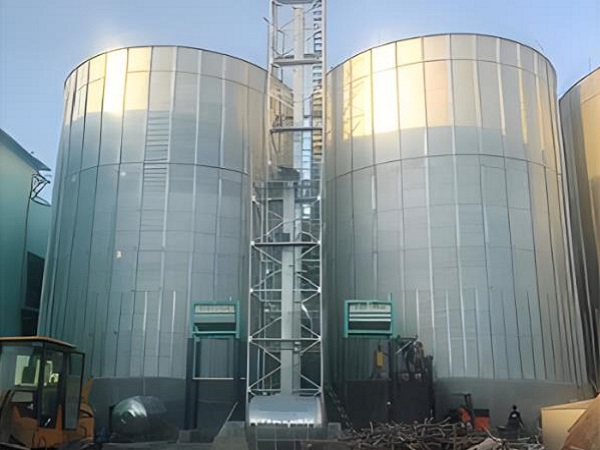
Analysis of factors affecting steel silo capacity
As a mainstream storage facility in the modern industrial field, the capacity of a steel silo is mainly restricted by three core parameters:
Geometric dimensions
The diameter and the height of the cylinder constitute the basic volume, usually with a diameter range of 6-60 meters and a height of up to 40 meters
Structural form
The effective volume difference between a flat-bottom silo and a cone-bottom silo can reach 15%-20%
Material characteristics
The stacking angle (repose angle) directly affects the effective loading rate, such as wheat (25°) can be stored more than cement (35°). 12%-18%
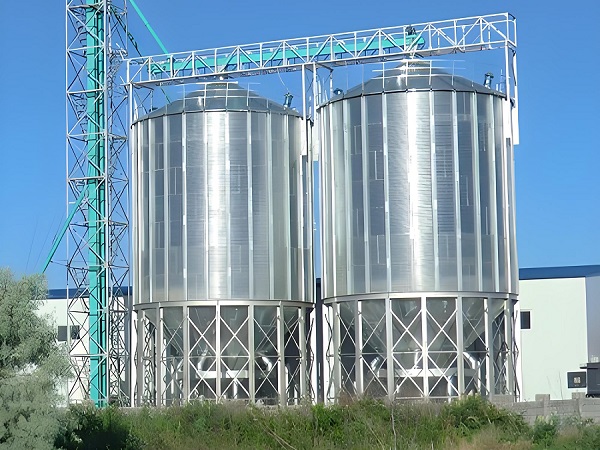
Capacity calculation formula and example
Use the internationally accepted column + cone segmentation calculation method:
Column part: V₁=πr²h (r is the radius, h is the column height)
Cone part: V₂=(πr²H)/3 (H is the vertical height of the cone)
Take a corn silo with a diameter of 20 meters, a column height of 15 meters, and a cone angle of 60° as an example:
Cone height H=10×tan60°≈17.32 meters
Total volume = 3.14×10²×15 + (3.14×10²×17.32)/3 ≈ 6280m³
Considering the corn stacking density of 0.75t/m³, the actual storage capacity is ≈4710 tons
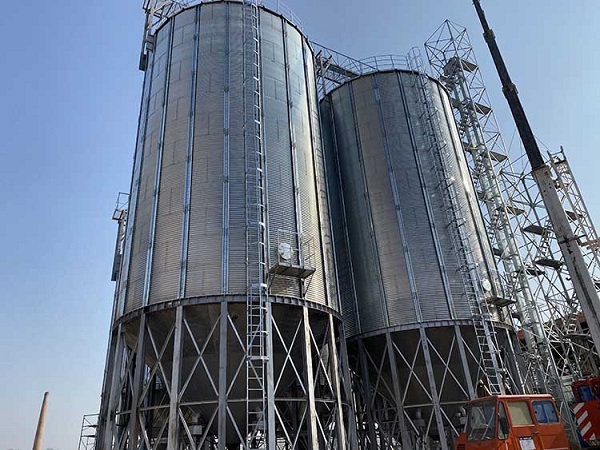
Key correction factors in engineering practice
Safety margin
GB50322 stipulates that we need to reserve 5% – 10% space.
Dynamic correction
We recommend taking 85% – 90% of the theoretical value for continuous operation.
Environmental compensation
Areas with a temperature difference of more than 20℃ need to increase the volume redundancy by 2%-3%
Industry application comparison data
Typical capacity range of warehouse type Applicable materials Small assembly warehouse 50-500m³ Seeds, additives Medium welding warehouse 500-5000m³ Grain, mineral powder Large spiral warehouse 5000-30000m³ Coal, cement clinker