In foreign trade exports and engineering construction, Grain Storage is not merely about building a house; it is an integrated system involving civil engineering, aerodynamics and automatic control. Today, drawing on my practical experience in the industry, I will take you on a deep dive into the four core forms of modern grain silos and how they work in collaboration and division of labor in actual operations.

choosing the right “bowl” is very important: The four main forces of modern grain silo
In international grain trade and large-scale storage projects, we usually classify grain silos into four categories based on terrain, turnover frequency and budget. Each category has its irreplaceable “character”.
Warehouse Type: The most reliable “big brother”
House-type warehouses include flat warehouses, arched warehouses and multi-story warehouses. Among them, the ** Horizontal Warehouse ** is currently the earliest built and has the most solid capacity base warehouse type worldwide.
Industry Insight: The advantage of bungalow warehouses lies in their excellent heat insulation and moisture-proof performance. For projects that require long-term strategic reserves (such as wheat and rice), bungalow warehouses are the first choice. Although its degree of automation is not as high as that of vertical silos, when combined with the current Recirculating Fumigation system and grain temperature monitoring technology, it can minimize losses.
Multi-story Warehouse: In cities with extremely tight land resources such as Hong Kong, Singapore or the coastal areas of China, we would recommend Multi-story Warehouse. Although it is costly and difficult to construct, its advantages in land conservation and coordination with processing plants are very obvious.
Silo: An efficient tool for ports and transshipment
If you have been to a large port or a large flour mill, those towering cylindrical buildings are silos.
Advantages: The vertical silo is a vertical deep silo, and its most prominent feature is its extremely high degree of mechanization. From the top-level grain receiving, cleaning, dust removal to weighing, almost unmanned operation can be achieved.
Practical experience: Vertical silos are usually constructed using Slipform Construction, which gives a very strong sense of integrity. If you are in pursuit of extremely high inbound and outbound efficiency (for instance, needing to turn over thousands of tons of grain every day), vertical silos are the best choice. Moreover, due to its conical bottom design, the grain can flow by gravity, eliminating a significant amount of manual cleaning costs.
Squat Silo: The “King of Cost-Effectiveness” in a Compromise
The shallow round warehouse is playfully called the “Fat warehouse” by us. Its height-to-diameter ratio is less than 1.5, and it has a short and stout appearance.
Why choose it? It combines the large capacity of flat warehouses with the high mechanization of vertical silos. Compared with tall vertical silos, shallow round silos have less strict requirements for the foundation, are more affordable in cost, and have a moderate thickness of the grain pile, which is more conducive to ventilation and cooling. In many national-level reserve warehouse expansion projects, the procurement frequency of shallow round warehouses is increasing year by year.
Steel Silo: A representative of earthquake resistance and flexibility
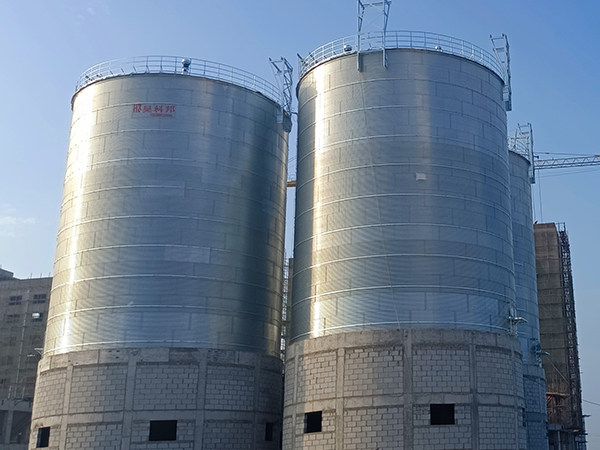
This is currently the most popular category in export foreign trade. Steel plate silos are formed by riveting or welding and have extremely high structural strength.
Flexibility: Its construction period is short, and it can even be disassembled and relocated. Its seismic performance ranks first among all warehouse types. For those overseas projects that are eager to go into production or have unstable geological conditions, steel plate silos are almost the only solution.
 steel grain silo
The “Logical Chain” of Grain Reserves: Which Level Does Your Project belong to?
As practitioners, we not only sell silos but also help clients plan functions. According to the logic of the evolution of Li Kui’s “Equal Purchase Law” to the present day, the current grain depots are mainly divided into the following four functional areas:
Collection Point
Directly connect with farmers. This type of warehouse is usually built in the center of the grain-producing area (with a radius of about 15 kilometers), and is required to have basic drying and short-term storage functions. Here, bungalow warehouses are usually the main type, with an emphasis on “quick storage”.
Transit Depot
It is located at a transportation hub. Its core indicator is the “annual turnover volume”. We usually recommend that transfer warehouses must be equipped with efficient vertical silos or shallow round silos, because the grain here is not for “storage” but for “flow”, and operational efficiency is the lifeline.
Reserve Base
The “ballast stone” of the country. The grains here last for 3 to 4 years (such as wheat and rice). Therefore, the requirements for heat insulation, airtightness and pest control in the reserve warehouse have reached an extremely strict level. Tall bungalow silos are the mainstream here, supplemented by grain cooling equipment to ensure that the quality of the grain remains as good as new during its “dormant” period.
Hardcore Technology: Practical Operation of the Inbound and Outbound Processes of vertical silo
In the consultation, many customers are concerned about the specific efficiency of grain output. Take the vertical silo as an example. In fact, the operational logic is very strict:
- Cone Bottom self-flow: This is the most ideal state. Open the valve at the bottom of the silo. The grain flows along the chute into the air-cushion belt conveyor and is directly sent to the working tower for measurement and loading onto the ship.
- Flat Bottom clearance: Although not commonly used, it is sometimes adopted in super-large diameter silos to balance structural pressure. This requires a secondary cleaning in conjunction with a dedicated Sweep Auger.
Special reminder: Modern silos must be equipped with multi-functional ventilation and fumigation devices. It not only kills insects, but more importantly, it can solve the grading phenomenon caused by the pressure of deep grain piles. If the problem of load reduction is not solved, the storage after long-term storage may cause blockage or damage to the structure when being taken out of the warehouse.
Industry Advice: How to Calculate the size of silo You Need?
Many non-professionals tend to confuse volume with tonnage. In standard design, we usually take the bulk density of wheat at $750kg/m³ as the benchmark value.
Calculation formula for bulk flat warehouse
The capacity of the silo = axis area × 95% (utilization rate) × height of grain storage × grain density
Silo calculation formula
The capacity of the warehouse = [3.14 × radius ^2 × height + volume of the cone bucket] × grain density
In actual engineering, we will fine-tune these parameters according to the type of grain (soybeans, corn or rice).
Conclusion
Food security is a global issue. Choosing the right granary is not only about protecting the grain but also safeguarding the value of the assets. From the regular flat silos of the Warring States Period to today’s automated vertical silos, technological updates have always revolved around “reducing losses, increasing efficiency, and ensuring quality”.
If you are planning a grain transfer station, processing plant supporting facilities or overseas aid construction projects and are unsure which type of warehouse is the most suitable for your geological conditions and climate:
I can provide you with a more detailed customized solution
- Based on the average temperature and humidity in your location, we recommend the most suitable insulation material solution.
- Provide loading pressure calculation tables based on different types of grains.
- Compare the return on investment (ROI) of reinforced concrete structures and all-steel structures in the location of your project for you.
Would you like to see specific engineering cases or obtain the preliminary design quotation sheet? Feel free to contact me directly.