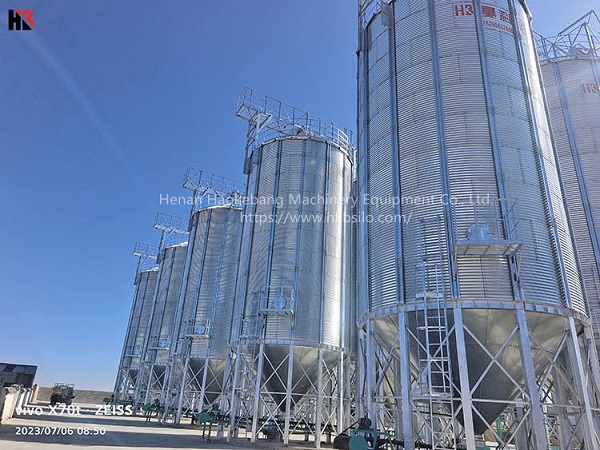
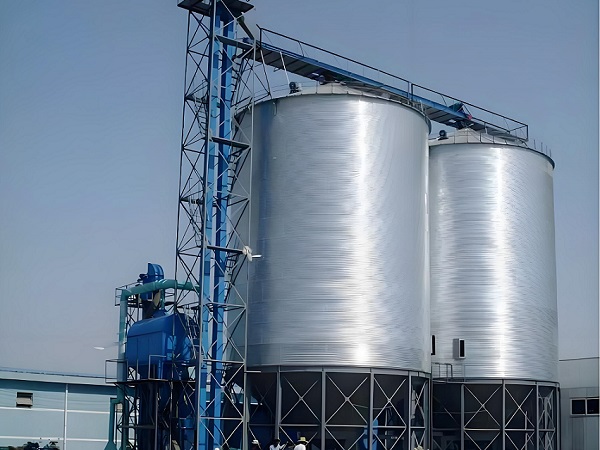
The basic structure of large welded steel silo
Large welded steel silo use thick steel plates as the main raw material. The steel plates are assembled into a cylindrical structure in circles through on-site automatic welding equipment, and welded to a conical or flat bottom silos into a closed whole. Its main structure consists of a silo body, a silo roof, a silo bottom, a discharge port, a ventilation system, a temperature control device, and necessary transportation and measurement and control equipment. The entire silo welds use automated continuous welding technology to ensure overall sealing and structural strength.
This type of steel silo usually has a huge capacity, and the single storage capacity can reach thousands of tons or even tens of thousands of tons. Due to the use of welding technology, the silo no longer relies on bolt connection or assembly flange, which can greatly reduce the risk of leakage, corrosion and structural looseness.

The core advantages of large welded steel silo
Strong sealing and safer storage
Compared with traditional prefabricated silos or bolt silos, large welded steel silos have no joints and gaps at the welds, which greatly improves the moisture-proof, insect-proof and corrosion-proof capabilities, and are particularly suitable for grain, powder or corrosive materials that need to be stored in a closed manner.
Stable structure and strong pressure bearing capacity
Through scientific cylinder design and material optimization, large welded steel silos perform well in bearing static pressure and wind load, and are suitable for a variety of geographical environments and climatic conditions. Even in strong winds or humid and hot environments, they can maintain long-term stable operation.
High customizability to meet different needs
Users can customize the silo diameter, height, capacity and discharge method according to project requirements, thereby maximizing land utilization. For example, port terminal projects can choose cone bottom discharge, while feed mills or cement plants prefer large welded steel silos with supporting spiral conveying systems.
Short construction period and low maintenance cost
Although it is a field welding construction, thanks to standardized production and modular design, a large welded steel silo usually takes only a few weeks to build. There is almost no need for complex maintenance in the later stage, and the overall life can reach more than 25 years.
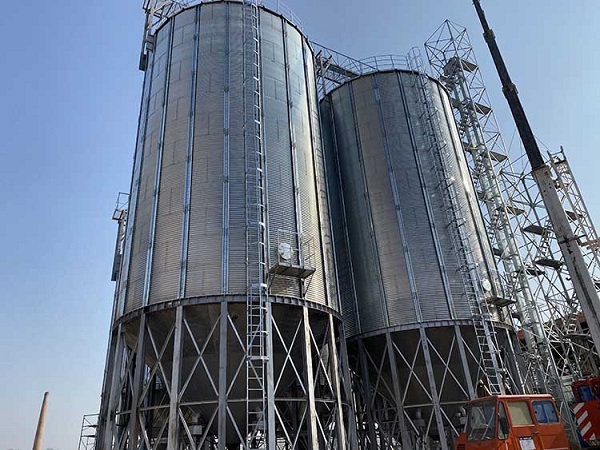
Main application scenarios
With the improvement of industrialization, the application fields of large welded steel silos are becoming more and more extensive, mainly covering the following categories:
Grain storage
Establishing a strategic reserve system for staple grains such as corn, wheat, and soybeans is an important means of regulation to ensure national food security.
Feed processing
Centralized storage of finished pellet feed and raw material ratio powder.
Cement building materials industry
Used for bulk storage of cement, clinker, mineral powder, fly ash, etc.
Energy and chemical industry
Storage of granular materials that are susceptible to moisture, such as coal powder, lime powder, and chemical raw materials.
Wharf and logistics park
Supporting bulk material turnover transportation to realize the automated management of bulk logistics.
4. Selection suggestions for large welded steel silo
In actual applications, users should make reasonable selections based on the following factors:
Material properties
Such as particle size, specific gravity, and whether the moisture content is high, determine the discharge method and the anti-corrosion level of the silo.
Storage requirements
For those with large annual turnover or long storage cycles, it is recommended to choose a large welded steel silo with a capacity of more than 5,000 tons.
Site conditions
When the site area is limited, a high silo design can be selected; if the bearing capacity of the foundation is poor, the foundation reinforcement should be strengthened.
Supporting facilities
Whether automatic weighing, automatic feeding system or intelligent monitoring system is required.
It is recommended that users fully examine the manufacturer’s design capabilities and engineering experience before selection, and give priority to suppliers with independent welding technology and installation qualifications to ensure the construction quality and later stability of large welded steel silos.
Future development trends
With the rise of intelligent manufacturing and green warehousing concepts, large welded steel silos are moving towards “intelligent, energy-saving, and integrated” directions. In the future, large-scale welded steel silos with integrated IoT monitoring, automatic ventilation control, and digital storage management will become the mainstream, helping enterprises to reduce costs and increase efficiency in operations.
Conclusion
Large-scale welded steel silo are not only an efficient material storage solution, but also an important part of the modern storage system. Its good sealing, excellent structural strength and strong customization capabilities make it show broad development potential in industrial applications. For enterprises pursuing long-term investment value and operational efficiency, choosing a set of large-scale welded steel silos with scientific design and standardized construction is undoubtedly an important step in promoting production scale and management modernization.