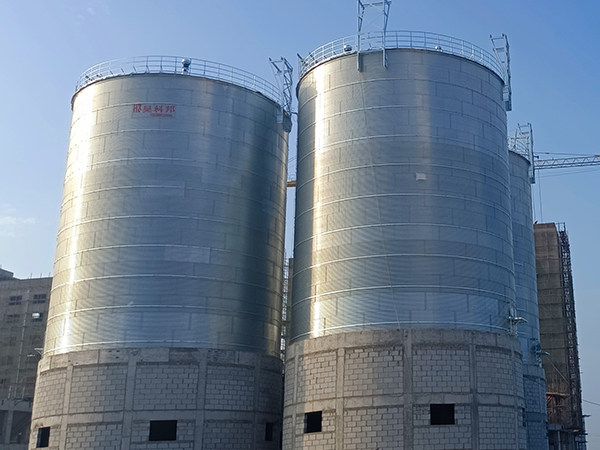
In this guide, Kebang provides a comprehensive analysis of hopper silo design, structural advantages, and how they optimize your return on investment (ROI). Before diving into the technical specifications of hopper designs, it is essential to understand the fundamental differences between general silos and grain silos.

Professional Hopper Bottom Silo array featuring customized discharge angles and reinforced seismic support legs, engineered for 25-year durability.
What is a Hopper Silo?
When we talk about a Hopper Silo, we’re really talking about saving you the headache of manual clean-outs. Unlike flat-bottom bins where you’re stuck using mechanical sweep augers to get every last bit of grain, a hopper silo lets physics do the heavy lifting.
We build these with a steep-sloped cone at the base. Whether it’s high-tensile galvanized steel or stainless for specialized chemicals, the design ensures your material flows through the outlet by pure gravity. You get a faster discharge with basically zero residue left behind to rot or attract pests.
Basic Structure of a Hopper Silo
What makes a hopper silo actually work in the field? It’s not just the shape—it’s how these four critical parts handle the pressure:
The Shell (Silo Body): We don’t just use standard metal. We use high-tensile corrugated steel. For most farms, a 275g/m² zinc coating is the sweet spot, but if you’re near the coast or in a high-humidity area, we usually bump that up to 450g/m². This is how we guarantee that 25-year lifespan without rust eating through the sheets.
The “Slope” (Conical Bottom): This is where most people get it wrong. You can’t just pick an angle. We design a 45° slope if you’re moving dry wheat or corn. But if you’re dealing with soybean meal or flour—stuff that likes to ‘bridge’ and get stuck—you absolutely need a 60° steep cone to keep things flowing.
The Skeleton (Support System): Think about the physics: thousands of tons resting on a few legs. We don’t take risks here. Depending on your local wind loads and earthquake risks, we use reinforced H-beams or heavy-duty pipe columns. It’s about making sure that silo stays upright when it’s full and the weather gets rough.
The Brain (Integrated Systems): It’s a complete loop. From the roof vents that prevent moisture buildup to the automated discharge gates at the bottom, everything is synced. It’s designed so you can monitor and empty the silo without ever having to step inside.

Selecting the right cone angle is critical for flow: A 45° angle is optimal for free-flowing dry grains, while a 60° steep cone prevents ‘bridging’ in sticky or moist materials.
Advanced Manufacturing: Lipp Double-Seam Technology
The real ‘secret sauce’ in our manufacturing is the German Lipp double-seam process. If you’ve only ever seen welded or bolted silos, this is a total game-changer.
Instead of relying on thousands of bolts or messy weld lines, we use a specialized machine to double-fold and ‘lock’ the steel strips together as the silo rises. Think of it as a continuous spiral of strength.
Zero-Leak Seal: Because it’s one continuous interlocking seam, there are no bolt holes for moisture to seep through. It makes the silo naturally airtight—perfect if you need to perform high-efficiency fumigation without gas leaking out.
Built-in Reinforcement: Those spiral ridges you see on the outside aren’t just for show. They act like external ribs, giving the structure incredible ‘hoop strength’ to handle the massive internal pressure of thousands of tons of grain.
Rapid Turnaround: We build from the ground up using a synchronized rolling system. It’s significantly faster than traditional assembly, meaning your facility can be up and running weeks ahead of schedule.
Core Advantages: Why Choose a Cone Bottom Silo?
Gravity Does the Work: Because of the cone bottom, you’re not messing around with complex internal sweep augers. This means two things: your energy bills drop since you aren’t powering extra motors, and you won’t be stuck doing mid-season repairs on machinery buried under tons of grain.
Small Footprint, Big Storage: If you’re tight on land, these are a lifesaver. We use a vertical-first design with a compact steel support frame, letting you stack massive amounts of inventory in a fraction of the ground space a traditional flat warehouse would grab.
No More “Dead Zones”: One huge issue with grain is mold in the corners. Our seamless interior walls, combined with targeted ventilation, eliminate those stagnant “dead corners.” You get fresh air circulation throughout the entire mass, keeping pests out and grain quality high.
Plug-and-Play Automation: These silos aren’t just big buckets; they are data-ready. We’ve designed them to sync perfectly with level sensors, temperature probes, and automated conveyors. You can basically run your entire inventory from a tablet without breaking a sweat.
Comparison: Hopper Silo vs. Flat-Bottom Silo
Choosing between these two depends on your specific storage volume and frequency of use.
| Feature | Hopper Silo (Cone-Bottom) | Flat-Bottom Silo |
| Primary Discharge | Gravity / Natural Flow | Mechanical Sweep Auger |
| Best Used For | Frequent Unloading / Batching | Long-term Bulk Storage |
| Maintenance | Low (Easy to Clean) | Medium (Mechanical parts) |
| Max Capacity | Usually < 1,500 Tons | Up to 15,000+ Tons |
| Foundation Cost | Higher (Steel Supports) | Lower (Flat Concrete) |
Applications Across Industries
Where do we see Hopper Silos making the biggest impact? It’s usually in facilities where manual labor is too slow or where material hygiene is non-negotiable.
High-Turnover Grain Hubs: In flour mills or breweries, you’re moving corn, wheat, or rice daily. You can’t afford to have workers clearing out a flat bin every time you switch batches. The hopper design allows for a seamless, automatic flow that keeps the mill running 24/7.
Precision Feed Batching: For feed mills, consistency is everything. These silos act as the perfect ‘buffer,’ ensuring compound ingredients are ready for precise weighing and mixing without any old material getting stuck and contaminating the next recipe.
Chemical & Plastic Handling: When dealing with plastic pellets or sensitive chemical resins, moisture and dust are the enemies. Our airtight Lipp-sealed hoppers keep the environment bone-dry, ensuring the polymers or powders remain ‘factory-fresh’ until they hit the production line.
Modern Bioenergy Plants: Biomass pellets and wood chips are notoriously bulky and prone to ‘arching.’ We’ve engineered specialized cone bottoms for bioenergy sites that handle these irregular materials, ensuring they slide into the furnace conveyors without constant operator intervention.
Global Success: Our Hopper Silo Projects in Action
Indonesia: 2×1,000 Ton Hopper Bottom Silos for Rice Mill Equipped with a 60° cone angle for high-moisture rice storage and an automated 15-ton grain dryer. [View Project Details →]
Zambia: 4×100 Ton Hopper Silos for Local Farm A compact storage solution designed for rapid batching and truck loading, significantly reducing manual labor costs. [View Project Details →]
FAQ: Real Answers for Your Storage Project
Q: 45° or 60°—How do I actually pick the right angle?
A: Look, you don’t want to guess here. It’s all about the Angle of Repose. If you’re moving clean, bone-dry corn or wheat, a 45° cone is the industry standard and works great. But here’s where people get into trouble: trying to save on silo height by using a shallow angle for “sticky” stuff like soybean meal or high-moisture feed. Those materials love to “bridge” (clog). If you don’t want your crew out there hitting the side of the silo with a rubber mallet just to get the grain moving, go with the 60° steep cone. It’s the only way to ensure gravity actually wins.
Q: Can these steel tanks really hold up for 25 years outdoors?
A: If they’re built cheaply? No. But we don’t do thin plating. We combine heavy-duty galvanization with Lipp spiral seaming. Unlike bolted bins that have thousands of tiny holes (potential rust spots), our spiral seam is one continuous, airtight lock. Whether you’re facing coastal salt air or tropical humidity, we engineer these to stay structural, not just “functional,” for over two decades.
Q: What if my site has weird size limits or earthquake risks?
A: We don’t believe in “one-size-fits-all” catalogs. Whether it’s a tiny 10t buffer bin or a massive 1,500t industrial setup, we adjust the steel gauge and seismic bracing to fit. If you’re in an earthquake-prone zone, we beef up the support legs and the base plates to handle those nasty lateral loads. We build for your specific GPS coordinates, not a generic warehouse.
Q: Why can’t I just use a regular flat concrete slab for the foundation?
A: That’s a recipe for a collapsed silo. In a flat-bottom bin, the weight is spread out. In a hopper silo, thousands of tons are focused entirely on a few support legs. You need a reinforced concrete foundation that can handle that concentrated “punching” force. The good news? We send you the full engineering drawings, so your local contractor knows exactly how much rebar to tie and how deep to pour.
Q: Can I store flour or fine powders without it turning into a brick?
A: You can, but gravity needs a teammate. Fine powders tend to “arch” and pack down tight. For these, we don’t just rely on the cone angle; we add vibration dischargers or fluidizing pads. These tools keep the powder “alive” and moving so it flows into your conveyors smoothly, without anyone having to poke at it with a stick from the top.
Q: How do I stop my grain from “cooking” or rotting inside?
A: We use a “detect and react” setup so you can sleep at night. We hang digital temperature cables inside that act like a nervous system. If those sensors pick up a heat spike—which usually means moisture is trapped or bugs are moving in—the system automatically triggers the high-flow ventilation fans. It flushes the heat out before your inventory turns into compost.
Why Choose Kebang for Your Storage System?
As a global leader in steel structure storage, Kebang offers a one-stop service from design and manufacturing to on-site installation. Our international engineering experience ensures that every hopper silo meets the highest safety and durability standards.
Ready to optimize your storage? Contact Our Engineers for a free layout design and project quote.
WhatsApp: +8615801054617 Email: info@cobansilo.com