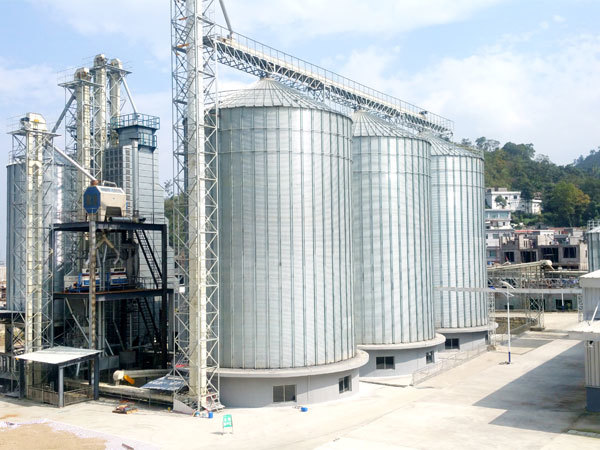
Definition of Grain Bin
Grain bin refers specifically to a special grain storage facility built with galvanized steel plates, which is mainly used for long-term storage of bulk agricultural products such as corn and wheat. Different from the general silo, its structural design pays more attention to the stability of grain storage, and is equipped with mechanical ventilation devices and temperature and humidity monitoring systems as standard. By actively regulating the microenvironment in the bins, it ensures that the grain maintains the best moisture content and quality during storage.

Grain Bin structural features include
Bin structure
Usually made of corrugated galvanized steel sheet, cylindrical, with a conical or dome top cover;
Ventilation system
An air channel is provided at the bottom, and a hood or exhaust hole is provided at the top to ensure air circulation;
Temperature control system
Built-in temperature probe to monitor temperature and humidity changes in the grain pile;
Discharging system
Includes ground scraper, screw conveyor or manual cleaning system.
Unlike the “grain silo” or “hopper silo” used for wet grain fermentation, grain bins focuses more on the long-term storage function of dry grain.
Main functions and effects of grain bin
Using grain bins to store grains has the following core advantages:
Extend the grain storage period
Through ventilation and temperature control systems, grain bin can effectively inhibit mold growth and insect breeding, so that grain can be safely stored for several months or even more than a year.
Reduce grain loss rate
Through scientific management and control, grain bins can effectively inhibit mildew rate, control respiratory loss, and control rodent and insect infestation below the industry safety threshold.
Improve loading and unloading efficiency
The matching automatic feeding and unloading system makes the entry and exit of bulk grains more efficient and reduces manual operations.
Facilitate inventory management and circulation scheduling
Combined with electronic temperature detection, automatic ventilation and digital management systems, grain traders can grasp the grain data in grain bins in real time and make scientific scheduling decisions.

Typical application scenarios of Grain Bin
Grain bins are widely used in the following fields:
Agricultural growers
Used for short-term or medium-term storage of grains after seasonal concentrated harvest;
Grain traders
As a transit warehouse, used for batch storage and classified shipment;
Grain and oil processing enterprises
Used for raw grain storage and ingredient buffering;
Food industry
Used for dry storage of some food-grade raw materials.
Especially in agriculturally developed countries such as North America, Australia, and Russia, grain bins are almost the “standard configuration” of every medium and large farm.
Differences between Grain Bin and Silo
Many people confuse grain bins with silos, but there are significant differences between the two. If you are currently trying to decide which system is better for your farm’s specific workflow, check out our in-depth comparison of Grain Bins vs. Silos here.
| Feature | Grain Bin (Flat-Bottom) | Grain Silo (Hopper-Bottom) |
|---|---|---|
| Storage Type | Dry grains only | Wet materials or fermented feed |
| Construction | Corrugated galvanized steel | Concrete or smooth steel |
| Ventilation | Essential | Often optional or minimal |
| Discharge Method | Sweep augers or manual tools | Gravity discharge (High efficiency) |
| Storage Period | Long-term (months to a year) | Short-term, depending on fermentation |
In short, grain bins is designed for “dry storage”, while silo focuses more on “wet storage” or special processing purposes.
Common price range and reference cost of 30,000 bushels grain bin
According to the latest industry data (2025) :
- The common market price of newly built ordinary steel silos (excluding complex drying systems, conveying facilities, etc.) is approximately $2.00 to $4.50 per bushel.
- Based on this estimation, the cost of 30,000 bushel grain bin is calculated as follows:
- Low-end (2.00 $/bu) → Total cost approximately $60,000
- High-end ($4.50 per bu) → Total cost approximately $135,000
- Quotations and releases from multiple industries indicate that the typical transaction price for a standard 30,000 bushel grain bin (only for grain storage silos, excluding additional systems such as drying and conveying) is approximately $70,000, equivalent to about $2.33 per bushel.
Therefore, based on the current common configuration, the cost of a grain bin of 30,000 bushels ≈ US$70,000 is a relatively realistic and referable value.
Cost composition and influencing factors
The actual cost of the grain bin is affected by multiple factors. The following variables should be noted:
- The structure and materials of the grain bin: Steel (galvanized for rust prevention) and processing technology are the main components of the cost.
- Foundation construction and installation: including concrete foundation (slab), ground treatment, installation and welding, etc. – If the foundation conditions are complex or the terrain is special, the cost will increase significantly.
- Whether it is equipped with ventilation/air supply/temperature control/conveying/drying/unloading systems, etc. : If these functions (such as dryers, fans, conveying devices) are added, the unit cost will increase – usually the cost of such a “full-function grain center” can be as high as 9-10 $/bu.
- Transportation, installation and on-site conditions: This includes transportation costs, labor, installation complexity, as well as geographical location (country of origin, distance, climate), all of which may cause significant fluctuations in the total price.
Factors to consider when purchasing Grain Bin
Capacity requirements
Varies from tens of tons to thousands of tons, depending on the scale of cultivation and sales cycle;
Ventilation system design
The designed ventilation volume needs to be maintained to effectively eliminate the phenomenon of hot and humid air stagnation at the bottom of the bin.
Structural strength
High-quality galvanized steel plates can resist wind pressure, snow pressure and time corrosion;
Installation and maintenance services
It is recommended to choose a brand or manufacturer with installation guidance and after-sales service;
Automation degree
Some grain bins support remote monitoring and intelligent control to improve management efficiency.
Development trend of grain bin
With the rapid development of agricultural mechanization and digitalization, modern grain bins are evolving towards “intelligent grain storage”. Many new grain bins have integrated:
Intelligent temperature and humidity detection systems;
Automatic opening/closing of fans;
Mobile phone remote APP management system;
Cloud data synchronization and early warning functions.
This facility significantly optimizes the stability and turnover efficiency of grain storage, and has become a key support node for the modern granary system and international grain trade.
Conclusion
In summary, grain bin are an indispensable grain storage tool in the modern agricultural system. Through scientific structural design and intelligent management system, it provides a safe, efficient and economical storage environment for grains. Whether it is an individual farmer, a grain company or a grain trader, the reasonable allocation of grain bins is an important means to reduce post-harvest losses and increase profits.