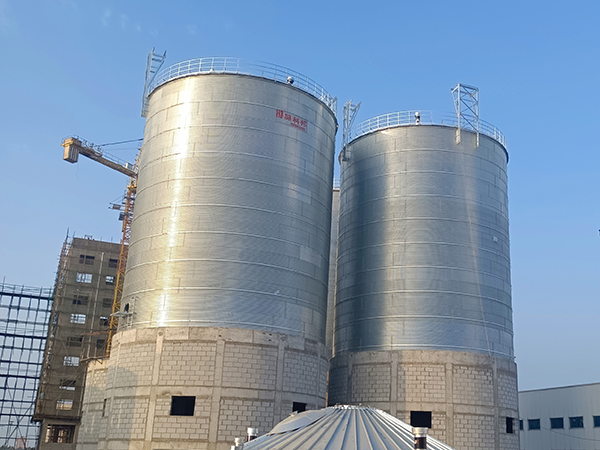
Today, drawing on my industry experience, I will take you through a deep dissection of the mysteries of silo from three dimensions: engineering mechanics, economic benefits, and practical operation, to explore why this “cylindrical” structure has become the top choice for global agricultural storage.
What exactly is a silo? In which corners of the world is it hidden?
In international trade, the Silo we often refer to is essentially a vertical container used for storing bulk materials. Although it is also used in the industrial field to store cement, coal ash or mineral powder, in the agricultural field, it is a core infrastructure for ensuring national food security.
At present, the mainstream silos are classified into several major categories: steel plate silos (especially prefabricated corrugated steel plate silos), concrete silos, and a small number of wooden or irregular-shaped containers. Among them, steel plate silos have become standard equipment in modern farms and large grain depots due to their low cost and short construction period.
If you pay attention to global agricultural production areas, you will find the distribution of silos very interesting:
China, the United States, Canada and Australia: These countries have vast plains and extremely high levels of mechanization. Silos usually appear in the form of “silo clusters”, combined with complex lifting, conveying and drying systems.
Brazil, Argentina and India: With the sharp increase in agricultural exports, the demand for modern steel plate silos in these emerging markets has almost grown explosively, as traditional stackable warehouses (house silos) are really inadequate in dealing with mold and pests caused by hot and humid climates.

Core Analysis: Why Is the “circle” the ultimate Form of the Granary?
Returning to the core topic: After the Great explosion in Lebanon, although a row of cylindrical grain silos at the port were severely damaged, the main body still stood firm. This not only shocked the general public but also once again verified the stability of the circular structure under extreme loads.
Force logic: A dimensional reduction strike from “bending moment” to “tensile force”
In mechanics of materials, grains are not static water; they possess “bulk pressure”. When you fill the granary with thousands of tons of wheat, these grains will exert a huge outward lateral pressure on the granary walls.
The pain point of square silos: If the silo walls are flat (square), the lateral pressure will act on the wall like “breaking a wooden board”, generating a huge bending moment. To prevent the wall from bursting, you must make it extremely thick or add countless reinforcing ribs. This is very cumbersome and expensive in engineering.
The genius of the circular silo: Its circular structure converts lateral pressure into circumferential tensile force. In simple terms, it’s like you stretch out a rubber band with both hands. Every part of the band is subjected to tensile force rather than being bent. Steel has extremely strong tensile strength. This structure enables the silo wall to withstand the maximum pressure with the minimum thickness.
The “Golden Cost-effectiveness” of Space and Materials
After being engaged in foreign trade equipment for a long time, everyone is very sensitive to costs. According to geometric theorems: when the circumferences are equal, the area of a circle is the largest. This means that if you use the same tonnage of steel to build a silo, a cylindrical silo can hold about 25% more grain than a square silo. For customers, this means that with the same investment, they get a larger storage capacity, which is the real return on investment (ROI).
“Dead Corners” : A major taboo in grain storage
Food is a living organism. It is afraid of moisture and insects.
The four corners of the square warehouse are the “blind spots” for material flow. Old grains can’t be released and new ones can’t be brought in. Over time, the grains in the dead corners will clump, mold and get infested with insects.
The cylindrical silo, in combination with the Hopper Bottom design, can achieve nearly perfect “first in, first out”. The material slides evenly along the circumference without any residual space. This is crucial for maintaining the quality of grain turnover.
Modern Steel Plate Silos: Not Just a “Big Tank”
The most popular type on the market now is the color steel/galvanized corrugated steel plate silo. As a professional, I suggest that when choosing a model, you should not only look at the capacity but also consider the supporting systems behind it.
Why do customers nowadays prefer color steel and galvanized steel sheets more?
- Anti-corrosion and sun protection: When exposed outdoors for a long time, galvanized sheets with a high zinc coating (such as 275g/㎡ or 350g/㎡) can ensure no rust for 30 years.
- Airtightness and pest control: The sealing technology of modern prefabricated silos is already very mature. Combined with the aluminum phosphide fumigation system, it can effectively kill pests such as weevil, which is difficult to achieve completely in room-type silos.
- Intelligent monitoring: Nowadays, the interiors of cylindrical silos are all filled with temperature-measuring cables. If the grain at a certain position gets hot (which means there may be a risk of mold), the system will automatically alarm and turn on the ventilation fan at the bottom.
Some Sincere Suggestions from Practitioners (Precautions)
Although cylindrical silos have many advantages, in actual operation, even the best silos will have problems if the following points are not paid attention to:
The foundation must be stable
The cylindrical silo is subjected to vertical force. Thousands of tons of grain are pressed on dozens of square meters of land, which imposes extremely high requirements on the foundation. Never set up a warehouse directly on soft soil just to save that little bit of construction cost.
Pay attention to ventilation
Grains have “breathing”. When the temperature alternates between cold and hot, condensation water (wall water) will form on the silo walls. It is essential to configure a reasonable ventilation system; otherwise, the top layer of grain will soon go bad.
Regularly “inspect the warehouse body”
As I mentioned earlier, regularly check if the bolts are loose and if the sealant is aged.
Conclusion
The reason why silos are designed in a cylindrical shape is not for aesthetic purposes, but rather the “optimal solution” resulting from the joint compromise of engineering, mechanics and economics. It withstands the greatest pressure with the least amount of materials and provides the cleanest storage environment.
Today, as the global food supply chain becomes increasingly tight, choosing a high-standard circular steel plate silo is essentially buying a long-term insurance policy for food assets.
If you are planning the warehouse upgrade of your farm or have any questions about the export technical parameters of silos, please feel free to send me a private message for discussion. We can provide customized basic design suggestions based on your local climate conditions and crop types.