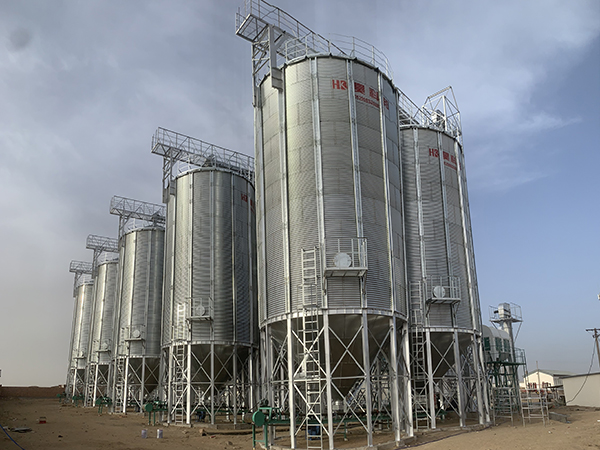
Structural mechanical properties of spiral coiled steel silo
The spiral coiled steel silo forms a continuous spiral rib structure through a unique bite process, and its bite edge strength can reach 5 times the thickness of the parent material (30-40mm wide). This design gives the silo excellent compressive resistance. Experimental data show that this structure can increase the seismic level by more than 40%, and can still maintain structural integrity under a magnitude 8 earthquake.
The silo adopts multi-layer composite plate technology, and customizes anti-corrosion solutions according to different material properties (such as cement pH value, fly ash abrasion coefficient), and its service life is extended by 3 times compared with traditional concrete silos.
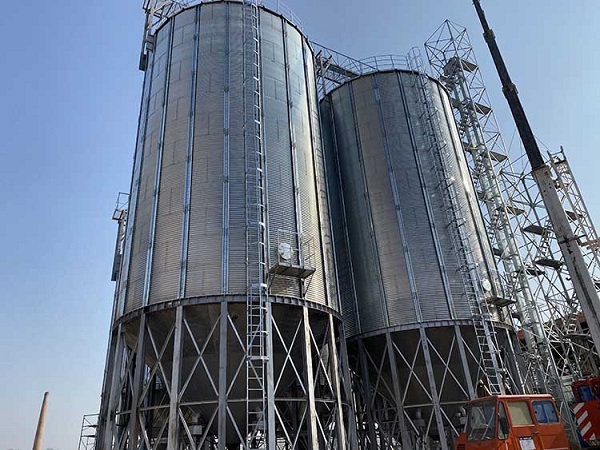
Air tightness and material adaptability analysis
Using dynamic sealing detection technology, the air leakage rate at the spiral bite joint is less than 0.05m³/h·m², which is particularly suitable for storing powdered materials with a particle size of <50μm. In the case of cement storage, the structure can control the hardening rate below 0.3%, which is 87% lower than traditional storage. The intelligent temperature control system effectively eliminates condensation on the silo wall. Additionally, it stabilizes humidity fluctuations within a range of ±5%RH.
Comparison of project economic performance
Indicators Spiral steel silo Concrete silos Advantage rate Construction period 15-20 days 90 days 83%↑ Foundation load 8t/m² 25t/m² 68%↓ Floor area 0.5m Spacing 1.2m Spacing 58%↓ Maintenance cost 0.8 yuan/ton per year 2.5 yuan/ton per year 220%↓
Fluidization system optimization solution
Using partition pulse fluidization technology, through:
Bottom cone angle optimization (55°±2°)
Fluidization rod matrix layout (spacing ≤1.2m)
Air pressure gradient control (0.05-0.2MPa adjustable) Achieve a discharge rate of 200t/h and a residual rate of <0.8%. For materials with high humidity levels (e.g., fly ash exceeding 8% moisture content), a microwave drying system is strongly recommended. This advanced drying solution can achieve up to 35% reduction in pretreatment energy consumption compared to conventional methods.
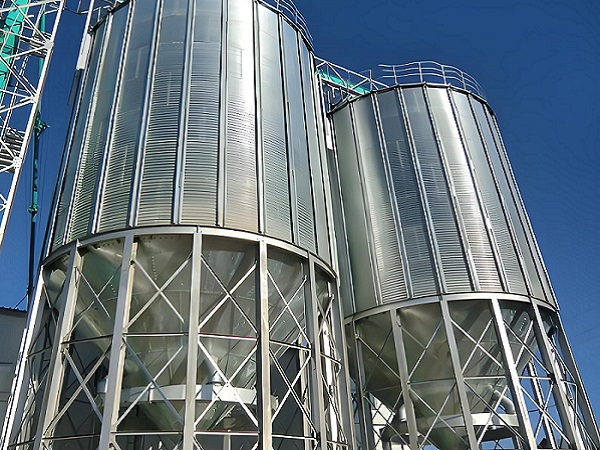
Key points for implementing moisture-proof technology
Construction phase
Use double-layer SBS waterproof membrane (thickness ≥ 4mm)
Operation phase
Deploy humidity linkage system, and automatically start the dehumidification unit when RH>70% is detected
Special treatment
For corrosive materials, polyurethane lining (thickness 3-5mm) can be added