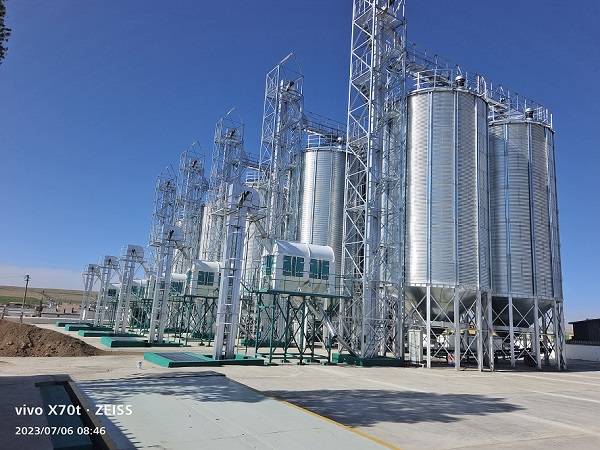
In fact, many friends who are new to the industry tend to confuse “warehouse” with “silo”. However, in modern industrial and agricultural logistics, there are essential logical differences between the two. To help everyone avoid detours when making project plans, I will, based on my practical business experience, break down in detail the differences between the two and explain why steel plate silos are becoming the mainstream for storing granular bulk materials.

Differences in core definitions: What are you storing?
Before discussing the advantages and disadvantages, let’s first clarify the positioning of the two:
Warehouse/Flat Storage
This is a general spatial concept, mainly targeting “pallet goods”. Whether it is a flat warehouse or a high-rise warehouse, it is better at handling bagged, boxed or irregularly shaped finished products.
Silo
This is specially designed for fluid bulk materials such as wheat, corn, cement, wood pellets, feed, etc. It is a special structure that manages by utilizing gravity and the fluidity of materials.
Why do steel silo outperform traditional flat silos in bulk material storage?
If your materials are powder or granules, the advantages of steel plate silos in terms of efficiency and cost are very obvious.
The ultimate utilization of vertical space
The traditional flat warehouse (square warehouse) mainly relies on the ground for load-bearing. The stacking height is limited by the Angle of rest of the materials and the strength of the walls, often resulting in a large waste of the upper space of the building. The maximum height of steel plate silos can reach over 30 meters. This means that on the same land area, the storage capacity of a silo could be 3 to 5 times that of a bungalow. This is a direct way to save money for ports or processing plants where land prices are high.
Construction period and capital recovery
Concrete structures (traditional warehouses) require a long period of formwork setting, pouring and curing. By the time the warehouse is built, the market conditions may have changed. Steel plate silos adopt prefabricated or spiral edge rolling processes. The main structure is prefabricated in the factory and quickly assembled on site like “building with blocks”. A project with a scale of several thousand tons can be delivered and put into operation within a few weeks, greatly shortening the investment payback period.
A dimensional reduction strike in the degree of automation
This is the most charming part of the silo. Loading and unloading grain in flat warehouses usually requires forklifts and a large number of workers, generating a lot of dust and causing significant losses. Silos can be perfectly connected to mechanical conveying systems: feeding from the top and discharging from the bottom by gravity or through a silo cleaner. With the help of sensors, you can monitor the material level, temperature and moisture in the warehouse in real time through a computer in the office. This “smart warehousing” model is difficult for traditional warehouses to achieve.

Steel Silo vs. Concrete Silo: How to Choose?
Even if they have decided to use silos, many users are still torn between choosing “steel plates” or “concrete”.
Durability and Cost
Concrete silos are indeed more durable and have a longer lifespan, but they are astonishingly expensive and immovable.
Flexibility
The seismic performance of steel plate silos is better, and if the factory is relocated or expanded in the future, the prefabricated steel plate silos can even be disassembled and moved.
Sealing and fumigation
The sealing technology of modern steel plate silos is already very mature. Combined with dedicated ventilation and fumigation systems, it performs extremely well in pest control and moisture prevention.
Practical Experience: The tricks of maintenance and fumigation
In daily management, the operational logic of the two warehousing methods is completely different:
Ventilation and cooling
The vertical height of the silo is large, and the natural convection is strong. Combined with the forced ventilation system at the bottom, the temperature control effect is very uniform.
Fumigation for pest control
Vertical silos usually adopt circulating closed fumigation, which has a high utilization rate of chemicals and thorough pest control.
Bungalow warehouses rely more on local ventilation fumigation. Although they can be flexibly zoned, they have higher requirements for air tightness and the operation is relatively cumbersome.
Conclusion: How should the final decision be made?
As industry advice, I have summarized a simple criterion for judgment:
The situation of choosing traditional bungalow warehouses
Your goods are diverse in types, packaged in different ways (some in bags and some in boxes), or have a small single-batch storage capacity and require frequent entry and exit of different varieties.
The situation of selecting steel silo
You are dealing with bulk materials of a single variety (such as grain and oil mills and feed mills with an annual processing capacity of over ten thousand tons), and you are pursuing extremely high turnover efficiency, low loss and automated management.
Investing in the future is essentially investing in efficiency. In the context of increasingly fierce global supply chain competition, reducing material losses during storage (such as mold, rodent damage, and manual handling losses) is the most direct profit growth point. This is also the reason why an increasing number of international grain merchants and large factories are turning to intelligent steel plate silo solutions.
If you are planning a new warehousing project and are unsure which specification of steel plate silo is more suitable for the characteristics of your materials (such as pressure calculation, anti-wall hanging design, etc.), you are welcome to exchange ideas in the comment section, or I can provide you with a basic project preliminary design proposal.