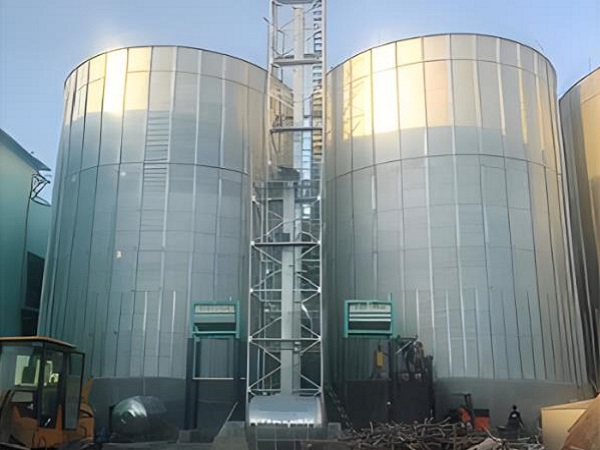
At Cobansilo, we provide engineered airflow solutions that ensure your grain meets international export standards every time. For tips to prevent condensation in steel silos, check our detailed guide.

Why Internal Heat is Your Biggest Risk
Grain is a living mass that generates its own heat. If that heat stays trapped, you lose quality fast.
Trapped Hot Spots: Grain acts like a blanket. Heat from the center can’t escape, creating mold in less than 48 hours. Often, the core is already rotting while the surface looks perfect.
Silo Sweating: When warm core air hits cold steel walls, moisture migrates to the roof. This drips back down and rots the top layer. One look at that “crust” and an export inspector will kill the entire shipment.
Toxin Risks: High temperatures trigger Aflatoxin. Without constant airflow, you risk total shipment rejection at the port.
Engineered Components: The Cobansilo Advantage
Our systems are built to industrial specifications that exceed standard farm-grade equipment.
A. High-Static Pressure Fan Engineering
We select fans based on precise Static Pressure calculations for your specific silo:
Centrifugal Fans: For tall, narrow silos. They provide the “push” needed to force air through deep, dense grain.
Axial Fans: For flat storage. High-volume airflow where high pressure isn’t the priority.
Industrial Durability: All fans feature Z600 galvanization or industrial powder coating to prevent rust in high-humidity coastal areas.
B. High-Performance Aeration Floors
Full-Floor Aeration: 100% perforation for zero “dead zones.”
Trough & Duct Systems: Engineered for heavy-duty loads and easy cleaning between harvests.
C. The “Digital Brain”: Automated Control
Ambient Weather Stations: Prevents running fans when external humidity is too high.
3D Thermal Mapping: Digital sensors at every 1.5m depth for a full internal view.
PLC Automation: Systems only activate during “Optimal Ventilation Windows,” cutting energy consumption by 40%.

Global Standards & Aeration Strategy
For exporters to the EU, North America, or China, compliance is non-negotiable. Our systems align with:
ISO 6322-1/2/3: International storage standards for cereals and pulses.
HACCP Integration: Mitigating biological hazards through precise thermal control.
Professional Aeration Logic:
Post-Harvest: Run fans at 0.15–0.25 m³/h·t for 150–200 hours to strip field heat.
Maintenance: Lock grain temp below 15°C to stop mold.
Winter Cooling: In temperate zones, pull temps down to 5°C to induce a dormant state for long-term safety.
Technical Benchmarking: Why Professional Systems Save Money
| Technical Feature | Traditional Aeration | Cobansilo Professional System |
|---|---|---|
| Airflow Calculation | Estimated / Manual | CFM/Static Pressure Software Modeled |
| Material Durability | Standard Grade Steel | Heavy-Duty Galvanized (Z600 Standard) |
| Control Logic | Human Dependent | AI-Driven ERH (Equilibrium Humidity) |
| Pest Mitigation | Chemical Fumigation Only | Thermal Suppression (Pest Dormancy) |
| ROI Period | Unclear / Long | Typically 12–18 Months |
Real-World Results (Case Studies)
Rice Storage (Thailand)
The Problem: Humidity levels over 85% were causing rice to yellow—a major issue for premium Jasmine rice exports. The Fix: We installed ventilation units with automated humidity sensors. These units shut down automatically when external air is too wet to prevent “bin-burn.” The Result: Spoilage dropped from 5% to just 0.5%, keeping the rice at export-grade quality.
Kazakhstan Wheat Storage
The harvest here often hits 35°C, which used to cause immediate weevil problems in the silos. By using the winter air to pull the grain down to 5°C, we managed to put the pests into dormancy naturally. The client ended up cutting their fumigation cycles by 75%, saving roughly $30,000 a year just on chemicals.
Comprehensive FAQ for Procurement Managers
Key considerations for technical integration, cost reduction, and compliance.
Conclusion: Protecting the Future of Grain
A Silo Ventilation System is more than a mechanical component; it is the life-support system for your grain. In a global market where quality defines price, investing in precision aeration is the most effective way to secure your margins and eliminate waste.
Ready to Optimize Your Facility?
* Includes Custom ROI Analysis & Technical CAD Layout at No Extra Cost.
Cobansilo Engineering: Reliable Storage Solutions Since 2008.