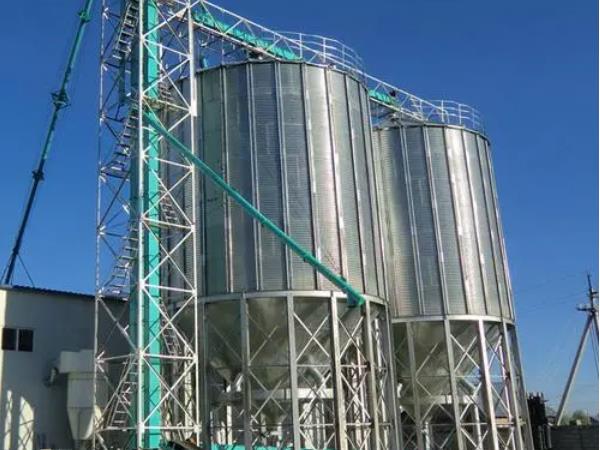
Common Discharge Methods for Steel Silo
Steel silo have gained widespread application in grain processing and transportation due to their high land utilization, automation, short construction period, and low investment costs. As economic development progresses, an evident trend in silos usage is the increasing single-bin capacity.
As storage capacity grows, ensuring smooth material discharge has become a crucial consideration in silos design and operation. In some cases, it even determines whether a project can proceed. This article introduces and discusses common discharge methods in grain steel silo, helping readers understand their advantages, disadvantages, and suitable applications. The goal is to enable engineers to select the most appropriate discharge method based on specific project requirements.
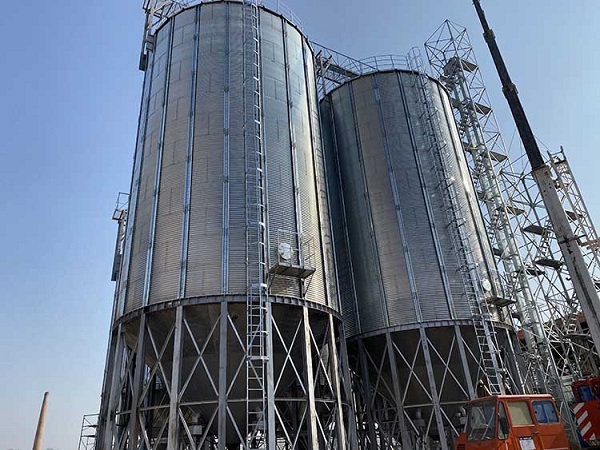
Common Discharge Methods
1. Full Conical Hopper Gravity Discharge
This method consists of either a concrete foundation (concrete conical hopper) or a full steel support structure. It offers several advantages: materials discharge smoothly with minimal residue, gravity assists in emptying the silos without additional equipment, the process remains simple and easy to use, and full utilization of storage capacity is possible. The conical hopper itself also increases the total storage volume. Additionally, using a steel support structure shortens construction time. However, the major downside is that the conical hopper’s height increases the silos foundation height, leading to higher civil engineering costs. When the silos diameter is too large, the foundation costs may exceed the cost of the steel silo itself. As a result, this method is generally unsuitable for large-diameter silos.
2. Semi-Conical Hopper with Internal Fill Discharge
This discharge method offers the following benefits: minimal material residue inside the silos, self-flowing material discharge without auxiliary equipment, and a lower foundation compared to full-conical hopper discharge. However, internal filling occupies part of the storage capacity, leading to reduced effective volume. For large-diameter silos, this loss becomes significant. Therefore, this method is more suitable for small- to medium-diameter silos.
3. Flat-Bottom Multi-Point Discharge
This method involves creating multiple discharge openings at regular intervals on the silo foundation plate (typically in odd numbers). Its primary advantage is that all storage capacity is fully utilized, as no internal fill is required. However, materials do not fully discharge through gravity alone, requiring additional cleaning methods.
Common cleaning methods include using a sweeper machine or a loader, while in regions with low labor costs, manual cleaning is also an option. Sweeper machines are expensive and complicated to use, making them costly for large silos operations. If using loaders for cleaning, sufficiently large access doors must be installed on the silo wall. The development of 3 x 2.8m large silo doors has successfully addressed the challenge of allowing sweepers to enter and exit silos, proving effective in facilities like Nanjing Port, Qingdao Port Group, and Guangzhou Port Group. This makes multi-point discharge feasible for large-diameter silos.
To accommodate loaders, designers typically use ground-supported silo foundations, requiring underground trenches to install discharge equipment. While this design works well in most cases, it poses challenges in areas with high groundwater levels, where waterproofing becomes a significant concern. In such cases, a support structure under the silos is necessary for construction stability.
4. Multi-Point Discharge with Internal Fill
This method combines multi-point discharge with internal filling to facilitate smooth material flow. Its main advantages include minimal residue, self-flowing discharge without auxiliary equipment, and reduced internal fill volume, leading to less storage loss. However, it still results in some capacity loss, involves a more complex filling process, and presents higher construction difficulty.
This approach was introduced to address cleaning challenges in multi-point discharge silos. It functions as a hybrid of the semi-conical hopper with internal fill and flat-bottom multi-point discharge. It still relies on gravity for discharge but uses multiple symmetrically arranged outlets (typically in a cross-shaped pattern) to minimize filling volume. In cases where sweepers or loaders are impractical, this method is one of the better options. However, it increases the complexity of the internal filling process and requires additional discharge equipment beneath the silo.
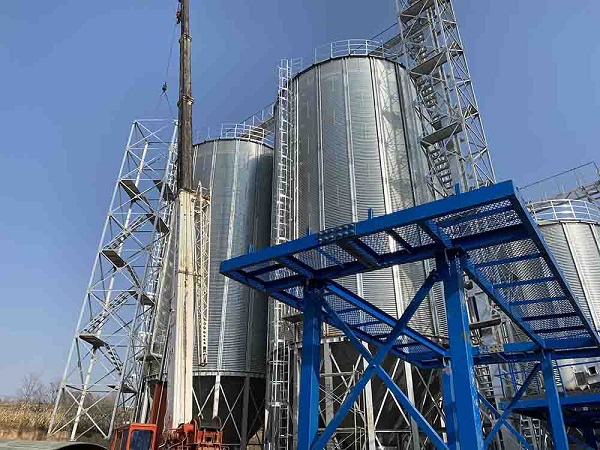
5. Fluidized Discharge
This method involves creating specially designed air ducts on a gently sloped fill layer and covering them with perforated plates. By introducing airflow, the material above the ducts enters a semi-suspended state, allowing for smooth discharge.
Advantages of fluidized discharge include:
Minimal material residue, as airflow assists in material movement.
Lower filling volume, reducing storage capacity loss.
Improved ventilation, as air ducts distribute airflow evenly.
However, several drawbacks limit its effectiveness:
Complex filling process and high construction difficulty.
Some capacity loss due to the required fill layer.
Unstable discharge performance, leading to inconsistent results.
Although the concept of fluidized discharge is promising, real-world applications have not yielded ideal results. Several factors contribute to its inefficiency:
Poor raw material quality and high impurity content can cause material caking, disrupting fluidization.
Airflow shortcuts occur when air ducts create openings in the grain bed, leading to inefficient airflow distribution and incomplete discharge.
Leaky air duct valves reduce airflow efficiency, preventing proper fluidization.
Aerodynamic design flaws in the air ducts cause excessive localized resistance, reducing actual airflow.
Through continuous testing, we have made some progress in improving fluidized discharge, but we do not recommend widespread adoption at this stage.
6. Other Discharge Methods
In addition to the primary methods above, some less common techniques are used for specific situations, typically as auxiliary discharge solutions. These include:
Sidewall discharge, which can provide additional outlets.
Vibrating discharge, useful for handling low-flowability materials like rice husks.
For challenging materials, vibrating discharge offers a viable solution by reducing blockage and improving flow consistency.
Conclusion
The selection of a silos discharge method depends on factors like steel silo size, material properties, project budget, and operational requirements. Full conical hopper discharge is effective but costly for large silos, while multi-point discharge offers a practical alternative with careful planning. Fluidized discharge, although promising, remains inconsistent in practice. By understanding the advantages and limitations of each approach, engineers can make informed decisions that optimize silo performance and efficiency.