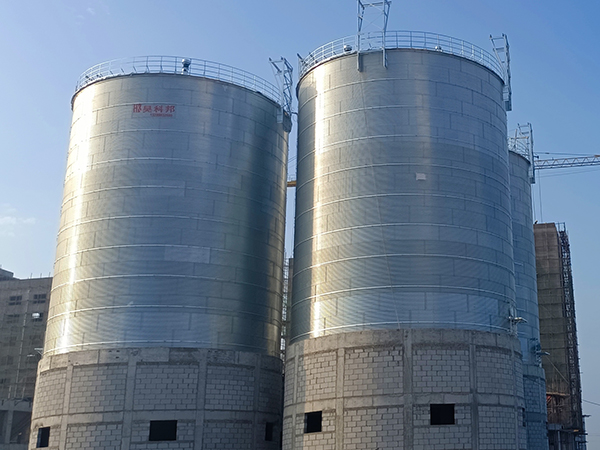
Grain Silo Unloading System
COBAN grain silos are designed to ensure safe storage, stable ventilation, and long-term grain preservation under different climate conditions. Each silo system can be customized based on capacity, grain type, and project requirements for optimal storage performance and reliability.

Grain Silo Unloading System
Silo Type:Flat Bottom / Hopper Bottom
Main Equipment:Discharge Gate, Screw Conveyor, Sweep Auger, Drag Conveyor
Conveying Equipment:Belt Conveyor / Bucket Elevator
Application:Maize, Wheat, Rice, Soybean & Bulk Grains
- Customized Capacity Design
- High Strength Galvanized Steel
- ISO Certified Manufacturing
- Global Installation Support
Applications
Corn Storage
Wheat Storage
Rice Storage
Soybean Storage
Feed Storage
Commercial Grain Storage
Product Details & Technical Information
A grain silo is designed to store grain safely. But once the grain needs to be processed, dried, transported, or loaded for delivery, it must leave the silo in a controlled and reliable way.
The Grain Silo Unloading System is the equipment and discharge arrangement installed at the bottom of a grain silo to remove stored grain and transfer it to the next stage of the handling system.
COBAN designs silo unloading systems according to the silo bottom structure, grain type, storage capacity, required discharge rate, and downstream conveying process.
The unloading arrangement is fundamentally different for flat-bottom silos and hopper-bottom silos.
Flat-bottom silo: center discharge + mechanical grain recovery, typically using a sweep auger.
Hopper-bottom silo: gravity discharge through the hopper outlet, normally followed by a conveyor or elevator.
The result is a coordinated system that allows grain to move from:
Grain Silo → Discharge Outlet → Conveyor → Elevator / Transfer System → Dryer, Cleaner, Processing or Loading
Grain Silo Unloading System at a Glance
| Item | COBAN Solution |
|---|---|
| Main function | Remove stored grain from the silo and transfer it downstream |
| Silo types | Flat-bottom and hopper-bottom silos |
| Typical equipment | Discharge gates, screw conveyors, sweep augers, drag conveyors |
| Downstream equipment | Belt conveyors, bucket elevators and other grain handling equipment |
| Suitable grains | Maize, wheat, rice, soybean and other free-flowing bulk grains |
| System design | Customized according to grain, silo, throughput and plant layout |
Why Silo Unloading Needs Proper Engineering
Unloading grain is not simply a matter of opening a hole at the bottom of the silo.
The grain must move through several connected points without creating a bottleneck.
If the silo outlet is too small, the discharge rate may be restricted.
If the conveyor is undersized, grain can accumulate above the conveyor.
If the downstream elevator cannot accept the required flow, the entire storage line may need to stop.
For flat-bottom silos, another issue exists: gravity cannot normally remove all of the grain from a flat floor. Mechanical recovery is therefore required.
This means that the unloading system should be designed as a complete material-flow section rather than as an individual conveyor.
A properly engineered system considers:
Silo bottom → outlet → gate → conveyor → transfer point → elevator → downstream equipment
This approach helps maintain stable grain flow and reduces unnecessary manual handling.
Flat Bottom Silo Unloading System
Flat-bottom silos are widely used for large-volume grain storage because they provide an efficient storage volume and practical construction for large diameters.
However, the flat floor creates a specific unloading requirement.
When the central outlet is opened, the grain directly above and around the outlet flows downward first. As the grain level falls, the natural gravity flow eventually stops while grain remains distributed across the silo floor.
A flat bottom silo unloading system therefore normally has two stages.
Stage 1: Gravity Discharge
Grain flows through the central outlet and enters the bottom conveying system.
Stage 2: Mechanical Grain Recovery
A silo sweep auger moves the remaining grain from the floor toward the center discharge area.
This combination allows the majority of stored grain to be discharged without relying on manual shoveling.
Typical Configuration
Flat Bottom Silo
↓
Center Discharge Outlet
↓
Slide Gate
↓
Bottom Screw Conveyor
↓
Sweep Auger
↓
Transfer Conveyor
↓
Bucket Elevator / Belt Conveyor
↓
Next Process
The actual arrangement can be adapted according to silo diameter, number of outlets, required capacity and plant layout.
Silo Sweep Auger for Flat Bottom Silos
The sweep auger is one of the most important pieces of equipment in a flat-bottom silo unloading system.
Its purpose is not to transport grain over a long distance. Its primary job is to recover grain remaining on the silo floor after the main gravity discharge has finished.
The sweep auger rotates around the silo and progressively moves the residual grain toward the central discharge area.
This provides several practical benefits:
- Reduces manual floor cleaning
- Improves grain recovery
- Shortens unloading operations
- Makes large flat-bottom silos easier to empty
- Integrates mechanical unloading with the central discharge system
For large silos, the sweep auger should be considered during the original silo design.
The floor, central outlet, sweep mechanism, supports, access points and bottom conveyor must be coordinated so that the equipment can operate correctly.
Hopper Bottom Silo Unloading System
A hopper-bottom silo has a sloped bottom that directs stored grain toward one or more lower outlets.
Because the grain is assisted by gravity, the unloading arrangement is generally simpler than that of a flat-bottom silo.
A typical hopper bottom silo unloading system consists of:
Hopper Bottom
↓
Discharge Outlet
↓
Slide Gate / Discharge Gate
↓
Screw Conveyor or Drag Conveyor
↓
Bucket Elevator / Belt Conveyor
↓
Next Process
The hopper angle and outlet arrangement need to be suitable for the material being stored.
Good gravity flow depends not only on the silo shape, but also on:
- Grain moisture
- Fines content
- Material flowability
- Grain temperature
- Compaction
- Outlet geometry
- Hopper angle
For this reason, a hopper-bottom silo should still be engineered according to the actual stored material.
Flat Bottom vs. Hopper Bottom Unloading System
| Feature | Flat Bottom Silo | Hopper Bottom Silo |
|---|---|---|
| Primary discharge principle | Gravity + mechanical recovery | Gravity-assisted discharge |
| Main outlet | Usually central outlet | Hopper outlet |
| Mechanical floor recovery | Sweep auger normally required | Usually unnecessary |
| Residual grain | Requires mechanical sweeping | Generally much lower |
| Bottom conveyor | Commonly integrated | Often installed below outlet |
| Best suited to | Large-volume storage | Frequent unloading and easier emptying |
| Unloading design | More mechanical components | Simpler discharge arrangement |
Neither design is automatically the right choice for every project.
For large-volume storage where grain may remain in the silo for extended periods, a flat-bottom silo can provide an economical storage solution.
Where frequent emptying, batch separation and easier discharge are priorities, a hopper-bottom silo may offer operational advantages.
COBAN evaluates these factors before determining the unloading arrangement.
Grain Silo Unloading Equipment
A complete silo discharge system may combine several types of equipment.
The correct combination depends on the required grain flow and the layout of the facility.
1. Silo Discharge Outlet
The discharge outlet provides the passage through which grain leaves the storage silo.
For a flat-bottom silo, the central outlet is usually the primary gravity discharge point.
For a hopper-bottom silo, the outlet is located at the lower end of the hopper.
Outlet dimensions and configuration need to correspond with the required grain flow.
2. Slide Gate / Discharge Gate
A discharge gate controls the connection between the silo and the conveying equipment.
It can be used to:
- Start or stop grain discharge
- Isolate the silo from the conveyor
- Assist flow control
- Facilitate equipment maintenance
- Integrate the discharge system with automated controls
The gate should be installed so that operators can safely inspect and maintain the equipment.
3. Grain Discharge Screw Conveyor
A screw conveyor is commonly used beneath or downstream of the silo outlet.
The rotating screw moves grain horizontally or over a designed conveying distance.
A grain discharge auger is particularly suitable where:
- Space is limited
- A compact bottom conveyor is required
- Controlled grain transfer is needed
- The silo is connected directly to an elevator or transfer point
Screw conveyor selection should consider:
- Required conveying capacity
- Screw diameter
- Rotational speed
- Conveyor length
- Grain characteristics
- Moisture
- Motor power
- Installation inclination
The objective is to obtain the required flow without unnecessarily increasing grain impact or mechanical load.
4. Sweep Auger
The sweep auger is mainly associated with flat-bottom silos.
Its function is to collect grain remaining on the floor and move it toward the central outlet.
It should not be confused with the main grain transfer conveyor.
The sweep auger solves the residual grain recovery problem, while the bottom conveyor transfers grain out of the silo.
5. Drag Conveyor
A drag or chain conveyor can be used where a robust enclosed conveying system is required.
It can be particularly useful for:
- Larger grain storage facilities
- Multiple silo discharge points
- Long horizontal transfer routes
- Common conveying lines serving several silos
The selection depends on required capacity, conveying distance and system layout.
6. Belt Conveyor
A belt conveyor is commonly used after silo discharge when grain needs to travel horizontally over a relatively long distance.
For example:
Multiple Silos → Bottom Discharge Conveyors → Belt Conveyor → Bucket Elevator
Belt conveyors can connect several storage silos to a common processing or loading line.
7. Bucket Elevator
The bucket elevator provides vertical grain transportation.
It is normally installed downstream of the silo discharge system rather than inside the silo bottom.
A typical application is:
Silo → Discharge Conveyor → Bucket Elevator → Cleaner / Dryer / Processing Line
The unloading conveyor and bucket elevator should therefore be matched in capacity.
How to Select the Right Silo Unloading Equipment
There is no single unloading machine suitable for every grain silo.
Equipment selection should begin with the material flow requirement.
Key Parameters
| Parameter | Influence on Unloading Design |
|---|---|
| Grain type | Determines flow behavior and handling characteristics |
| Grain moisture | Can affect flowability and bridging |
| Silo capacity | Influences outlet and mechanical arrangement |
| Silo diameter | Important for sweep auger design |
| Bottom type | Determines gravity or mechanical discharge principle |
| Required discharge rate | Determines conveyor and outlet capacity |
| Conveying distance | Influences conveyor selection |
| Vertical lifting height | Determines elevator requirements |
| Downstream equipment | Sets the practical system flow requirement |
| Operating frequency | Influences equipment selection and durability |
The important point is that silo storage capacity and unloading capacity are not the same parameter.
A 3,000-ton silo does not necessarily need to discharge 3,000 tons in one day.
The unloading system should instead be designed around the required operating cycle and the capacity of the connected grain handling line.
Matching the Silo Discharge Rate with the Complete System
The unloading system should be balanced with every machine downstream.
For example:
Silo Discharge
→ Bottom Screw Conveyor
→ Belt Conveyor
→ Bucket Elevator
→ Grain Cleaner
If the silo can discharge faster than the bucket elevator can transport, the elevator becomes the bottleneck.
If the conveyor is smaller than the required flow, the silo cannot achieve the expected unloading rate.
Therefore, COBAN considers:
Outlet Capacity → Conveyor Capacity → Elevator Capacity → Processing Capacity
as one connected design chain.
This is particularly important in commercial grain storage facilities, grain collection centers, feed mills and grain processing plants.
Grain Silo Unloading System Installation
A reliable unloading system starts with correct installation.
Silo Outlet Alignment
The discharge outlet should align correctly with the bottom conveyor or transfer chute.
Incorrect alignment can create uneven loading, grain accumulation and unnecessary mechanical stress.
Conveyor Alignment
Screw conveyors and drag conveyors require proper alignment of:
- Shafts
- Bearings
- Couplings
- Gear reducers
- Motor
- Conveyor housing
The conveyor should also have sufficient access for inspection and maintenance.
Sweep Auger Installation
For a flat-bottom silo, the sweep auger must operate correctly across the floor without interference.
Its relationship with the center outlet and bottom conveyor is particularly important.
Electrical Integration
Where automatic operation is required, the unloading system can be integrated with the electrical control system.
Downstream equipment should be running before grain is released into the conveying line.
This prevents unnecessary accumulation and overload at transfer points.
How to Operate a Grain Silo Unloading System
A practical operating sequence is:
1. Inspect the System
Check the discharge gate, conveyor, elevator, bearings, guards and electrical system before operation.
2. Start Downstream Equipment
Start the receiving conveyor or elevator first.
3. Open the Silo Discharge
Open the appropriate gate gradually and allow grain to enter the conveying system.
4. Monitor Grain Flow
Check the conveyor load, motor condition and transfer points.
5. Complete Gravity Discharge
For a hopper-bottom silo, the majority of suitable free-flowing grain can be discharged through the hopper outlet.
For a flat-bottom silo, continue with the sweep auger when the central gravity flow is substantially complete.
6. Stop in the Correct Sequence
Close the silo discharge first, allowing the conveyors to clear the remaining grain before stopping the downstream equipment.
This helps prevent grain accumulation inside the conveying system.
Important Safety Considerations
Grain unloading equipment contains moving mechanical components and operates around bulk grain and grain dust.
The following practices are essential:
- Never enter a silo while unloading equipment is operating.
- Never stand directly above or inside flowing grain.
- Lock out and isolate electrical power before maintenance.
- Keep guards installed around rotating components.
- Do not remove blockages while machinery is energized.
- Inspect bearings, shafts, couplings and drives regularly.
- Keep grain dust under control.
- Maintain suitable access for inspection and emergency response.
- Follow the project’s applicable electrical, fire and occupational safety requirements.
For flat-bottom silos, particular attention must be paid to the sweep auger because it is a moving machine operating inside the silo.
Where Is a Grain Silo Unloading System Used?
COBAN unloading systems can be incorporated into different grain storage applications.
Grain Farms
For moving harvested grain from storage to a dryer, cleaner, truck or processing system.
Commercial Grain Storage
For connecting multiple storage silos with common conveying and dispatch systems.
Grain Collection Centers
For efficient grain turnover between receiving, storage and dispatch operations.
Feed Mills
For transferring stored maize, wheat, soybean and other raw materials into the feed production process.
Grain Processing Plants
For controlled feeding from storage into cleaning, milling or processing equipment.
Ports and Grain Terminals
For connecting large storage silos with high-capacity conveying and loading systems.
Grain Silo Unloading System in a Complete Storage Solution
The unloading system is the link between storage and utilization.
A complete grain storage facility may include:
Truck Receiving
↓
Pre-cleaning
↓
Bucket Elevator
↓
Grain Dryer
↓
Grain Silo
↓
Silo Unloading System
↓
Belt / Screw Conveyor
↓
Bucket Elevator
↓
Cleaning / Processing / Truck Loading
Each stage has a different function.
The silo protects the grain during storage.
The aeration system manages storage conditions.
The temperature monitoring system helps identify abnormal temperature changes.
The unloading system removes the grain from storage and returns it to the material-handling network.
This is why unloading should be considered during the initial silo layout rather than added after the storage structure has already been designed.
COBAN Grain Silo Unloading Solution
COBAN provides grain silo unloading equipment and complete discharge solutions for flat-bottom and hopper-bottom grain silos.
Our engineers evaluate the complete operating chain rather than selecting equipment only according to silo tonnage.
The design can incorporate:
- Grain silo discharge outlets
- Slide gates
- Screw conveyors
- Grain discharge augers
- Silo sweep augers
- Drag conveyors
- Belt conveyors
- Bucket elevators
- Grain cleaners
- Grain dryers
- Aeration systems
- Temperature monitoring systems
- Dust-control equipment
- Electrical control systems
The final configuration is determined according to:
Grain → Silo → Required Flow → Conveying Route → Downstream Equipment
This approach allows the unloading system to become a functional part of the complete grain storage project instead of an isolated bottom-discharge machine.
FAQ About Grain Silo Unloading Systems
How do you unload grain from a flat-bottom silo?
A flat-bottom silo normally uses a central discharge outlet for the initial gravity flow. A sweep auger is then used to move the remaining grain on the floor toward the central discharge point.
How do you unload a hopper-bottom grain silo?
Grain in a hopper-bottom silo flows toward the lower outlet under gravity. A discharge gate controls the flow, while a screw conveyor, drag conveyor or other transfer equipment moves the grain to the next stage.
What equipment is used to unload a grain silo?
Common equipment includes discharge gates, screw conveyors, discharge augers, sweep augers, drag conveyors, belt conveyors and bucket elevators. The exact combination depends on the silo design and project requirements.
Do flat-bottom silos need a sweep auger?
For practical mechanical emptying, a sweep auger is commonly used because gravity alone cannot remove all grain distributed across a flat silo floor.
Is a hopper-bottom silo easier to unload?
Generally, yes. The sloped bottom allows grain to move toward the outlet by gravity, reducing the need for mechanical floor recovery. However, grain flow still depends on the material characteristics and hopper design.
What determines grain silo unloading capacity?
The required discharge rate depends on grain type, silo outlet configuration, conveyor capacity, downstream elevator capacity, conveying distance and the required operating cycle.
Can the silo unloading system be automated?
Yes. The discharge gates, conveyors and downstream handling equipment can be integrated into an electrical control system with equipment interlocks and operating sequences.
Can COBAN design the unloading system together with the silo?
Yes. COBAN can design the silo discharge arrangement together with the storage silo, conveyors, bucket elevators, dryers, cleaners and other grain handling equipment so that the individual machines work as one complete system.
Get a Grain Silo Unloading System Designed for Your Project
The correct unloading system depends on the silo bottom, grain characteristics, required discharge rate and downstream process.
Send COBAN the following information for preliminary engineering:
| Project Information | Your Requirement |
|---|---|
| Grain type | __________ |
| Silo capacity | __________ tons |
| Silo type | Flat bottom / Hopper bottom |
| Required unloading capacity | __________ t/h |
| Number of silos | __________ |
| Conveying distance | __________ m |
| Discharge destination | Dryer / Cleaner / Processing / Truck / Other |
COBAN can then recommend the appropriate grain silo unloading equipment, conveyor arrangement and discharge configuration for your grain storage project.
Request A Quote
Tell us your capacity, grain type, and project location. We will design a turnkey solution for you.