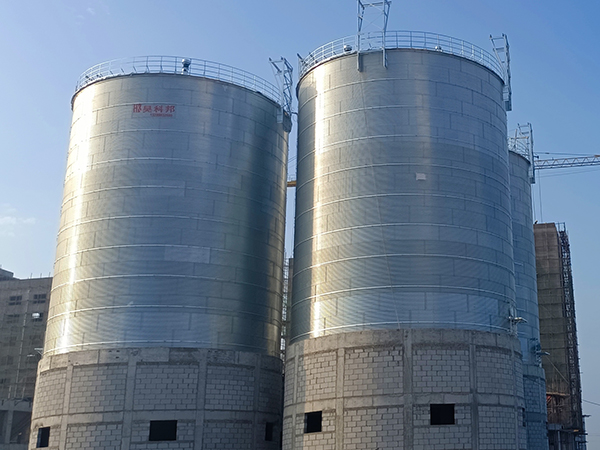
Grain Silo Temperature Monitoring System
COBAN grain silos are designed to ensure safe storage, stable ventilation, and long-term grain preservation under different climate conditions. Each silo system can be customized based on capacity, grain type, and project requirements for optimal storage performance and reliability.

Grain Silo Temperature Monitoring System
Application:Grain Silo Temperature Monitoring
Installation:Inside Grain Silo
Monitoring:Multi-Point Temperature Detection
Function:Temperature Monitoring & Abnormality Alarm
- Customized Capacity Design
- High Strength Galvanized Steel
- ISO Certified Manufacturing
- Global Installation Support
Applications
Corn Storage
Wheat Storage
Rice Storage
Soybean Storage
Feed Storage
Commercial Grain Storage
Product Details & Technical Information
Grain can look perfectly normal on the surface while heating is already developing several meters below the grain surface.
This is one of the main reasons temperature monitoring is installed on commercial grain silos. A grain silo temperature monitoring system continuously measures the temperature at different points inside the stored grain mass, allowing operators to identify abnormal temperature changes before they develop into serious storage problems.
For COBAN grain silos, the temperature monitoring system works as an important part of the silo management system rather than as an independent accessory. It can be integrated with the silo structure, temperature cables and control equipment to provide operators with a clear view of grain temperature conditions inside the silo.
The purpose is simple:
Know what is happening inside the grain before the problem becomes visible outside the silo.
What Is a Grain Silo Temperature Monitoring System?
A Grain Silo Temperature Monitoring System is a temperature detection and monitoring system installed inside a grain silo to measure temperature at multiple locations within the stored grain.
Unlike checking grain temperature manually from the surface, the system can monitor temperature at different vertical and horizontal positions.
A typical system consists of:
| Component | Main Function |
|---|---|
| Temperature cables | Installed vertically inside the grain mass |
| Temperature sensors | Measure grain temperature at different heights |
| Junction / connection system | Connects sensors to the monitoring circuit |
| Control unit | Collects and processes temperature data |
| Monitoring software/display | Shows temperature readings and abnormal areas |
| Alarm function | Alerts operators when temperature changes exceed the set limits |
The actual configuration can be adjusted according to silo diameter, height, grain type, storage capacity and monitoring requirements.
Why Is Temperature Monitoring Important in a Grain Silo?
The temperature of stored grain is not always uniform.
After grain enters a silo, several factors can cause localized temperature changes:
- Grain moisture differences
- Uneven grain drying
- Respiration of grain
- Microbial activity
- Insect activity
- Condensation
- Airflow differences
- Grain fines accumulation
- External temperature changes
A small warm area can therefore develop inside the grain mass without any obvious sign at the silo roof or wall.
Temperature change is often an early warning.
For example, if most monitoring points remain around the normal storage temperature while one sensor gradually increases over several readings, the operator has a reason to investigate that area.
The system does not simply tell you “the grain is hot.”
More importantly, it helps answer:
Where is the temperature changing? How fast is it changing? Is the change local or widespread?
That information is valuable when deciding whether aeration, grain movement, inspection or other corrective action is required.

Grain Temperature Monitoring
How Does the System Work?
The operating principle is straightforward.
1. Temperature sensors are positioned inside the silo
Temperature cables are suspended vertically from the upper structure of the silo.
Sensors are distributed along the cable at predetermined intervals so that temperature can be measured at different grain depths.
The number and arrangement of cables depend mainly on the silo diameter and the required monitoring coverage.
2. Sensors measure grain temperature
Each sensor measures the local temperature surrounding its position.
Because sensors are distributed throughout the grain mass, the system can identify differences between different storage zones.
3. Data is transmitted to the control system
Temperature readings are collected by the monitoring system and presented to the operator.
Instead of manually entering the silo to check conditions, operators can review multiple measurement points from the monitoring interface.
4. Abnormal temperature changes trigger attention
When a temperature point exceeds a preset value or shows an unusual increase, the system can provide an alarm or warning.
The operator can then determine whether further inspection or grain-conditioning measures are necessary.
Where Are Temperature Sensors Installed?
The most important point is that temperature monitoring must measure the grain mass, not simply the temperature of the silo wall or surrounding air.
For this reason, temperature cables are normally suspended inside the silo.
A simplified arrangement looks like this:
Silo roof
↓
Temperature cable
● Sensor
● Sensor
● Sensor
● Sensor
● Sensor
Stored grain
↓
Silo floor
Several cables can be distributed across the silo to create multiple monitoring zones.
The exact arrangement should be engineered according to the silo dimensions and grain storage conditions rather than simply installing a fixed number of sensors on every project.
What Does the Temperature Monitoring System Actually Monitor?
The system provides more useful information than a single temperature value.
Operators can pay attention to three important aspects:
1. Absolute temperature
A high temperature reading may indicate that the grain needs attention.
However, absolute temperature alone does not always tell the complete story.
2. Temperature difference
If one area is significantly warmer than surrounding points, this can indicate a localized problem.
For example:
| Monitoring Point | Temperature | Interpretation |
|---|---|---|
| Point A | 22°C | Normal reference |
| Point B | 22.5°C | Similar condition |
| Point C | 23°C | Slight difference |
| Point D | 28°C | Requires investigation |
| Point E | 22°C | Normal reference |
Point D is more important than simply knowing the average silo temperature.
3. Temperature trend
A gradual temperature increase can be more meaningful than a single high reading.
For example:
24°C → 24.5°C → 25.5°C → 27°C
This upward trend deserves attention even if the grain has not yet reached an extremely high temperature.
Temperature Monitoring and Aeration Work Together
A temperature monitoring system does not replace the aeration system.
The two systems perform different jobs.
| System | Main Purpose |
|---|---|
| Temperature monitoring | Detects and identifies temperature changes |
| Aeration system | Moves air through the grain to control storage conditions |
| Grain dryer | Reduces grain moisture before or during storage |
| Grain cleaning system | Removes impurities and fines |
| Silo | Provides controlled physical storage |
This is an important distinction.
Temperature monitoring tells the operator when and where attention may be required; aeration provides one of the main tools for correcting grain temperature conditions.
For a complete grain storage facility, these systems should therefore be considered together rather than independently.
Key Advantages of COBAN Grain Silo Temperature Monitoring System
1. Multi-Point Temperature Measurement
Instead of relying on one temperature reading, multiple sensors provide information from different locations inside the grain mass.
This makes it easier to identify localized temperature differences.
2. Early Detection of Abnormal Conditions
A temperature increase can be detected before a storage problem becomes visually obvious.
Early detection gives operators more time to respond.
3. Suitable for Large Grain Silos
As silo capacity increases, manual inspection becomes increasingly impractical.
A properly designed monitoring system allows operators to observe temperature conditions across large storage volumes from a centralized interface.
4. Supports Grain Storage Management
Temperature data can be used together with grain moisture information, aeration records and storage history.
This provides a more complete basis for storage decisions.
5. Reduces Dependence on Manual Inspection
Operators do not need to rely entirely on periodic manual checks.
Continuous or scheduled monitoring provides more consistent information during long-term storage.
6. Helps Protect Grain Quality
The ultimate purpose is not simply temperature measurement.
It is to help maintain stable storage conditions and reduce the risk of grain quality deterioration caused by localized heating and unfavorable storage conditions.
COBAN Temperature Monitoring System for Different Silo Sizes
The monitoring configuration should be designed according to the actual silo.
There is no engineering reason to use exactly the same sensor arrangement for a small silo and a large commercial silo.
Important design factors include:
- Silo diameter
- Silo height
- Storage capacity
- Grain type
- Expected storage period
- Grain moisture
- Local climate
- Aeration configuration
- Required monitoring resolution
Example configuration logic
| Silo Condition | Monitoring Consideration |
|---|---|
| Small silo | Basic multi-point monitoring may be sufficient |
| Medium silo | More sensing points improve coverage |
| Large commercial silo | Multiple temperature cables are normally required |
| High-capacity silo | Monitoring layout should cover different storage zones |
| Long-term storage | More attention should be given to temperature trends |
| High-humidity environment | Temperature monitoring becomes particularly valuable |
The final sensor quantity and cable layout should be confirmed during the silo engineering stage.
Temperature Monitoring Is Especially Important in These Situations
Long-Term Grain Storage
The longer grain remains in storage, the more important continuous condition monitoring becomes.
High-Moisture Grain
Grain entering storage at excessive moisture levels has a higher risk of developing storage problems. Temperature monitoring provides an additional layer of control after drying.
Tropical and Humid Regions
High ambient humidity and temperature fluctuations can make grain storage more challenging.
Large Commercial Grain Storage Facilities
When thousands of tons of grain are stored in multiple silos, manually checking every storage zone is not practical.
Grain Trading and Processing Facilities
For grain that will later be processed or sold, maintaining stable storage conditions is directly related to preserving product quality and commercial value.
Temperature Monitoring During Different Storage Stages
The system is useful throughout the storage cycle.
| Storage Stage | Temperature Monitoring Purpose |
|---|---|
| After grain loading | Establish initial temperature condition |
| Early storage | Detect abnormal temperature development |
| Long-term storage | Monitor temperature stability |
| Aeration | Observe temperature changes during cooling |
| Seasonal temperature changes | Identify temperature gradients |
| Before unloading | Confirm storage condition |
| During suspected heating | Locate abnormal zones |
This makes temperature monitoring a continuous storage-management tool, not merely an emergency alarm device.
What Should Operators Do When Temperature Rises?
A temperature alarm should not automatically be interpreted as a single specific failure.
The operator should first examine:
- Which sensor has increased?
- How much has the temperature changed?
- Is the change localized or occurring throughout the silo?
- Is the temperature continuing to increase?
- What is the grain moisture condition?
- Has aeration recently been performed?
- Are there unusual weather or condensation conditions?
The monitoring system identifies the location and trend. The operator then combines that information with grain condition and silo operating records to determine the appropriate response.
Possible actions may include:
- Checking aeration conditions
- Reviewing grain moisture
- Increasing monitoring frequency
- Inspecting the affected area
- Aerating when appropriate
- Moving or unloading grain if necessary
The correct response depends on the grain type, storage condition and severity of the temperature change.
Grain Silo Temperature Monitoring System vs. Manual Checking
| Comparison | Temperature Monitoring System | Manual Checking |
|---|---|---|
| Measurement points | Multiple | Limited |
| Monitoring frequency | Continuous or scheduled | Periodic |
| Locating hot spots | Much easier | Difficult |
| Large silo application | Suitable | Labor-intensive |
| Temperature trend | Can be recorded | Difficult to track |
| Early warning | Yes | Limited |
| Operator workload | Lower | Higher |
| Long-term storage | Highly useful | Less practical |
For a small temporary storage operation, manual inspection may have a role.
For large-capacity steel grain silos, however, multi-point temperature monitoring provides a much more practical method of understanding what is happening inside the grain.
Integration With COBAN Grain Silo Systems
The temperature monitoring system should not be considered an isolated component.
For a complete COBAN grain storage project, it can be coordinated with:
- Galvanized steel grain silo
- Silo aeration system
- Grain dryer
- Bucket elevator
- Belt conveyor
- Grain cleaner
- Screw conveyor
- Silo unloading system
- Level monitoring system
- Grain temperature monitoring system
- Central control system
This integration allows the operator to move from “storing grain” to “actively managing grain conditions.”
For example:
Grain Dryer → Grain Silo → Temperature Monitoring → Aeration → Condition Monitoring → Safe Storage
Each part has a different role, but together they form a complete grain storage process.
Temperature Monitoring System Specifications
Because temperature monitoring is normally customized to the silo structure, the following values should be treated as typical engineering considerations rather than a fixed configuration for every COBAN project.
| Parameter | Typical Configuration |
|---|---|
| Application | Grain storage temperature monitoring |
| Installation | Inside grain silo |
| Sensor arrangement | Multi-point |
| Installation method | Vertical temperature cables |
| Monitoring | Local / centralized monitoring |
| Warning function | Temperature abnormality alarm |
| Applicable silos | Small to large-capacity grain silos |
| Integration | Silo and grain storage control system |
The final number of cables, sensors, monitoring points and control equipment should be determined according to the silo diameter, height, capacity and project requirements.
Why Include Temperature Monitoring When Buying a Grain Silo?
A steel silo provides the physical storage space, but safe grain storage depends on more than the steel structure.
The condition of the grain changes after it enters the silo.
Without temperature monitoring, operators may know:
“The silo is full.”
With temperature monitoring, they can know:
“The grain temperature is stable, and this storage zone is behaving differently from the others.”
That difference is important.
For commercial grain storage, especially where hundreds or thousands of tons of grain are stored for months, the ability to identify abnormal conditions early can significantly improve storage management.
COBAN Engineering Approach
From our grain storage project experience, temperature monitoring should be considered during silo design, not added as an afterthought.
The correct monitoring layout depends on the geometry of the silo and the characteristics of the stored material.
For this reason, when we design a grain silo system, we consider:
Silo capacity → Silo diameter → Grain type → Storage period → Aeration design → Temperature cable layout → Monitoring points → Control system
The objective is not to install as many sensors as possible.
The objective is to install enough strategically positioned monitoring points to provide useful information about the grain mass.
Frequently Asked Questions
What is the purpose of a grain silo temperature monitoring system?
It measures grain temperature at multiple locations inside the silo and helps operators identify abnormal temperature changes before they develop into serious storage problems.
Where are temperature sensors installed?
They are normally installed along vertical temperature cables suspended inside the grain mass. The number and arrangement depend on the silo dimensions and monitoring requirements.
Can temperature monitoring detect hot spots?
Yes. Multi-point measurement allows operators to compare temperatures at different locations and identify localized areas with unusual temperature increases.
Is temperature monitoring necessary for every grain silo?
The need depends on silo size, grain type, storage period and project requirements. For commercial and long-term grain storage, it is strongly recommended because manual inspection becomes increasingly limited as storage capacity increases.
Does temperature monitoring replace aeration?
No. Temperature monitoring detects and locates temperature changes, while aeration is used to manage grain temperature and storage conditions.
Can the system be used with different grains?
Yes. The system can be applied to common stored grains such as maize, wheat, paddy, rice, barley, sorghum and other bulk agricultural materials, with the monitoring strategy adapted to the material and storage conditions.
How many temperature sensors does a grain silo need?
There is no universal number. Sensor quantity depends mainly on the silo diameter, height, capacity and required monitoring coverage. COBAN can determine the appropriate arrangement during project design.
Get a Grain Silo Temperature Monitoring System With Your Silo
A grain silo should not only provide storage capacity. It should also give operators the information needed to manage the grain inside it.
COBAN can integrate the Grain Silo Temperature Monitoring System with galvanized steel grain silos and related grain handling equipment according to the project capacity, grain type and operating conditions.
If you are planning a new grain storage facility, provide the silo capacity, grain type, number of silos and expected storage period, and the temperature monitoring arrangement can be designed as part of the complete silo system rather than treated as a separate accessory.
Request A Quote
Tell us your capacity, grain type, and project location. We will design a turnkey solution for you.