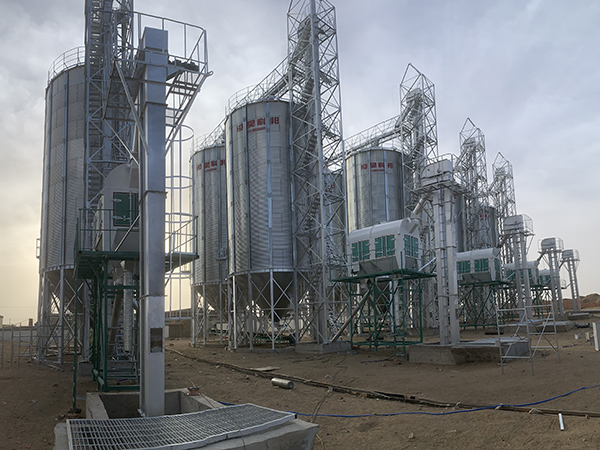
Grain Silo Aeration System
COBAN grain silos are designed to ensure safe storage, stable ventilation, and long-term grain preservation under different climate conditions. Each silo system can be customized based on capacity, grain type, and project requirements for optimal storage performance and reliability.

Grain Silo Aeration System
Application:Grain Cooling & Storage Aeration
Suitable Grain:Maize, Wheat, Rice, Soybean, Barley, etc.
Main Components:Aeration Fan, Ducts, Perforated Floor & Roof Vents
Airflow:Designed according to Silo Capacity & Grain Depth
Installation:Silo Bottom / Aeration Floor + Roof Ventilation
- Customized Capacity Design
- High Strength Galvanized Steel
- ISO Certified Manufacturing
- Global Installation Support
Applications
Corn Storage
Wheat Storage
Rice Storage
Soybean Storage
Feed Storage
Commercial Grain Storage
Product Details & Technical Information
A grain silo is not complete simply because it has enough storage capacity. Long-term grain storage also requires effective control of temperature, moisture, airflow and grain condition.
A Grain Silo Aeration System is one of the most important components of a modern grain storage system. It forces controlled airflow through the stored grain to remove excess heat, equalize grain temperature, reduce moisture migration and create a more stable storage environment.
For grain stored for several months or longer, especially in hot, humid or rainy regions, proper silo aeration can make a significant difference in grain quality and storage losses.
At COBAN, we normally consider the aeration system as part of the silo design rather than an optional accessory added after installation.
What Is a Grain Silo Aeration System?
A grain silo aeration system is a combination of fans, air ducts, perforated floors or air-distribution channels, vents and control components designed to move ambient air through stored grain.
A typical system includes:
| Component | Main Function |
|---|---|
| Aeration Fan | Supplies or extracts air through the grain mass |
| Air Inlet / Fan Transition | Connects the fan with the silo air-distribution system |
| Perforated Aeration Floor | Distributes air evenly beneath the stored grain |
| Aeration Ducts | Delivers air to different areas of the silo |
| Roof Vent / Exhaust Vent | Allows air to leave the silo |
| Temperature Sensors | Monitor grain temperature at different levels |
| Humidity / Weather Control | Helps determine when aeration should operate |
| Control Panel | Controls fan operation and monitoring |
The exact configuration depends on the silo diameter, grain depth, grain type, storage capacity, local climate, airflow requirement and intended storage period.
Why Is Grain Silo Aeration So Important?
Stored grain is still biologically active.
Even after harvesting and drying, grain continues to exchange heat and moisture with the surrounding environment. Temperature differences inside a large grain mass can create natural air currents. Warm air can move upward through the grain, carry moisture with it and cause moisture accumulation in cooler areas.
Over time, this can contribute to:
- Moisture migration
- Condensation
- Mold growth
- Insect activity
- Hot spots
- Grain caking
- Spoilage
- Reduced germination quality
- Loss of commercial value
Aeration works by reducing temperature differences throughout the grain mass and maintaining a more uniform storage environment.
The basic principle is simple:
Fan → Air Distribution → Grain Mass → Heat Removal → Roof Vent
The engineering challenge is making sure that airflow reaches the grain uniformly, rather than creating a few high-airflow channels while leaving other areas poorly ventilated.
Grain Silo Aeration Is Not Grain Drying
This is one of the most important points when designing a grain storage system.
A grain dryer removes a significant amount of moisture from freshly harvested grain.
A grain silo aeration system primarily controls grain temperature and maintains uniform storage conditions.
| Item | Grain Dryer | Silo Aeration System |
|---|---|---|
| Main purpose | Reduce grain moisture | Control grain temperature |
| Airflow | High | Relatively low |
| Heat source | Often heated air | Normally ambient air |
| Moisture removal | Significant | Limited |
| Typical application | Wet harvested grain | Properly dried grain |
| Operation | During drying | Periodically during storage |
| Main equipment | Dryer + heating system | Fan + ducts + aeration floor |
| Storage role | Prepare grain for storage | Maintain grain quality |
Aeration airflow is generally much lower than airflow used for natural-air drying or heated-air drying. Published guidance commonly places stored-grain aeration around 0.1–0.5 CFM/bu, depending on the storage objective and system design.
Therefore:
Do not put wet grain into a silo and expect the aeration fan to replace a grain dryer.
If the incoming grain has excessive moisture, the correct solution is normally grain drying first, followed by controlled silo aeration and storage management.
How Does a Grain Silo Aeration System Work?
The working process can be divided into five stages.
1. Air Enters the Aeration System
The fan draws or pushes ambient air into the aeration duct or plenum beneath the grain.
2. Air Is Distributed Across the Silo Bottom
A perforated floor or aeration ducts distribute the air across the grain surface area.
This part is critical.
A powerful fan cannot compensate for poor air distribution.
3. Air Passes Through the Grain
The air moves through the void spaces between individual grain kernels.
As it travels through the grain mass, it exchanges heat with the grain.
4. Grain Temperature Becomes More Uniform
The temperature difference between different layers of grain gradually decreases.
This helps reduce the temperature gradients that drive natural moisture migration.
5. Warm or Moist Air Leaves Through the Roof
The displaced air exits through adequately sized roof vents.
The silo therefore needs both:
Air inlet + air distribution + air outlet
A fan alone is not a complete aeration system.
Where Is the Aeration System Installed?
For a conventional flat-bottom grain silo, the main aeration components are normally installed at the bottom of the silo.
Typical installation arrangement
Aeration Fan → Transition → Air Plenum / Duct → Perforated Floor → Grain → Roof Vent
The most common arrangements include:
1. Full Perforated Aeration Floor
A perforated floor covers most or all of the silo bottom.
Advantages:
- More uniform air distribution
- Suitable for larger silos
- Good for long-term grain storage
- Suitable for different grain types
- Convenient for automated aeration systems
2. Aeration Duct System
Instead of a completely perforated floor, perforated ducts are installed beneath or within the grain storage area.
Common duct layouts include:
- U-shaped
- Cross-shaped
- Radial
- Half-round ducts
- Multiple parallel ducts
This can reduce initial investment while still providing effective aeration when properly designed.
3. Multiple-Fan Aeration System
Large-diameter or high-capacity silos may require several fans.
The number of fans is not determined simply by silo capacity. It depends on:
- Grain volume
- Grain depth
- Required airflow
- Static pressure
- Grain type
- Duct configuration
- Climate
- Cooling target
Fan selection should therefore be based on the required airflow at the expected static pressure, rather than selecting a fan only by motor horsepower.

Where Should the Aeration Fan Be Installed?
For most flat-bottom steel grain silos, the aeration fan is installed outside the silo near the lower section, connected to the aeration inlet or plenum.
This arrangement offers several advantages:
- Easy maintenance
- Convenient electrical connection
- Shorter air path
- Easy inspection
- Reduced installation complexity
- Better protection of the motor from grain dust inside the silo
The fan foundation should be stable and protected from standing water, especially in areas with heavy rainfall.
The connection between the fan and silo should also be properly sealed to prevent uncontrolled air leakage.
Why Roof Ventilation Is Equally Important
Many people focus only on the aeration fan.
That is a mistake.
If the fan supplies air into a silo but the air cannot escape efficiently, the system cannot operate as designed.
The silo therefore needs adequate roof vents or exhaust vents.
The ventilation outlet should provide enough free area for the designed airflow and should prevent rain, birds and insects from entering the silo.
Research-based guidance recommends adequate roof vent area and notes that insufficient exhaust capacity can limit airflow and increase condensation risks.
For this reason, COBAN’s silo aeration design considers:
Fan capacity + air distribution + roof ventilation
as one integrated system.
Grain Silo Aeration in Hot and Humid Climates
Aeration becomes particularly important in tropical and subtropical regions.
This includes many grain storage projects in:
- Africa
- Southeast Asia
- South Asia
- South America
- Central America
- Coastal regions
- Areas with long rainy seasons
In these regions, the challenge is not simply high temperature.
It is the combination of:
High temperature + high relative humidity + frequent rainfall + large temperature differences
that makes grain storage more difficult.
What can happen without proper aeration?
Suppose grain enters a silo after harvesting and drying.
The grain temperature may initially be relatively high.
If the grain mass is not properly cooled, temperature differences can develop between the center, wall and upper layers.
Warm air can move upward and transport moisture toward cooler regions.
This can eventually produce:
Moisture accumulation → Localized wet areas → Mold → Hot spots → Grain deterioration
Aeration helps break this cycle by reducing temperature differences and maintaining a more uniform grain mass.
Special Considerations for Rainy Regions
A common misunderstanding is:
“If the weather is humid, we should keep the aeration fan running continuously.”
Not necessarily.
Aeration air itself contains moisture.
When outside air conditions are unfavorable, excessive or poorly controlled aeration can introduce unwanted moisture into the grain.
Therefore, in humid and rainy regions, aeration should be based on grain temperature, outside temperature, relative humidity and the desired storage condition, rather than simply operating the fan continuously.
During prolonged rain or very humid weather, fan operation may need to be stopped depending on the system design and ambient conditions.
For tropical grain storage projects, we normally recommend combining:
- Grain temperature monitoring
- Proper roof ventilation
- Weather-aware fan operation
- Adequate grain drying before storage
- Regular grain inspection
- Appropriate aeration airflow
- Good silo sealing
How Much Airflow Does a Grain Silo Need?
There is no single fan size suitable for every silo.
Aeration is commonly expressed as:
CFM/bu — Cubic Feet per Minute per Bushel
The required airflow depends on the purpose of the system.
For example, published engineering guidance gives approximately 0.1–0.5 CFM/bu as a general range for stored-grain aeration, while higher airflow rates are associated with faster cooling or drying applications.
A simplified design relationship is:
Required Airflow = Stored Grain Volume × Target Airflow Rate
However, actual fan selection must also consider:
- Grain depth
- Grain type
- Bulk density
- Static pressure
- Aeration floor resistance
- Duct resistance
- Grain fines
- Desired cooling time
Therefore, fan horsepower alone is not an adequate design parameter.
How Long Should Grain Aeration Run?
The answer depends heavily on airflow.
For example, published data shows that at around 0.1 CFM/bu, cooling can take roughly 120 hours for clean grain under certain conditions, while higher airflow rates reduce the required operating time.
This illustrates an important engineering principle:
More airflow generally means faster cooling, but the fan should still be selected according to the actual grain depth and system resistance.
A short period of fan operation may cool only the grain layer closest to the incoming air. If the fan is stopped too early, significant temperature differences can remain inside the grain mass.
How Should a Grain Silo Aeration System Be Operated?
A practical operating strategy is:
After Grain Loading
Run aeration when suitable ambient conditions are available to remove harvest or dryer heat.
During Storage
Periodically operate the fan to maintain relatively uniform grain temperature.
During Temperature Changes
Use aeration to reduce excessive temperature differences within the grain mass.
Before Long-Term Storage
Cool the grain to an appropriate storage temperature based on:
- Grain type
- Moisture content
- Storage duration
- Local climate
- Insect pressure
During Rainy Weather
Do not automatically operate the fan simply because the grain feels warm.
Check ambient temperature and humidity before operation.
Grain Silo Aeration + Temperature Monitoring
For commercial grain storage, aeration should ideally work together with a grain temperature monitoring system.
Temperature cables installed at different positions and elevations can detect:
- Hot spots
- Temperature differences
- Abnormal heating
- Developing storage problems
This creates a much more effective management cycle:
Monitor → Identify abnormal temperature → Start aeration → Equalize temperature → Monitor again
Instead of running fans blindly, the operator can make decisions based on actual grain conditions.
For large silos, this becomes increasingly important because the operator cannot physically inspect the center of the grain mass.
Grain Silo Aeration System for Different Grains
Different grains have different storage characteristics.
| Grain | Aeration Consideration |
|---|---|
| Maize / Corn | Temperature control is important for long-term storage |
| Wheat | Aeration helps maintain uniform temperature and reduce insect activity |
| Rice / Paddy | High moisture and humidity require particularly careful management |
| Soybean | Oil-rich grain requires careful temperature control |
| Sorghum | Proper cooling helps maintain storage stability |
| Barley | Temperature and moisture uniformity are important |
| Coffee Beans | Requires careful temperature and humidity management |
| Sunflower Seed | Oilseed characteristics require stronger attention to temperature |
| Feed Grain | Stable temperature helps protect downstream feed quality |
The final aeration design should always be based on the actual material rather than applying one standard fan configuration to every silo.
COBAN Engineering Approach to Grain Silo Aeration
In COBAN grain silo projects, the aeration system is normally considered during the silo design stage, rather than treating it as an independent accessory after the silo has already been manufactured.
For example, when designing a commercial maize storage system, the engineering process can consider:
Storage capacity → Silo diameter → Grain depth → Grain type → Local climate → Required airflow → Static pressure → Fan selection → Aeration floor/duct → Roof ventilation → Temperature monitoring
This approach is important because changing the fan after installation does not necessarily solve an incorrectly designed air-distribution system.
Example: Large Maize Storage Project
Consider a commercial grain storage facility using several large steel silos for maize.
The customer may initially focus on silo capacity—for example, how many tons each silo can store.
However, the engineering problem is larger than capacity.
If the silo stores grain for several months in a warm and humid environment, the system also needs to answer:
- How quickly can the grain be cooled?
- How is air distributed across the silo bottom?
- Is the grain depth creating excessive static pressure?
- Is the roof exhaust sufficient?
- How are hot spots detected?
- When should the fans operate?
- What happens during the rainy season?
A properly designed Grain Silo Aeration System addresses these questions before the silo is installed.
This is why aeration should be treated as a core part of the grain storage system, not simply a fan mounted beside the silo.
Key Factors COBAN Considers When Designing Aeration
| Design Factor | Why It Matters |
|---|---|
| Silo Capacity | Determines the total grain volume |
| Silo Diameter | Affects air-distribution distance |
| Grain Depth | Strongly affects static pressure |
| Grain Type | Different grains have different storage characteristics |
| Grain Moisture | Determines storage risk and aeration strategy |
| Local Climate | Influences cooling opportunities and humidity |
| Storage Duration | Long-term storage requires stricter temperature control |
| Required Airflow | Determines fan capacity |
| Static Pressure | Determines actual fan performance |
| Aeration Floor | Determines airflow uniformity |
| Roof Ventilation | Provides the air exit path |
| Temperature Monitoring | Helps detect hot spots |
| Control System | Automates or simplifies fan operation |
What Happens If a Silo Has No Aeration System?
A steel silo can physically store grain without an aeration system.
But that does not mean it can reliably manage grain quality during long-term storage.
Without controlled aeration, the grain mass is more vulnerable to:
- Temperature stratification
- Moisture migration
- Local condensation
- Mold development
- Insect activity
- Hot spots
- Grain caking
- Quality deterioration
The risk becomes greater as:
Silo capacity ↑
Storage period ↑
Grain moisture ↑
Ambient temperature ↑
Relative humidity ↑
For this reason, aeration is regarded as an essential part of modern grain storage design.
Grain Silo Aeration System: Main Benefits
1. Controls Grain Temperature
Removes excess heat and reduces temperature differences.
2. Reduces Moisture Migration
Uniform grain temperature helps reduce internal convection currents that can move moisture toward cooler areas.
3. Reduces Hot Spots
Continuous monitoring combined with controlled aeration helps respond to abnormal temperature zones.
4. Helps Control Insects
Lower grain temperatures can reduce insect activity, although aeration should not be considered a replacement for proper pest-control procedures.
5. Protects Grain Quality
Stable storage conditions help preserve grain quality during long storage periods.
6. Particularly Valuable in Humid Regions
In tropical and rainy climates, proper temperature and moisture management becomes even more important.
7. Reduces Storage Losses
Preventing localized spoilage can be considerably more economical than discovering damaged grain after months of storage.
Grain Silo Aeration System Installation Checklist
Before commissioning the system, the following points should be checked:
Fan
- Correct airflow capacity
- Correct static-pressure performance
- Proper motor protection
- Stable foundation
- Safe electrical connection
Air Distribution
- Aeration ducts correctly installed
- Perforated floor properly supported
- No blocked air passages
- Good sealing around connections
- Uniform air-distribution arrangement
Silo Roof
- Adequate roof ventilation
- Rain protection
- Proper exhaust area
- No blocked vents
Monitoring
- Temperature cables correctly positioned
- Sensors working correctly
- Control panel tested
- Alarm functions checked
Operation
- Fan rotation checked
- Airflow direction confirmed
- Initial aeration schedule established
- Operators trained in temperature and humidity monitoring
Grain Silo Aeration System Is an Investment in Grain Quality
The value of a grain silo is not determined only by how many tons it can hold.
A 5,000-ton silo that cannot properly control grain temperature can create a much larger economic risk than a well-designed storage system with slightly higher initial investment.
A complete grain storage system should therefore be considered as:
Steel Silo + Aeration System + Temperature Monitoring + Proper Grain Drying + Grain Handling + Correct Storage Management
Among these components, the Grain Silo Aeration System provides the physical means to actively control the storage environment inside the grain mass.
For customers building grain storage facilities in Africa, Southeast Asia, South America, the Middle East and other hot or humid regions, aeration design deserves particular attention.
Need a Grain Silo Aeration System for Your Project?
COBAN can design the aeration configuration according to your actual silo and grain-storage conditions.
To select the appropriate grain silo aeration fan, aeration floor, air ducts and ventilation configuration, we normally need:
- Grain type
- Silo capacity
- Number of silos
- Silo diameter or available site dimensions
- Initial grain moisture
- Expected storage period
- Local climate
- Required cooling performance
- Whether temperature monitoring is required
Do not select an aeration fan based only on motor power.
The correct system should be designed around airflow, static pressure, grain depth and air-distribution uniformity.
That is what determines whether the aeration system actually protects the grain after the silo has been filled.
Request A Quote
Tell us your capacity, grain type, and project location. We will design a turnkey solution for you.