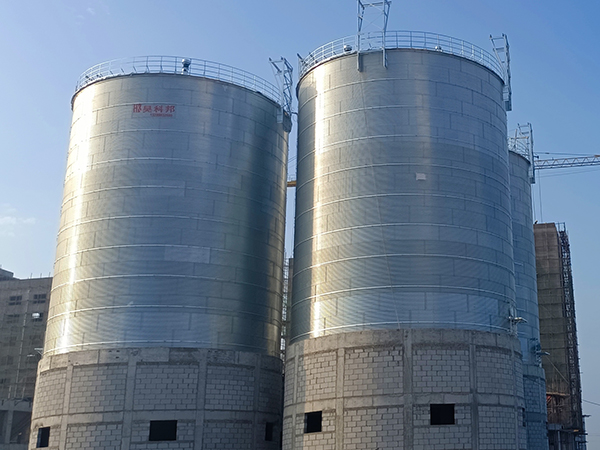
Grain Bucket Elevator
COBAN grain silos are designed to ensure safe storage, stable ventilation, and long-term grain preservation under different climate conditions. Each silo system can be customized based on capacity, grain type, and project requirements for optimal storage performance and reliability.

Grain Bucket Elevator
Application:Vertical Grain Conveying & Elevating
Capacity:Customized According to Project Requirements
Lifting Height:Customized According to Silo Layout
Suitable Grain:Maize, Wheat, Rice, Paddy, Soybean, Barley, etc.
Main Components:Buckets, Belt, Casing, Motor, Gearbox & Boot
- Customized Capacity Design
- High Strength Galvanized Steel
- ISO Certified Manufacturing
- Global Installation Support
Applications
Corn Storage
Wheat Storage
Rice Storage
Soybean Storage
Feed Storage
Commercial Grain Storage
Product Details & Technical Information
What Is a Grain Bucket Elevator?
A Grain Bucket Elevator is a vertical conveying machine that uses a continuous belt or chain equipped with buckets to lift bulk grain.
The buckets scoop grain from the bottom section and carry it upward inside a vertical casing. At the head section, the grain is discharged through centrifugal or continuous discharge depending on the elevator design.
A typical grain bucket elevator consists of:
| Component | Function |
|---|---|
| Head Section | Drives the belt and provides grain discharge |
| Drive Motor | Provides lifting power |
| Gearbox | Transfers and reduces motor speed |
| Belt / Chain | Continuously carries the buckets |
| Buckets | Scoop and lift grain |
| Casing | Encloses the conveying system |
| Boot Section | Receives grain at the bottom |
| Inlet | Connects with upstream conveying equipment |
| Discharge Chute | Transfers grain to the next equipment |
| Inspection Door | Allows maintenance and inspection |
| Belt Tracking System | Helps maintain stable belt operation |
The actual configuration depends on capacity, lifting height, grain type, grain characteristics and system layout.
Why Is a Bucket Elevator Important in Grain Storage?
Horizontal conveyors require considerable space when grain needs to be moved upward.
A bucket elevator solves this problem by moving grain vertically.
For example, a flat-bottom grain silo may be several meters higher than the receiving area. Grain must therefore be lifted before it can enter the silo through a distributor.
A typical grain handling route may look like:
Truck → Intake Hopper → Pre-Cleaner → Grain Dryer → Bucket Elevator → Distributor → Grain Silo
Without a reliable vertical conveying system, the silo cannot operate efficiently as part of an automated storage facility.
This is why a bucket elevator is not simply a material transfer machine.
It is often the vertical backbone of a grain storage and handling system.
How Does a Grain Bucket Elevator Work?
The working principle is relatively simple, but reliable operation depends on correct bucket spacing, belt speed, loading rate and discharge design.
Step 1 — Grain Enters the Boot
Grain arrives at the bottom of the bucket elevator through the inlet.
The boot must receive grain continuously without excessive accumulation.
Step 2 — Buckets Scoop the Grain
As the belt or chain moves, buckets pass through the grain and fill with material.
Step 3 — Grain Is Lifted Vertically
The loaded buckets travel upward inside the elevator casing.
The enclosed structure minimizes the floor space required for vertical conveying.
Step 4 — Grain Reaches the Head
At the top, the belt passes around the head pulley.
The change in direction allows the grain to leave the buckets.
Step 5 — Grain Is Discharged
The grain enters the discharge chute and moves toward:
- Grain silo
- Rotary distributor
- Grain cleaner
- Dryer
- Processing machine
- Another conveyor
- Loading system
The elevator therefore becomes a connection point between different stages of the grain handling process.
Where Is a Grain Bucket Elevator Installed?
The location depends on the complete grain storage system.
However, bucket elevators are commonly installed in several key positions.
1. Between Grain Receiving and Silo Storage
This is one of the most common applications.
Truck → Intake → Cleaner → Bucket Elevator → Distributor → Silo
The elevator lifts incoming grain to the required silo inlet height.
2. After a Grain Dryer
Wet grain is often cleaned and dried before entering long-term storage.
The elevator can lift dried grain from the lower discharge area to the storage silo.
Dryer → Bucket Elevator → Distributor → Silo
This arrangement is particularly common in commercial grain storage projects.
3. Between Silos and Processing Equipment
After storage, grain may need to be transported to:
- Flour mills
- Rice mills
- Feed mills
- Grain cleaning systems
- Packaging systems
The bucket elevator can raise grain to the required processing elevation.
4. In Central Grain Handling Towers
For larger grain storage facilities, several elevators may be installed around a central handling tower.
The tower can integrate:
- Bucket elevators
- Distributors
- Grain cleaners
- Conveyors
- Sampling equipment
- Weighing systems
- Dust collection systems
This creates a more organized grain handling layout.
Grain Bucket Elevator in a Complete Grain Silo System
The bucket elevator should not be considered independently.
A complete grain silo project normally involves several interconnected machines.
Typical Grain Storage Flow
Grain Receiving
↓
Pre-Cleaning
↓
Grain Drying
↓
Bucket Elevator
↓
Rotary Distributor
↓
Grain Silo
↓
Aeration
↓
Temperature Monitoring
↓
Bottom Discharge
↓
Bucket Elevator / Conveyor
↓
Loading or Processing
The bucket elevator provides the vertical connection between these stages.
This is particularly important for multi-silo facilities because one elevator can potentially serve several storage bins through an appropriately designed distribution system.
Grain Bucket Elevator vs. Other Grain Conveyors
Different conveying equipment has different applications.
| Equipment | Main Direction | Typical Application |
|---|---|---|
| Bucket Elevator | Vertical | Lifting grain to silos or elevated equipment |
| Belt Conveyor | Horizontal / Inclined | Long-distance grain transfer |
| Screw Conveyor | Horizontal / Slight Incline | Short-distance controlled conveying |
| Chain Conveyor | Horizontal | High-capacity grain transfer |
| Drag Conveyor | Horizontal | Heavy-duty bulk grain handling |
| Pneumatic Conveyor | Flexible | Specialized grain transport |
A bucket elevator is normally selected when the system requires high vertical lifting capacity with limited floor space.
It is not intended to replace every other conveyor.
The best grain handling system combines different conveying technologies according to the material-flow route.
How to Select a Grain Bucket Elevator?
Choosing an elevator based only on its nominal capacity is not enough.
Several engineering parameters should be considered.
1. Grain Capacity
Capacity is normally expressed in:
- t/h
- tons per hour
- bushels per hour
The elevator should provide enough capacity for the upstream and downstream equipment.
For example, if a grain dryer produces 20 t/h, selecting an elevator that can only handle 10 t/h will create a bottleneck.
2. Lifting Height
The required height determines the elevator casing length and drive requirements.
The calculation should consider:
Receiving elevation + equipment height + silo roof height + discharge position
The actual required lifting height should be confirmed during system layout.
3. Grain Type
Different materials behave differently.
COBAN bucket elevators can be configured for applications involving:
- Maize / Corn
- Wheat
- Rice
- Paddy
- Soybean
- Sorghum
- Barley
- Other bulk agricultural materials
Material characteristics affect bucket design, belt speed and feeding arrangement.
4. Grain Moisture
Wet grain can behave differently from dry grain.
High-moisture material may have:
- Higher adhesion
- Poorer flowability
- Increased tendency to bridge
- Higher conveying resistance
Therefore, elevator selection should consider whether the grain is being conveyed before or after drying.
5. Required Capacity Margin
An elevator should not normally operate continuously at the absolute maximum rated capacity.
A reasonable engineering margin helps accommodate:
- Variation in grain flow
- Temporary surges
- Different grain bulk densities
- Upstream equipment fluctuations
This helps improve operational stability.
Grain Bucket Elevator Capacity
The actual conveying capacity is influenced by:
Bucket Volume × Bucket Spacing × Belt Speed × Filling Efficiency × Bulk Density
This means that two elevators with the same casing size may not necessarily have the same conveying capacity.
Important variables include:
- Bucket size
- Bucket spacing
- Belt speed
- Grain density
- Filling rate
- Discharge efficiency
For this reason, professional elevator selection should be based on the actual grain and project conditions, rather than simply choosing the largest available model.

Grain Bucket Elevator Internal Structure Diagram
Bucket Elevator Belt Speed and Grain Damage
Grain handling equipment must move grain efficiently without unnecessarily increasing mechanical impact.
Excessive speed can increase:
- Grain impact
- Dust generation
- Bucket loading problems
- Belt vibration
- Mechanical wear
On the other hand, insufficient speed may reduce the required capacity.
The correct belt speed therefore depends on:
- Grain type
- Bucket design
- Elevator capacity
- Lift height
- Discharge method
- Required grain quality
For fragile or high-value materials, gentle handling becomes particularly important.
How to Reduce Grain Damage in a Bucket Elevator?
A good grain bucket elevator should do more than move grain.
It should also minimize unnecessary grain damage.
Important measures include:
Controlled Feeding
Avoid suddenly flooding the boot with excessive grain.
Correct Bucket Filling
Buckets should be loaded consistently rather than overloaded.
Proper Belt Speed
Select a suitable speed according to the grain characteristics.
Smooth Discharge
The head pulley and discharge chute should be designed to minimize unnecessary impact.
Good Belt Tracking
A misaligned belt can cause friction, vibration and premature wear.
Regular Maintenance
Worn buckets, belts and bearings should be replaced before they cause serious operating problems.
Grain Bucket Elevator Safety
Because bucket elevators operate continuously at relatively high speed, safety must be considered during design and operation.
Important safety components may include:
- Belt alignment monitoring
- Speed monitoring
- Bearing temperature monitoring
- Emergency stop system
- Inspection doors
- Proper guarding
- Drive protection
- Access platforms
- Maintenance ladders
- Dust-control measures
In grain facilities, dust management is particularly important.
Grain dust can accumulate around mechanical equipment and should be controlled through appropriate housekeeping, dust collection and facility design.
Bucket Elevator Installation
Correct installation directly affects elevator reliability.
Foundation
The boot section should have a stable foundation capable of supporting the equipment and dynamic loads.
Vertical Alignment
The elevator casing must be installed vertically.
A small alignment error can cause:
- Belt deviation
- Bucket rubbing
- Uneven wear
- Increased vibration
Head Support
The head section must be adequately supported, especially for tall elevators.
Inlet Connection
The incoming conveyor should deliver grain smoothly into the boot.
Discharge Connection
The discharge chute should provide a smooth transition to the next equipment.
Maintenance Access
Inspection and maintenance areas should be considered before installation, not after commissioning.
Bucket Elevator Maintenance
Routine maintenance is essential for long-term operation.
| Inspection Item | What to Check |
|---|---|
| Belt | Tension, wear and alignment |
| Buckets | Cracks, deformation and loose fasteners |
| Bearings | Temperature, noise and lubrication |
| Head Pulley | Wear and alignment |
| Boot | Grain accumulation and blockages |
| Motor | Temperature and abnormal noise |
| Gearbox | Lubrication and operating condition |
| Casing | Loose connections and deformation |
| Safety Devices | Sensors and emergency stops |
| Discharge Chute | Blockage and wear |
A common mistake is to inspect only the motor.
The elevator is a complete mechanical system, and failures often originate from belt tracking, bearing problems, bucket damage or material accumulation.
Grain Bucket Elevator for Humid and Tropical Regions
Grain handling equipment in tropical regions faces additional challenges.
High humidity and frequent rainfall can increase the risk of:
- Corrosion
- Moisture entering equipment
- Grain sticking
- Material accumulation
- Electrical problems
- Belt deterioration
For projects in Africa, Southeast Asia and other humid regions, the equipment configuration should consider the local environment.
Depending on the project, important measures may include:
- Galvanized steel construction
- Properly protected drive components
- Weather protection
- Sealed bearings where appropriate
- Good drainage around the foundation
- Corrosion-resistant components
- Proper electrical protection
- Effective dust and moisture management
The goal is not simply to make the elevator work on the day of commissioning.
The goal is to make it reliable throughout the storage season.
Grain Bucket Elevator + Grain Silo Distributor
The bucket elevator and silo distributor often work together.
The elevator lifts grain to the required elevation.
The distributor then directs grain to the selected silo.
For example:
Bucket Elevator → Rotary Distributor → Silo 1 / Silo 2 / Silo 3 / Silo 4
This arrangement allows one grain elevator to serve multiple silos.
The advantage is not only reduced equipment quantity.
It also creates a more organized grain handling system with centralized control and easier material routing.
For multi-silo projects, COBAN engineers therefore consider the elevator and distributor as one part of the overall grain-flow design.
COBAN Grain Bucket Elevator Design
Our approach is different from simply selling a standard elevator model.
When designing a grain handling system, we first determine the complete material route.
For example:
Where does the grain enter?
Where does it need to go?
How many tons per hour must be handled?
What is the lifting height?
Is the grain wet or dry?
How many silos must one elevator serve?
What equipment is installed before and after the elevator?
Only after these questions are answered do we determine the elevator configuration.
This approach helps prevent one of the most common problems in grain handling projects:
A conveyor with sufficient nominal capacity but an unsuitable system layout.
Why Choose COBAN Grain Bucket Elevator?
1. Designed for Complete Grain Handling Systems
COBAN does not treat the bucket elevator as an isolated machine.
It can be integrated with:
- Grain silos
- Grain dryers
- Grain cleaners
- Rotary distributors
- Belt conveyors
- Chain conveyors
- Aeration systems
- Grain temperature monitoring systems
This makes the elevator suitable for complete grain storage solutions.
2. Capacity Matched to the System
The elevator capacity is selected according to the actual material flow rather than simply choosing a standard machine.
3. Suitable for Different Grain Types
The configuration can be adapted to different grain characteristics and handling requirements.
4. Galvanized Steel Options
For grain storage facilities in humid or rainy environments, corrosion resistance is particularly important.
Galvanized steel construction can provide better protection for long-term outdoor or semi-outdoor applications.
5. Practical Maintenance Design
Inspection access and replaceable wear components are considered during equipment design.
6. Complete Project Engineering
For customers purchasing a complete grain storage system, COBAN can coordinate the relationship between:
Silo + Elevator + Conveyor + Distributor + Dryer + Cleaner + Aeration + Control System
This reduces compatibility problems during installation and commissioning.
Example: Bucket Elevator in a Multi-Silo Grain Storage Project
Consider a commercial grain storage facility with several steel silos.
The customer needs to receive harvested maize, clean it, dry it and distribute it among multiple storage silos.
A typical process can be designed as:
Truck Receiving
↓
Pre-Cleaning
↓
Grain Dryer
↓
Bucket Elevator
↓
Rotary Distributor
↓
Multiple Grain Silos
The bucket elevator lifts the grain from the lower processing area to the elevated distribution point.
The distributor then directs the grain to the selected silo.
During unloading, another conveying route can transport grain from the silo discharge area toward processing or truck loading.
This demonstrates an important point:
The value of a bucket elevator is not only its lifting capacity. Its real value is how effectively it connects the different levels of the entire grain storage system.
Common Grain Bucket Elevator Problems
Elevator Blockage
Usually related to excessive feeding, poor grain flow or accumulation in the boot.
Belt Slippage
May be caused by incorrect belt tension, moisture, overloaded operation or pulley problems.
Belt Misalignment
Often related to improper installation, uneven loading or pulley alignment.
Excessive Vibration
Can indicate mechanical misalignment, bearing problems, loose components or uneven operation.
Bucket Damage
May result from foreign materials, incorrect installation or excessive loading.
Low Actual Capacity
The problem may not be the elevator itself. It can originate from insufficient upstream feeding, incorrect bucket filling or poor discharge.
A good troubleshooting approach therefore examines the whole grain handling line, not only the elevator.
Grain Bucket Elevator: An Essential Part of Grain Handling
For a modern grain storage facility, grain needs to move efficiently between different elevations.
The bucket elevator provides this vertical conveying function with:
- High lifting capability
- Compact footprint
- Continuous operation
- Integration with automated grain handling
- Connection between processing and storage equipment
More importantly, its performance affects the entire storage system.
A properly selected elevator prevents bottlenecks between the grain dryer, silo distributor, storage bins and downstream processing equipment.
Complete Grain Storage Solution from COBAN
A reliable grain storage project is more than a steel silo.
COBAN can integrate the bucket elevator with a complete grain storage and handling system, including:
Grain Receiving System
→ Grain Cleaning
→ Grain Drying
→ Bucket Elevator
→ Grain Distribution
→ Aeration System
→ Temperature Monitoring
→ Grain Discharge
→ Conveying
→ Loading / Processing
The bucket elevator is the vertical link that keeps this system moving.
If you are planning a new grain storage facility or upgrading an existing grain handling system, the elevator should be selected together with the silo capacity, dryer capacity, conveyor capacity and material flow.
Send COBAN Your Project Requirements
To recommend a suitable Grain Bucket Elevator, provide:
- Grain type
- Required capacity (t/h)
- Lifting height
- Number of silos
- Grain moisture condition
- Upstream equipment
- Downstream equipment
- Local power supply
- Project location
COBAN can then design the elevator and its connections according to the complete grain handling route rather than selecting the machine by capacity alone.
Request A Quote
Tell us your capacity, grain type, and project location. We will design a turnkey solution for you.