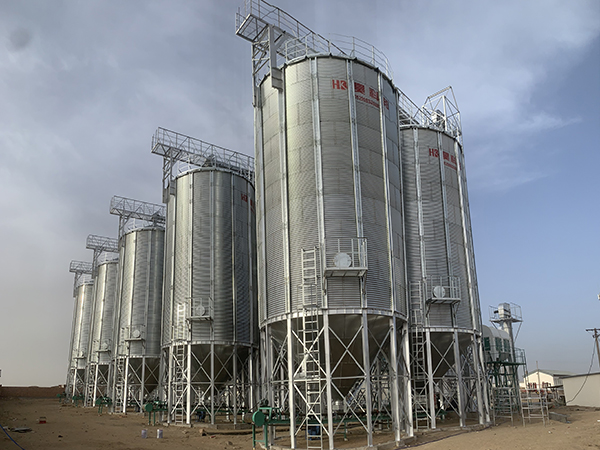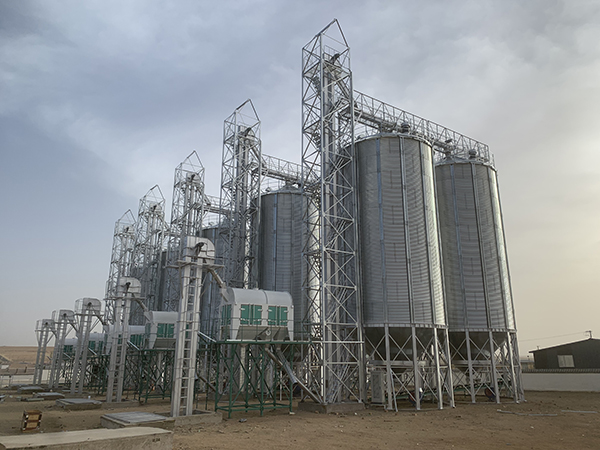

Commercial Grain Silos
COBAN grain silos are designed to ensure safe storage, stable ventilation, and long-term grain preservation under different climate conditions. Each silo system can be customized based on capacity, grain type, and project requirements for optimal storage performance and reliability.

Commercial Grain Silos
Silo Capacity:50–50,000 Tons
Material:Hot-Dip Galvanized Steel
Suitable Grains:Maize, Wheat, Rice, Soybean, Sorghum, Barley
Silo Types:Flat Bottom & Hopper Bottom
Supporting Systems:Aeration, Temperature Monitoring & Grain Conveying
- Customized Capacity Design
- High Strength Galvanized Steel
- ISO Certified Manufacturing
- Global Installation Support
Applications
Corn Storage
Wheat Storage
Rice Storage
Soybean Storage
Feed Storage
Commercial Grain Storage
Product Details & Technical Information
Commercial grain storage requires more than simply placing grain inside a steel bin. A commercial silo system must handle large storage volumes, frequent grain turnover, aeration, temperature control, loading and unloading, and long-term grain quality management.
COBAN Commercial Grain Silos are designed for farms, grain traders, grain terminals, flour mills, rice mills, feed mills, grain processing plants, and commercial grain storage facilities that need reliable bulk grain storage.
Depending on the project, silo capacities can be configured from 50 tons to 50,000 tons, with multiple silos working together as a complete grain storage system.
The silo capacity, diameter, wall height, roof structure, aeration system, unloading equipment, and conveying capacity are selected according to the customer’s grain type, storage period, site conditions, and daily handling requirements.
Commercial Grain Silo Specifications
| Item | Typical Configuration |
|---|---|
| Silo Capacity | 50–50,000 tons |
| Main Material | Hot-dip galvanized steel sheets |
| Suitable Grains | Maize, wheat, rice, soybean, sorghum, barley and other free-flowing grains |
| Silo Type | Flat bottom silo / Hopper bottom silo |
| Roof | Galvanized steel conical roof |
| Wall Thickness | Designed according to silo diameter, height and stored material |
| Aeration | Perforated floor, ventilation ducts and centrifugal/axial fans |
| Temperature Control | Cable temperature sensors and monitoring system |
| Unloading | Gravity unloading / sweep auger / mechanical unloading |
| Grain Handling | Bucket elevators, belt conveyors, chain conveyors, screw conveyors |
| Capacity Range | Customized according to project requirements |
Final technical specifications are determined through engineering design according to grain density, capacity, local climate, wind load, seismic conditions and project layout.
Why Choose Commercial Grain Silos Instead of Warehouse Storage?
For a small farm, bagged grain or a conventional warehouse may be sufficient. Once the storage volume increases, however, bulk grain storage becomes much easier to manage with silos.
A properly designed commercial grain silo system provides controlled storage conditions while reducing manual handling.
Higher Storage Density
Vertical grain silos make better use of limited land. Multiple silos can be installed within the same facility and connected to a common conveying system.
This is particularly useful for grain traders and processing plants where land availability is limited but storage demand continues to increase.
Better Grain Handling
Bulk grain can be moved mechanically from receiving to cleaning, drying, storage and final discharge.
Instead of repeatedly moving grain by labor, the entire process can be organized into a continuous material flow.
Easier Grain Quality Management
Commercial grain storage needs to control moisture and temperature rather than simply keep grain under a roof.
A commercial silo can be equipped with:
- Aeration fans
- Temperature monitoring cables
- Grain level sensors
- Dust collection equipment
- Roof vents
- Automatic control systems
This gives operators much better control over stored grain.

commercial grain storage
What Can Be Stored in Commercial Grain Silos?
COBAN commercial grain silos can be designed for different bulk agricultural commodities.
Maize Storage
Maize is one of the most common commodities stored in commercial grain silos. Before entering the silo, maize normally needs proper cleaning and drying.
For maize storage, the system can include:
Receiving → Cleaning → Drying → Bucket Elevator → Commercial Grain Silo → Aeration → Discharge
The drying target should be determined according to the intended storage period, local climate and final use.
Wheat Storage
Wheat is widely stored in commercial grain terminals, flour mills and grain trading facilities.
The silo system should provide good aeration and temperature monitoring, particularly where wheat will remain in storage for several months.
Rice and Paddy Storage
Paddy and rice require careful moisture management because excessive moisture can lead to heating, mold growth and quality deterioration.
For rice mills, commercial silos can be integrated with paddy cleaning, drying, conveying and milling systems.
Soybean Storage
Soybeans have different flow and storage characteristics compared with cereals. Silo design and handling equipment should therefore be selected according to soybean bulk density, flowability and storage conditions.
Other Bulk Grains
Commercial grain silos can also be designed for:
- Sorghum
- Barley
- Oats
- Sunflower seeds
- Other suitable bulk agricultural products
The stored material should always be confirmed during the engineering stage because material characteristics directly affect silo design and handling equipment.
Flat Bottom or Hopper Bottom Commercial Grain Silo?
This is one of the first decisions customers need to make when planning a commercial grain storage facility.
| Requirement | Flat Bottom Silo | Hopper Bottom Silo |
|---|---|---|
| Large storage capacity | Excellent | Good |
| Long-term storage | Excellent | Good |
| Cost per ton | Usually lower | Usually higher |
| Automatic discharge | Requires mechanical equipment | Easier gravity discharge |
| Frequent grain turnover | Good | Excellent |
| Foundation | Large floor foundation | Elevated foundation |
| Suitable for large grain terminals | Very suitable | Suitable |
| Cleaning after discharge | Requires sweep system | Easier |
When We Usually Recommend Flat Bottom Silos
For large-capacity commercial grain storage projects, flat bottom silos are often the more economical choice.
They are particularly suitable when the customer needs to store thousands or tens of thousands of tons and the grain does not need to be completely discharged every day.
A sweep auger or other mechanical unloading system can be installed for final grain removal.
When Hopper Bottom Silos Make More Sense
If the customer needs frequent unloading, batch storage, seed storage or fast grain turnover, a hopper bottom silo can be a better option.
The conical hopper allows grain to discharge by gravity, reducing the amount of mechanical cleaning required.
The correct choice should be based on storage capacity + turnover frequency + project budget + site conditions, rather than simply choosing the silo with the lowest purchase price.
Commercial Grain Silo Aeration System
Aeration is one of the most important parts of a commercial grain storage system.
The purpose of aeration is not simply to “blow air into the grain.” The airflow needs to be sufficient to remove accumulated heat and help maintain a stable grain temperature.
A typical system includes:
Aeration fan → Air duct → Perforated floor → Grain bulk
During storage, operators can monitor grain temperature and select an appropriate aeration cycle according to grain condition and outside weather.
For large commercial grain storage facilities, we recommend designing the aeration system together with the silo rather than adding fans after installation.
Grain Temperature Monitoring
A large silo may contain hundreds or thousands of tons of grain. The operator cannot judge the internal grain condition simply by looking at the surface.
This is why commercial grain silos are commonly equipped with grain temperature monitoring systems.
Temperature cables are installed vertically inside the silo, allowing operators to identify abnormal temperature increases at different positions.
A typical monitoring system can help detect:
- Localized heating
- Temperature differences between grain layers
- Potential moisture migration
- Aeration problems
- Early signs of grain deterioration
For large commercial grain storage projects, temperature monitoring should be considered a basic part of the silo design rather than an optional accessory.
Commercial Grain Silo Handling System
A silo itself is only one part of a commercial grain storage facility.
The real efficiency of the project depends heavily on the grain handling system.
A typical commercial grain storage line may include:
1. Grain Receiving
Trucks unload grain into a receiving pit or receiving hopper.
2. Pre-Cleaning
A grain cleaner removes large impurities, straw, dust and other foreign materials before storage.
3. Grain Drying
If incoming grain has excessive moisture, a grain dryer reduces moisture to an appropriate storage level.
4. Vertical Conveying
Bucket elevators transfer grain to the required height.
5. Grain Distribution
A rotary distributor or other distribution equipment directs grain to the selected silo.
6. Storage
The grain enters the commercial grain silo for controlled storage.
7. Aeration
Fans and ventilation channels help manage grain temperature.
8. Unloading
Grain is discharged from the silo and transferred to processing, packaging or truck loading.
This integrated approach is particularly important for commercial facilities because a high-capacity silo with insufficient conveying capacity can become a bottleneck for the entire plant.

commercial grain silo system
How Much Grain Can a Commercial Silo Store?
There is no single “standard” commercial silo size.
The correct capacity depends on several factors:
Annual grain throughput
Peak receiving volume
Required storage period
Number of grain varieties
Daily processing capacity
Available land
Future expansion plan
For example, a grain trader may need several medium-capacity silos instead of one extremely large silo because different grain purchases need to be stored separately.
A processing plant may prefer several silos arranged around a central conveying tower so that different raw materials can be selected independently.
For a large grain terminal, dozens of silos may be connected to high-capacity receiving, conveying and loading systems.
Commercial Grain Silo Layout Options
The layout should be considered before purchasing the silos.
Option 1: Small Commercial Storage Facility
A simple arrangement can include:
Receiving Pit → Cleaner → Elevator → Silo → Discharge Conveyor
This is suitable for farms, grain traders and smaller grain storage businesses.
Option 2: Multi-Silo Commercial Storage
Several silos can share:
- Bucket elevators
- Belt conveyors
- Distribution equipment
- Cleaning machines
- Aeration systems
- Control systems
This reduces duplicated equipment and makes the system easier to operate.
Option 3: Grain Storage + Processing Plant
For rice mills, flour mills and feed mills, the silo system can be directly connected with the processing line.
Truck Receiving → Cleaning → Drying → Storage → Processing → Finished Product
This arrangement reduces unnecessary grain transportation and allows the storage system to become part of the complete production process.
How We Design a Commercial Grain Silo Project
When a customer asks us for a commercial grain silo quotation, we do not start by selecting a silo model from a fixed catalog.
We first need to understand how the facility will actually operate.
Step 1 — Confirm the Grain
We need to know whether the material is maize, wheat, paddy, rice, soybean, sorghum or another commodity.
Bulk density and flow characteristics affect the engineering design.
Step 2 — Confirm Required Capacity
The total required storage capacity and the capacity of each individual silo are determined.
For example:
4 × 3,000-ton silos = 12,000-ton total nominal storage capacity
This configuration may provide more flexibility than using a single 12,000-ton silo.
Step 3 — Check Grain Moisture
Incoming moisture determines whether a dryer should be installed before the silo.
Storing wet grain directly in a silo without appropriate drying and aeration can create serious quality problems.
Step 4 — Calculate Grain Throughput
We determine how many tons per hour the receiving and discharge systems need to handle.
The bucket elevator, conveyor, cleaner, distributor and other equipment should be matched accordingly.
Step 5 — Study the Site
We consider:
- Available land
- Silo arrangement
- Truck access
- Foundation conditions
- Existing buildings
- Electrical supply
- Local wind conditions
- Rainfall and climate
- Future expansion
Step 6 — Build the Complete System
The final proposal may include silos, conveying, cleaning, drying, aeration, temperature monitoring, dust collection and electrical control.
This prevents customers from purchasing individual machines that later cannot work efficiently as one system.
Commercial Grain Silo Accessories and Equipment
Depending on project requirements, COBAN can integrate the silo with a complete grain handling system.
Main Equipment
- Grain receiving hopper
- Bucket elevator
- Belt conveyor
- Chain conveyor
- Screw conveyor
- Rotary distributor
- Grain cleaner
- Grain dryer
- Aeration fan
- Temperature monitoring system
- Grain level indicator
- Dust collector
- Silo unloading equipment
- Electrical control cabinet
The equipment capacity is matched according to the required grain flow rather than selecting each machine independently.
Designed for Different Climates
Commercial grain storage projects are built in very different environments.
A silo operating in a dry region has different requirements from one installed in a humid tropical area.
For example, projects in Africa and Southeast Asia may need particular attention to:
- High ambient humidity
- High rainfall
- Moisture migration
- Ventilation
- Corrosion protection
- Roof sealing
- Aeration capacity
In hot regions, temperature management becomes particularly important because high ambient temperatures can increase the difficulty of maintaining stable grain conditions.
The silo design should therefore consider the local climate, not just the nominal storage capacity.
Galvanized Steel Construction
COBAN commercial grain silos use galvanized steel as the primary construction material.
Galvanized steel provides corrosion protection while keeping the silo structure relatively light and suitable for modular manufacturing and transportation.
The steel panels are manufactured according to the engineering design and assembled on site.
For overseas projects, this modular construction method is particularly useful because the silo components can be transported in sections and assembled at the customer’s location.
Commercial Grain Silos: What Customers Should Check Before Buying
A low silo price does not necessarily mean a low project cost.
Before comparing quotations from different commercial grain silo suppliers, we recommend checking the following:
1. Is the quoted capacity nominal or usable?
Make sure you understand whether the stated capacity refers to nominal storage capacity or practical working capacity.
2. Is aeration included?
A silo without a properly designed aeration system may not provide the storage performance you expect.
3. Is temperature monitoring included?
For large commercial silos, this is an important part of grain quality management.
4. What is the conveying capacity?
The storage capacity may be large, but if the elevator and conveyors are too small, truck unloading and grain discharge will become slow.
5. Is the foundation included in the engineering scope?
The silo foundation must be designed according to the silo load and local soil conditions.
6. Can the system be expanded?
A commercial grain business often grows over time. The initial layout should leave reasonable space for additional silos.
Why Work With COBAN for Commercial Grain Storage?
The main value of a commercial grain silo project is not the steel bin itself. It is whether all the equipment works together after installation.
From our engineering experience, many storage problems originate from mismatched equipment rather than from the silo body.
For this reason, we can develop the project around the customer’s actual grain flow:
Storage Capacity → Silo Quantity → Layout → Receiving Capacity → Cleaning → Drying → Conveying → Aeration → Temperature Monitoring → Discharge
This approach allows the customer to purchase a complete system instead of trying to connect equipment from different suppliers afterward.
COBAN can provide commercial grain storage equipment for projects ranging from relatively small storage facilities to large multi-silo grain storage plants.
Commercial Grain Silo Project Support
For an overseas project, equipment supply is only one part of the work.
We can support customers through:
- Storage capacity calculation
- Silo selection
- Grain flow design
- Equipment configuration
- General layout planning
- Technical drawings
- Equipment manufacturing
- Export packing
- Installation guidance
- Commissioning support
- Operator training
- After-sales technical support
The final equipment configuration is developed according to the customer’s grain, capacity, site and operating requirements.
Need a Commercial Grain Storage System?
If you are planning a commercial grain storage facility, send us the following information:
1. Grain type: maize, wheat, rice, soybean, etc.
2. Total storage capacity: for example 5,000 / 10,000 / 20,000 tons
3. Number of silos preferred: if already known
4. Incoming grain moisture: if available
5. Required grain throughput: tons per hour
6. Project location: country and city
7. Available site dimensions: if available
Based on these details, we can work out a suitable commercial grain silo configuration, including silo capacity, quantity, layout and supporting grain handling equipment.
The objective is not simply to supply a silo. The objective is to build a storage system that can receive, store, protect and move grain efficiently throughout its operating life.
Request A Quote
Tell us your capacity, grain type, and project location. We will design a turnkey solution for you.