Introduction
One question comes up repeatedly when discussing grain storage projects with maize processors, feed mills, and grain traders:
Should maize be stored in a steel silo or a warehouse?
At first glance, both can hold grain. Both are used around the world. Both can be part of a successful storage system.
The challenge is that storage costs, grain losses, labor requirements, and future expansion options can vary significantly depending on the choice.
In many projects we have worked on across Africa, Southeast Asia, and South America, clients often focus on construction cost alone. After two or three harvest seasons, they discover that grain quality loss, insect infestation, and handling inefficiencies have a much greater impact on profitability than the initial investment.
This article compares maize silo storage and warehouse grain storage from an engineering and operational perspective to help commercial users choose the most suitable solution.
Why Is Choosing the Right Maize Storage System So Important?
Maize is highly sensitive to moisture, temperature changes, insects, and mold development.
A few common situations we often see include:
- Maize entering storage above 14% moisture
- Poor ventilation during rainy seasons
- Rodent contamination
- Manual handling losses
- Uneven grain temperatures inside storage facilities
A storage loss of only 2% may not sound serious.
For a facility storing 5,000 tons of maize, that equals:
| Storage Volume | Loss Rate | Grain Loss |
|---|---|---|
| 5,000 tons | 2% | 100 tons |
| 10,000 tons | 2% | 200 tons |
| 20,000 tons | 2% | 400 tons |
For commercial operators, storage design directly affects profitability.
That is why selecting between a maize silo and a warehouse should be treated as an engineering decision rather than simply a construction decision.
What Is the Difference Between a Maize Silo and a Warehouse?
The biggest difference is how grain is stored and managed.
Maize Silo

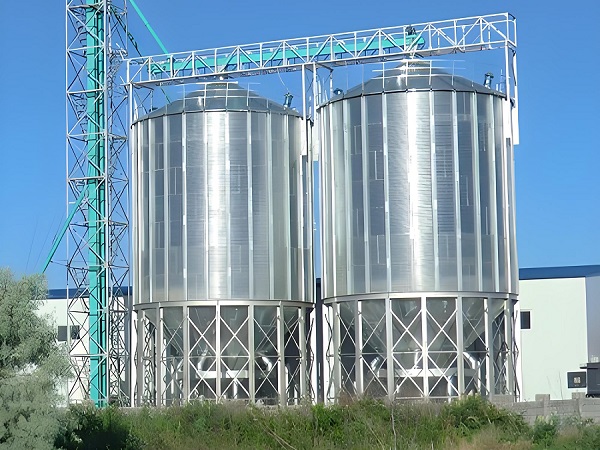
A maize silo stores grain vertically.
The grain mass forms a deep column inside a steel structure.
Typical capacities range from:
- 100 tons
- 500 tons
- 1,000 tons
- 5,000 tons
- 20,000 tons
- 50,000 tons
Most commercial silos include:
- Aeration systems
- Temperature monitoring cables
- Mechanical conveying systems
- Grain discharge equipment
Warehouse Storage

A warehouse stores grain horizontally.
Maize is usually piled directly on the floor or separated by partitions.
Typical storage heights:
- 3–6 meters
Storage capacities vary based on building size.
Operations often rely on:
- Front-end loaders
- Forklifts
- Manual inspection
- Portable ventilation equipment
Maize Silo vs Warehouse: Side-by-Side Comparison
| Item | Maize Silo | Warehouse |
|---|---|---|
| Storage Density | High | Medium |
| Land Requirement | Small | Large |
| Automation | High | Low |
| Labor Requirement | Low | High |
| Temperature Monitoring | Easy | Difficult |
| Aeration Efficiency | Excellent | Moderate |
| Expansion | Modular | Limited |
| Initial Investment | Higher | Lower |
| Long-Term Operating Cost | Lower | Higher |
| Grain Loss Risk | Low | Higher |
| Suitable Capacity | 500-50,000 tons | 50-5,000 tons |
In practice, the storage volume often becomes the deciding factor.
When Is a Warehouse the Better Choice?
A warehouse is not necessarily a poor solution.
In some situations, it is actually the most economical option.
Small Seasonal Storage
For farms storing:
- 100 tons
- 300 tons
- 500 tons
for short periods, a warehouse may provide sufficient protection.
The investment is relatively low and construction can be completed quickly.
Multiple Commodity Storage
Warehouses offer flexibility.
Clients storing:
- maize
- soybean meal
- wheat bran
- rice husk
- bagged feed
often prefer warehouses because different materials can be separated easily.
Temporary Expansion
One thing we often see during bumper harvest years is a sudden shortage of storage space.
A warehouse can be built much faster than a large silo system.
Advantages
- Lower initial cost
- Flexible usage
- Fast construction
- Suitable for multiple products
Limitations
- Higher labor costs
- Difficult temperature control
- More insect pressure
- Greater rodent risk
- Lower storage efficiency
When Is a Maize Silo the Better Choice?
Once storage volumes increase, silos begin showing clear advantages.
Large Commercial Storage
For capacities above:
- 1,000 tons
- 2,000 tons
- 5,000 tons
- 10,000 tons
silos usually become more economical over their operating life.
Long-Term Storage
If maize will remain in storage for:
- 3 months
- 6 months
- 12 months
temperature management becomes critical.
A properly designed silo allows:
- Aeration cooling
- Temperature monitoring
- Moisture management
These functions are difficult to achieve consistently inside large warehouses.
High Throughput Operations
Feed mills and grain trading centers often move hundreds of tons per day.
Mechanical conveying systems connected to silos can significantly reduce loading and unloading time.
Advantages
- Higher storage efficiency
- Lower grain loss
- Better grain quality preservation
- Reduced labor costs
- Easier automation
Limitations
- Higher initial investment
- Longer planning period
- Requires proper engineering design
How Do Storage Losses Compare?
This is often where the economics become clear.
From our engineering experience, storage losses usually come from four sources:
- Moisture migration
- Mold growth
- Insect activity
- Handling losses
Typical Warehouse Losses
Under average management conditions:
- 2% to 5% annual loss
Poorly managed facilities may exceed 7%.
Typical Silo Losses
With proper drying and aeration:
- Less than 1%
- Often below 0.5%
Example
Assume maize value:
- $250 per ton
Storage volume:
Difference in loss:
- Warehouse: 3%
- Silo: 0.8%
Annual grain saved:
220 tons
Value retained:
$55,000 annually
This calculation often changes how investors view storage projects.
How Do Construction Costs Compare?
Many buyers focus only on capital expenditure.
That can be misleading.
Warehouse Cost Components
- Land
- Foundation
- Steel structure
- Roofing
- Ventilation equipment
- Loading machinery
Silo System Cost Components
- Foundation
- Steel silo
- Bucket elevators
- Conveyors
- Aeration system
- Temperature monitoring
- Control system
Typical Trend
| Storage Capacity | Warehouse Usually More Economical | Silo Usually More Economical |
|---|---|---|
| Below 1,000 tons | ✓ | |
| 1,000-3,000 tons | Depends | Depends |
| Above 5,000 tons | ✓ |
One thing we often see is clients comparing only construction costs while ignoring operational expenses over 15-20 years.
That comparison rarely tells the full story.
What Common Mistakes Should Be Avoided?
Building Storage Before Drying Capacity

Many storage issues begin before grain enters storage.
Maize should normally be dried to:
- 13%–14% moisture
before long-term storage.
Ignoring Future Expansion
A facility storing 2,000 tons today may require 6,000 tons within five years.
Expansion planning should start during the initial design stage.
Choosing Based Only on Budget
The cheapest structure is not always the lowest-cost solution over time.
Underestimating Aeration Requirements
In tropical climates, aeration design is often more important than storage volume itself.
No Temperature Monitoring
Hot spots inside grain masses can develop long before visible spoilage appears.
Monitoring systems help detect problems early.
What Storage Solution Do We Usually Recommend?
There is no universal answer.
From our experience, recommendations generally follow these guidelines:
| Project Type | Recommended Solution |
|---|---|
| Small farm | Warehouse |
| Grain collection center | Silo |
| Feed mill | Silo |
| Grain trader | Silo or hybrid |
| Emergency storage | Warehouse |
| Long-term strategic reserve | Silo |
A hybrid system is often the most practical choice.
Many successful projects combine:
- Main silo storage
- Warehouse buffer storage
- Drying equipment
- Grain cleaning equipment
This approach balances investment, flexibility, and operational efficiency.
FAQ
Can maize be stored safely in a warehouse?
Yes, if moisture content is controlled and storage periods are relatively short. Good ventilation and pest management are essential.
What moisture level is recommended for maize storage?
For long-term storage, we typically recommend 13% to 14% moisture.
How long can maize remain in a steel silo?
With proper drying, aeration, and monitoring, maize can be stored safely for many months and in some cases more than one year.
Is a silo always more expensive than a warehouse?
Not necessarily. Initial investment is usually higher, but lifetime operating costs are often lower.
Which storage system requires less labor?
A silo system generally requires fewer workers because grain handling can be automated.
Can warehouses use aeration systems?
Yes. Floor aeration systems can be installed, although airflow distribution is usually less uniform than in a silo.
What is the minimum storage capacity where a silo becomes practical?
Many projects begin seeing benefits around 500–1,000 tons, depending on grain turnover and labor costs.
Can silos and warehouses be used together?
Yes. Many commercial grain facilities use silos for bulk storage and warehouses for temporary or seasonal overflow storage.
Conclusion
The debate between maize silo vs warehouse storage is not really about which structure is better. It is about which solution fits your operating conditions, storage volume, grain turnover rate, and long-term business plan.
If your project handles a few hundred tons of maize for short periods, a warehouse may be sufficient.
If you plan to store thousands of tons, preserve grain quality for months, reduce labor costs, and automate grain handling, a silo system usually provides stronger long-term value.
Before making a decision, gather the following information:
- Annual maize production or purchase volume
- Required storage capacity
- Expected storage duration
- Local climate conditions
- Grain moisture levels
- Available land area
- Future expansion plans
With these parameters, an engineering team can calculate storage requirements, aeration demand, equipment sizing, and overall project economics. COBAN can assist with storage layout planning, grain drying integration, capacity calculations, and complete commercial grain storage system design based on actual project conditions.