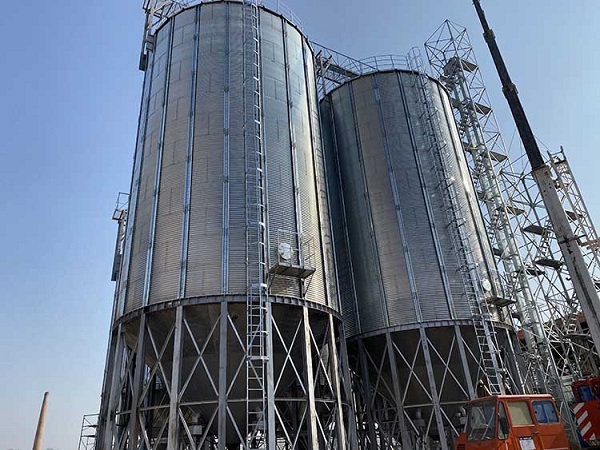
“Forget the sales talk. This is a technical breakdown of how to handle coffee storage in the tropics. If you’re protecting high-scoring Arabica, you need to know exactly how the engineering affects your bottom line.”

The Numbers: Traditional Bags vs. Professional Coffee Bean Silos
| The Numbers | Traditional Bag Storage | COBAN Engineered Silo |
|---|---|---|
| Safe Storage Window | 3 – 6 Months (Quality dips quickly) | 24+ Months (Peak freshness) |
| Product Loss Ratio | 3% – 8% (Pests/Moisture/Handling) | Less than 0.3% |
| Land Footprint | Large (Horizontal stacking) | Minimal (Vertical efficiency) |
| Labor Intensity | High (Manual stacking) | Push-button (1-2 operators) |
☕ Engineered Specifically for Coffee Exporters
Standard silos often fail coffee traders. Our Coffee-Specific Engineering ensures your green beans maintain their specialty grade score. Check our full range of Nitrogen-compatible hopper silos.
The Science: Why Jute Bags are Killing Your Coffee Export Quality
Coffee beans are living cargo. They don’t just sit there; they constantly exchange moisture with the Ugandan air. In regions like Mbale or the Lake Victoria basin, this ‘breathing’ is a death sentence for quality. Once the beans suck in that humid air, you’re looking at mold, aroma loss, and a total collapse of your export cup score.
Mycotoxin & Mold Risk
It’s not just about the smell. Mold growth leads to mycotoxin contamination, which can result in entire shipments being rejected at European or American ports. You don’t just lose the batch; you lose your reputation with the buyer.
Oxidation & Aroma Bleed
The essential oils that give coffee its value oxidize the moment they are exposed to oxygen. In a porous jute bag, this process is constant. Once that aroma is gone, your premium price is gone too—you’re left selling specialty beans at commercial prices.
Pest Pressure: The Coffee Bean Borer
Jute bags are effectively invisible to pests. They offer zero protection against the coffee bean borer, which can devastate an entire warehouse batch in weeks if left unmanaged.
Manager’s Insight: > I’ve stood in warehouses in Mbale where the “warehouse smell” was so strong you could tell the beans were already degrading just by walking in. A sealed steel silo isn’t just a container; it’s a vault. You’re locking out the tropical humidity and locking in the essential oils that define your profit margins.

Real-World ROI: How a 1,000T Coffee Silo Saved $80,000 in Masaka
Back in 2024, a major export hub in Masaka was bleeding money—their Arabica stock was seeing a 4.5% annual loss. On paper, it doesn’t sound like much, but for a facility of that scale, it meant over $80,000 was simply vanishing every year into mold and weight loss.
We tore out their chaotic manual bag-and-pallet setup and installed a 1,000-ton automated silo hub (dual 500T hoppers). The results weren’t just gradual; they were immediate:
Losses bottomed out: Shrinkage plummeted from 4.5% to just 0.2% in year one.
Labor Overhaul: They used to need a crew of 12 people just to haul and stack bags. Now? The entire site is run by 2 technicians at a control desk.
Market Leverage: Most importantly, their cupping scores stayed rock-solid for 10 months. Instead of panic-selling before the beans degraded, they had the luxury of holding stock until the global market price peaked.
They hit full ROI in just 2.8 years—essentially paying for the entire engineering upgrade solely through the money they stopped losing.
Advanced Protection: Nitrogen Flushing & Automated Climate Intelligence
Freshness Through Nitrogen Flushing
For high-end specialty coffee, we recommend Nitrogen Flushing. Specialty coffee dies when it oxidizes. We use Nitrogen Flushing to displace oxygen entirely from the silo. It’s the only way to keep a batch harvested 12 months ago tasting like it was picked last week. It’s the only way to keep a harvest tasting fresh 12 months later—period.
Automated Climate Intelligence
Forget manual checks. We run thermocouple cables through the grain mass so you can see heat spikes in real-time. If the core temperature climbs, the fans respond. But there’s a hard logic-lock: the system won’t pull in damp air. If it’s a rainy day in Masaka, the fans stay off. You only move air when the weather is right.
Uganda-Tough Engineering: Z450 Steel & 60° Coffee Silo Hopper Design
Coffee isn’t corn. You can’t use a standard grain silo and expect your cupping scores to survive. Here’s the engineering you actually need:
Z450 Galvanized Steel: Defeating Lake Victoria’s Humidity
Standard zinc coating is 275g/㎡. For Uganda’s humidity, we use 450g/㎡ (Z450). This massive increase in protection adds decades to the silo’s life, preventing the structural rust that kills cheaper units within a few seasons.
60° Hopper Bottom: Ensuring Total Emptying & FIFO Flow
Coffee isn’t as “slippery” as corn or wheat. It’s a high-value, sensitive crop that needs a steeper 60-degree angle to move. A shallow bottom is a trap; it leaves old beans stuck in the corners to rot. Our 60° design ensures the silo clears out completely every single time. The oldest beans exit first (First-In, First-Out)—no leftovers, no mold, and zero risk of last year’s crop ruining your fresh harvest.
Heat Insulation: Stopping the “Oven Effect”
In areas with direct, punishing sun exposure, a standard steel silo acts like an oven. Without protection, internal temperatures can spike high enough to literally “cook” the essential oils out of your beans. We solve this with a double-wall insulation layer. It creates a thermal break that kills heat transfer before it reaches the grain mass. Whether it’s the peak of the afternoon heat or a sudden tropical downpour, the internal environment stays stable—protecting your cupping scores from thermal shock.
Installation Excellence: Avoiding Foundation Failure in Coffee Storage Projects
A silo is only as good as the ground it stands on. We don’t take shortcuts where they matter most.
Soil Bearing Analysis: Respecting Uganda’s Red Soil
You can’t just pour a concrete slab and hope for the best. In Uganda’s red soil, a 500-ton load is a massive gamble. We conduct a proper soil bearing analysis for every project. If the ground shifts even two inches because the foundation wasn’t engineered for the load, the silo tilts, the seals pop, and your entire investment is trashed.
The Zero-Welding Rule: Preserving the Z450 Shield
We enforce a strict no-welding rule on-site. The second you touch a welding torch to the silo body, you’ve burnt off the Z450 zinc protection. It’ll look fine today, but it’ll be a rust bucket in two seasons. We use high-tensile bolts and industrial-grade sealant at every single joint—it’s a slower process, but it’s the only way to keep the structure airtight and rust-proof during a Masaka downpour.
The 48-Hour Torture Test: Handing Over the Keys
Before we leave the site, the system goes through a 48-hour torture test on the sensors and automated gates. We simulate real-world pressure to ensure the flow from the truck to the hopper is seamless. If the system can’t handle a full-speed discharge under pressure, we don’t hand over the keys.
Technical Specs: Choosing the Right Coffee Bean Silo for Your Capacity
Choosing the right size is about more than just capacity; it’s about your 5-year growth plan.
| Capacity | Recommended Model | Zinc Coating | Best For |
|---|---|---|---|
| 50 – 200 Tons | Small Hopper Bottom | Z350 | Local washing stations / Co-ops |
| 300 – 1000 Tons | Commercial Hopper | Z450 High-Grade | Regional Exporters / Hubs |
| 2000+ Tons | Flat Bottom Industrial | Z450 High-Grade | Government reserves / Large Scale Processors |
FAQ: Critical Insights on Coffee Storage
Technical solutions for high-humidity tropical environments.
Request a Coffee Storage Layout & Moisture Risk Assessment
Don’t let humidity dictate your profit margins. Let’s design a storage solution that fits your volume and your budget perfectly.
Get Your Personalized Engineering Proposal 👇
* Our project managers will contact you within 24 hours with a preliminary CAD layout.
Coban Coffee Storage Systems: Engineered for High-Humidity Markets.