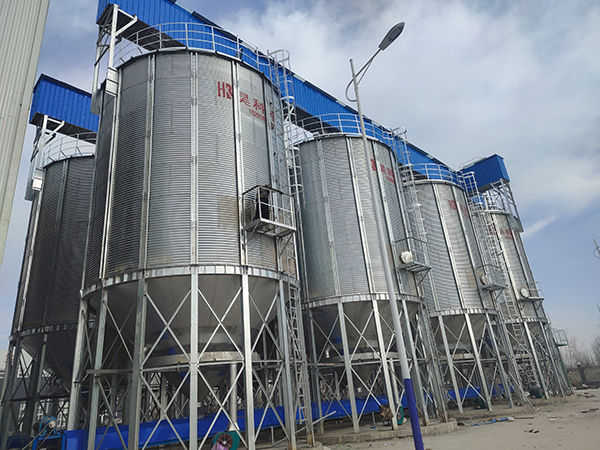
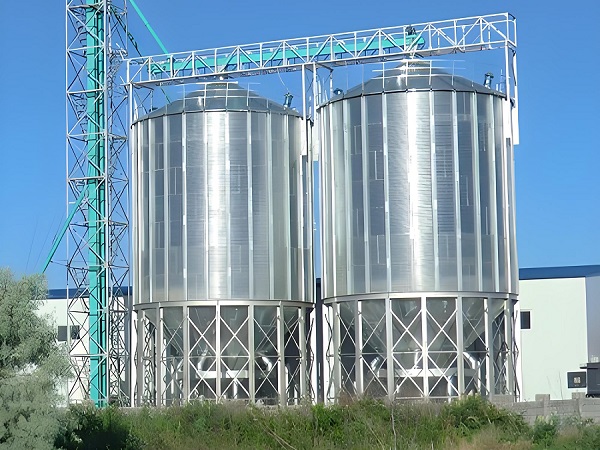
Choosing the right grain silo capacity is not simply a matter of calculating how much grain you want to store.
For a grain trading business, the silo must match purchasing volume, turnover speed, harvest season, grain moisture, transportation capacity, cash flow, and future expansion plans. A silo that is too small can force frequent selling when prices are unfavorable. A silo that is too large ties up capital and leaves storage space unused.
From our experience working on grain storage projects, the most practical approach is to calculate silo capacity from the actual grain flow of the business, rather than selecting a standard silo size first.
1. Start With Your Annual Grain Trading Volume
The first number to determine is how much grain your business actually handles in a year.
For example, a grain trader may purchase:
- 5,000 tons of maize per year
- 10,000 tons of wheat per year
- 20,000 tons of paddy per year
- 50,000 tons or more across several purchasing locations
However, annual trading volume does not equal required silo capacity.
If a trader purchases 10,000 tons of maize throughout the year and sells it continuously, a 10,000-ton silo is usually unnecessary.
The more useful question is:
How much grain do I need to hold at the same time during my busiest purchasing period?
That figure becomes the starting point for selecting grain storage silo capacity.
2. Calculate Peak Inventory Instead of Annual Sales
A simple calculation can be used:
Required storage capacity = Peak grain inventory × Safety factor
The peak inventory is the maximum amount of grain that may remain in storage before enough grain is sold or transported out.
For example:
| Business situation | Annual grain volume | Maximum grain held at one time | Suggested installed capacity |
|---|---|---|---|
| Small trader | 3,000 t | 1,000 t | 1,200–1,500 t |
| Growing trader | 10,000 t | 3,500 t | 4,000–4,500 t |
| Medium trader | 20,000 t | 7,000 t | 8,000–9,000 t |
| Large trader | 50,000 t | 18,000 t | 20,000–22,000 t |
| Regional grain buyer | 100,000 t | 35,000 t | 40,000 t+ |
These are planning examples rather than fixed engineering specifications. The final capacity should be calculated from the actual purchasing and selling cycle.
For many projects, allowing around 10–20% additional working capacity is useful because grain inflow rarely follows a perfectly predictable schedule.
3. Look Carefully at the Harvest Season
Harvest season can completely change the capacity requirement.
Suppose a grain trader normally handles 20,000 tons of maize per year. If purchases are spread evenly over 12 months, the required storage may be relatively modest.
But if 12,000 tons arrive within two or three months after harvest, the storage requirement becomes much higher.
A practical calculation is:
Peak storage requirement = Monthly purchasing volume − Monthly sales volume
Consider this example:
- Monthly maize purchases during harvest: 4,000 tons
- Monthly sales: 1,500 tons
- Storage increase: 2,500 tons/month
- Harvest purchasing period: 4 months
The inventory could increase by approximately:
2,500 × 4 = 10,000 tons
In this situation, a trader handling 20,000 tons annually may still require around 10,000 tons of usable storage capacity.
This is why selecting a silo according to annual turnover alone often leads to the wrong result.

4. Choose Several Silos Instead of One Very Large Silo
For grain trading businesses, we normally prefer dividing the total capacity among several silos rather than putting everything into one storage bin.
For example, instead of:
1 × 10,000-ton grain silo
a trader may choose:
4 × 2,500-ton grain silos
The second arrangement provides more flexibility.
Why multiple silos can be better
Different batches may have different:
- Moisture contents
- Grain qualities
- Purchase dates
- Suppliers
- Varieties
- Grades
- Intended customers
If all grain is placed in one large silo, separating these batches later becomes difficult.
With multiple grain storage silos, the trader can keep different lots separate and sell them according to quality and market demand.
For a grain trading business, storage flexibility can be just as important as total capacity.
5. Don’t Calculate Capacity From the Silo’s Nominal Volume Alone
This is an important point when comparing grain silo manufacturers.
A silo’s advertised capacity may refer to its nominal grain holding capacity, but the actual usable storage depends on the grain density, silo geometry, roof space, discharge design, and operating conditions.
Different grains have different bulk densities.
Typical approximate values include:
| Grain | Approximate bulk density |
|---|---|
| Wheat | 0.72–0.82 t/m³ |
| Maize | 0.68–0.75 t/m³ |
| Paddy | 0.55–0.65 t/m³ |
| Sorghum | 0.70–0.75 t/m³ |
| Barley | 0.60–0.70 t/m³ |
These figures are only for preliminary estimation. Actual values should be confirmed according to the grain condition and project requirements.
Therefore, when requesting a grain silo price, provide the supplier with the grain type and required tonnage rather than asking only for a silo with a certain diameter.
6. Match Silo Capacity With Your Grain Dryer
If your grain trading business purchases freshly harvested grain, silo capacity should not be considered separately from drying capacity.
For example:
Receiving → Cleaning → Drying → Temporary Storage → Long-Term Storage → Selling
If the trader buys wet maize directly from farmers, the storage system needs enough capacity to receive grain while the dryer is operating.
A common mistake is installing a large storage silo but using an undersized grain dryer.
For example:
- Grain purchasing: 100 tons/hour
- Grain dryer: 20 tons/hour
- Receiving: 80 tons/hour
The receiving system may quickly become congested during harvest.
The storage system should therefore be designed as a complete grain handling system, not simply a collection of storage tanks.
7. Consider Grain Turnover Rate
A grain trader usually makes money by buying grain at one price and selling it when market conditions are favorable.
This means storage duration matters.
A business with fast turnover may need less total capacity but higher handling efficiency.
A business that stores maize or wheat for several months may need more capacity and stronger storage management.
A useful indicator is:
Storage turnover = Annual grain throughput ÷ Average stored grain
For example:
If the business handles 30,000 tons annually and normally keeps 6,000 tons in storage:
30,000 ÷ 6,000 = 5 turnovers/year
The same 30,000-ton business with slower turnover may need considerably more physical storage.
8. Leave Space for Grain Segregation
Do not use 100% of the storage capacity for one product if your business trades several grain types or quality grades.
For example, a trader may handle:
- Maize
- Wheat
- Sorghum
- Soybean
- Paddy
Even when total annual volume is high, each product may require separate storage.
A 10,000-ton storage system could therefore be configured as:
| Silo | Capacity | Main use |
|---|---|---|
| Silo 1 | 3,000 t | Maize |
| Silo 2 | 3,000 t | Maize |
| Silo 3 | 2,000 t | Wheat |
| Silo 4 | 1,000 t | Sorghum |
| Silo 5 | 1,000 t | Quality separation / temporary storage |
This configuration provides more operating flexibility than simply installing two 5,000-ton silos.
9. Use Your Transport Capacity as a Design Constraint
The storage capacity should also match the transportation system.
Consider a trader receiving 500 tons of grain per day.
If trucks deliver most of the grain during an 8-hour working period, the receiving system needs to handle roughly:
500 ÷ 8 = 62.5 tons/hour
The receiving pit, bucket elevator, conveyors, cleaner, dryer and transfer equipment should therefore be designed around the actual peak flow.
The same applies to grain dispatch.
If customers collect 300 tons per day, the outbound system must be capable of loading trucks quickly enough to avoid queues.
A large silo connected to a small conveyor system does not create an efficient grain storage facility.
10. A Practical Capacity Selection Method
For a grain trading company that does not yet know what capacity to choose, we recommend working through these six numbers:
Step 1 — Calculate annual purchasing volume
Example:
20,000 tons/year
Step 2 — Identify the peak purchasing period
Suppose:
12,000 tons are purchased during the main harvest
Step 3 — Calculate sales during the same period
Suppose:
5,000 tons are sold during harvest
Potential inventory accumulation:
12,000 − 5,000 = 7,000 tons
Step 4 — Add operating reserve
Allow approximately 10–20% additional capacity:
7,000 × 1.15 = 8,050 tons
Step 5 — Divide the capacity into practical silo sizes
Instead of one 8,000-ton silo, a possible arrangement is:
4 × 2,000-ton grain silos
Step 6 — Check the complete handling system
The final design should then verify:
- Truck receiving capacity
- Bucket elevator capacity
- Conveyor capacity
- Grain cleaning capacity
- Grain drying capacity
- Silo filling rate
- Silo discharge rate
- Aeration requirements
- Temperature monitoring
- Truck loading capacity
This produces a much more reliable grain storage design than simply selecting a silo based on annual trading volume.
11. Which Grain Silo Capacity Is Suitable for Your Business?
As a preliminary reference, the following ranges can help traders determine where to start.
| Business scale | Typical silo capacity range | Suitable application |
|---|---|---|
| Small grain trader | 100–1,000 t | Local buying and short-term storage |
| Growing trader | 1,000–5,000 t | Regional grain collection |
| Medium trader | 5,000–20,000 t | Commercial grain trading |
| Large trader | 20,000–50,000 t | Large regional purchasing |
| Grain storage center | 50,000 t+ | Industrial and centralized storage |
There is no universal “best grain silo size.”
A 2,000-ton silo may be ideal for one trader and completely inadequate for another company with the same annual sales volume.
The correct size comes from the peak inventory and operating cycle.
12. Don’t Forget Empty Silo Capacity for Incoming Grain
One practical issue is often overlooked.
Imagine a trader has 10,000 tons of total storage capacity, but 9,000 tons are already occupied when the new harvest begins.
Technically, the company owns 10,000 tons of storage. Operationally, it only has 1,000 tons available.
This can force the trader to:
- Sell grain earlier than planned
- Rent external warehouses
- Stop purchasing from farmers
- Pay additional transportation costs
- Accept lower prices during harvest
For this reason, a good storage plan should maintain some available capacity before the major harvest period.
13. Plan for Future Expansion
If the grain trading business is growing rapidly, it may be more economical to install a modular system.
For example:
Phase 1
4 × 1,000-ton silos = 4,000 tons
Phase 2
Add:
2 × 2,000-ton silos = 4,000 additional tons
Final capacity
8,000 tons
This approach allows the trader to start with a manageable investment while leaving room for expansion.
The civil foundation, conveyor routing, electrical system and control system should be considered during the first phase so that future expansion does not require rebuilding the entire facility.

grain silo price
14. Capacity Is Only One Part of Grain Storage Cost
When comparing grain silo quotations, don’t compare only the price per ton.
A complete grain storage project may include:
- Galvanized steel grain silos
- Silo roofs and stiffeners
- Aeration system
- Temperature monitoring system
- Grain cleaning machine
- Bucket elevators
- Belt or screw conveyors
- Receiving hopper
- Grain dryer
- Dust collection system
- Control panel
- Loading and unloading equipment
A cheaper silo may not necessarily produce a cheaper project if important auxiliary equipment is missing.
For a grain trader, the more useful calculation is:
Total investment ÷ Effective annual grain throughput
This gives a better indication of how efficiently the storage investment will be used.
15. Grain Silo Capacity Should Be Designed Around the Business, Not the Other Way Around
From an engineering perspective, we normally ask a grain trading customer several questions before recommending silo sizes:
- What grain will you store?
- How many tons do you purchase annually?
- How many tons arrive during the busiest month?
- How much grain do you normally sell each month?
- How long do you intend to store the grain?
- What is the expected maximum inventory?
- Do you trade different grain grades?
- What is the average and peak truck receiving volume?
- Do you need grain drying before storage?
- What storage capacity will you need in three to five years?
The answers provide a much clearer basis for selecting the right grain storage silo capacity.
Recommended Approach for Grain Traders
If you are starting a new grain storage project, don’t begin by asking:
“What is the largest silo I can afford?”
Start with:
“How many tons of grain will I need to hold at the same time, and how quickly must that grain move through my facility?”
For example, if your peak inventory is approximately 7,000 tons, a practical starting point may be 8,000–9,000 tons of installed silo capacity, divided among several silos according to grain type and quality requirements.
For a larger trading business, the same calculation can be scaled to 10,000 tons, 20,000 tons, 30,000 tons or more.
At COBAN, we normally approach a grain storage project from the material flow first: receiving → cleaning → drying → storage → aeration → discharge → truck loading. This makes it possible to select silo capacity together with the handling equipment instead of treating the silo as an isolated piece of equipment.
Final Checklist Before Ordering a Grain Silo
- Calculate annual grain purchasing volume
- Identify the peak harvest purchasing volume
- Calculate maximum inventory
- Add a reasonable operating reserve
- Decide how many separate silos are needed
- Check grain bulk density
- Match silo capacity with dryer capacity
- Check receiving and discharge rates
- Allow capacity for different grain grades
- Consider three-to-five-year business growth
- Compare the complete grain storage system, not only silo price
The right grain silo capacity is the capacity that supports your purchasing strategy, protects grain quality, and allows you to sell when the market is right—not simply the biggest silo that fits on the site.