Aflatoxin is not usually a storage problem that appears overnight.
In most cases, the conditions that allow it to develop have already been created much earlier — during harvesting, handling, drying or the first few weeks of storage.
This is something we pay close attention to when working on maize storage projects.
A customer may come to us looking for a maize silo because he wants to protect harvested maize for several months. The silo is important, but the silo itself is not the first thing I look at. I want to know the condition of the maize before it enters the silo, how it was dried, how much moisture it contains, how the grain will be cooled, and how the operator plans to monitor it afterward.
That is where aflatoxin prevention really begins.
For maize storage, the basic principle is straightforward:
Do not give mold the moisture, heat and time it needs to develop.
What Makes Stored Maize Vulnerable to Aflatoxin?
Aflatoxin is associated with certain molds, including Aspergillus species. These molds are more likely to become a problem when maize is stored under unfavorable conditions.
The conditions we are most concerned about are usually not just one single factor.
| Storage condition | What can happen |
|---|---|
| Maize enters storage too wet | Mold growth becomes more likely |
| Grain temperature is too high | Biological activity increases |
| Moisture is uneven | Local wet spots can develop |
| Insect infestation | Kernels are damaged and heat can build up |
| Large quantity of fines | Airflow becomes less uniform |
| Poor aeration | Heat and moisture are harder to control |
| Roof leakage or condensation | Localized wetting can occur |
| Long storage without inspection | Early warning signs may be missed |
This is why I would never describe aflatoxin prevention as simply “dry the maize and put it into the silo.”
There are several stages between harvest and safe long-term storage, and each one matters.

1. The First Mistake: Putting Wet Maize Directly Into the Silo
This is probably the easiest problem to understand.
Freshly harvested maize often contains too much moisture for safe long-term storage. If it is loaded into a silo without proper drying, the grain mass may not remain uniform.
One section can become wetter than another. Some areas may also be warmer.
Once that happens, the storage environment becomes much harder to control.
A large maize silo may contain hundreds or thousands of tons of grain. An operator cannot judge the condition of the entire grain mass by taking a handful from the surface.
That is why drying maize before storage is such an important step.
The target moisture should be selected according to the maize condition, expected storage period, local climate and applicable storage or food-safety requirements. There is no sensible reason to use one fixed number for every maize storage project.
What matters is that the grain entering the silo is at a moisture level appropriate for the intended storage conditions.
2. Drying Uniformly Is More Important Than Simply Drying Fast
Customers sometimes focus heavily on dryer capacity.
That is understandable, especially during harvest season.
But from a storage point of view, I am equally concerned with whether the grain is dried consistently.
If part of a batch is properly dried while another part remains too wet, the average moisture reading can be misleading.
For a commercial operation, it is better to think about three questions:
Was the maize dried enough?
Was it dried evenly?
Was the result checked after drying?
A maize grain dryer should therefore be selected according to more than daily throughput. The incoming moisture, maize variety, local harvest conditions, required final moisture and desired drying schedule all need to be considered.
3. Do Not Forget the Cooling Stage
This is one of the details that is easy to overlook when discussing maize drying.
After heated drying, the maize is warmer than the surrounding environment.
If warm grain is moved directly into long-term storage, the temperature inside the silo may not be uniform.
That can cause moisture migration.
For example, the center of a grain mass may behave differently from the outer layers. Later, when temperatures change between day and night, moisture can move and condense around colder areas of the storage structure.
So, in practical operation, drying and cooling should be considered together.
A drying line that removes moisture efficiently but does not provide a sensible cooling arrangement is not a complete storage solution.
4. Clean the Maize Before It Goes Into the Silo
Another problem we often notice in grain handling projects is the amount of dust, fines and broken material entering storage with the maize.
Fine material does not behave in the same way as sound kernels.
It tends to settle in particular areas and can interfere with airflow. Broken kernels may also deteriorate faster than intact kernels.
For that reason, a maize storage line will often benefit from cleaning before the grain reaches the silo.
A simple way to think about it is:
Cleaner grain = easier drying + more predictable airflow + easier storage management.
This is particularly important for larger maize silo systems, where even a small amount of fines can accumulate repeatedly during many loading cycles.
5. Damaged Maize Deserves Special Attention
Not every kernel coming from the field is in good condition.
Mechanical harvesting, insects, weather and rough handling can produce cracked or damaged kernels.
These kernels have less protection than intact maize and deserve greater attention during storage.
When we review a customer’s storage plan, we do not only ask, “How many tons of maize are you storing?”
We also want to know what condition the grain is in when it arrives.
If a batch contains a significant amount of damaged maize, separating poor-quality material before long-term storage is often a much better decision than mixing everything together and hoping the good grain will protect the bad grain.
It will not.
6. Moisture Measurement Should Not Be a One-Time Job
One of the habits I recommend most strongly is keeping records.
A moisture test before drying is useful.
A moisture test after drying is more useful.
Checking the grain again during storage is better still.
Why?
Because the moisture condition of a stored grain mass can change.
Temperature differences inside the silo can cause moisture migration. Environmental changes can also influence what is happening inside the storage system.
A simple storage record can look like this:
| Check point | What should be recorded |
|---|---|
| At receiving | Moisture and general grain condition |
| Before drying | Incoming moisture |
| After drying | Final moisture |
| After cooling | Grain temperature |
| During storage | Temperature trend |
| Routine inspection | Odor, insects, caking and visible changes |
| Before discharge | Grain condition and any abnormal findings |
These records become especially useful when something unusual happens.
Instead of asking, “Why is this silo heating up?”, the operator can look back and see when the change started.

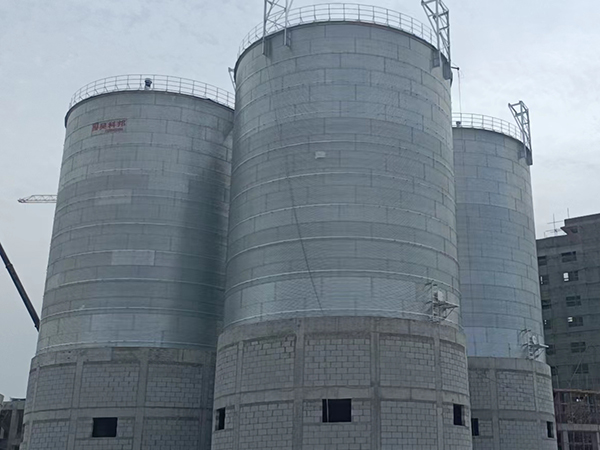
Maize Silo
7. A Maize Silo Needs Temperature Monitoring
A large grain mass can hide a problem for quite some time.
That is why a maize silo temperature monitoring system is not just an optional display panel for a large commercial project.
Temperature sensors provide an early indication that something inside the grain mass may have changed.
The most useful information is often not a single temperature value, but the trend.
For example:
- The entire silo remains stable — normal.
- One area slowly becomes warmer — investigate.
- Several sensors rise together — check the overall storage condition.
- A rapid increase appears in one location — take action quickly.
A temperature monitoring system does not tell you exactly what caused the problem.
But it can tell you where to start looking.
That is extremely valuable when thousands of tons of maize are involved.
8. Aeration Is for Management, Not for Fixing Badly Dried Maize
This point is worth making very clearly.
Some customers assume that if the maize is too wet, stronger aeration will solve the problem.
It does not work that way.
A maize silo aeration system is mainly used to manage grain temperature and maintain more uniform storage conditions. It is not a substitute for proper drying.
The normal sequence is closer to:
Harvest → Cleaning → Drying → Cooling → Silo Storage → Aeration and Monitoring
not:
Harvest → Silo → Use the fan to dry everything later
The fan, duct arrangement and airflow path need to be designed according to the silo and grain characteristics.
For a large silo, simply choosing a powerful fan does not guarantee good airflow through the entire grain mass.
9. Look for Hot Spots Before They Become a Serious Problem
In practical grain storage, a small temperature rise deserves attention.
Suppose most of the maize in a silo remains stable, but one temperature sensor starts moving upward over several readings.
I would not wait for visible mold.
The operator should check possible causes such as:
- Localized moisture
- Insect activity
- Poor airflow
- Grain compaction
- Moisture migration
- Local grain deterioration
This is one of the reasons a storage system should be monitored continuously rather than inspected only when the silo is being emptied.
10. Insects Can Start a Chain Reaction
Insect activity is not only a pest-control problem.
Insects damage kernels.
They also produce heat as their activity increases.
That heat can contribute to a local hot spot. Once a hot and damp area develops, the storage condition may deteriorate further.
So pest management has a direct connection with grain quality.
Before loading maize, the silo and associated handling equipment should be cleaned and inspected. During storage, operators should remain alert to signs of insect activity.
Any pesticide or fumigation treatment should be carried out by trained personnel under the applicable local rules and product instructions.
The important thing is not to wait until the infestation is obvious.
11. Keep Old Grain and Dust Out of the New Storage Cycle
A silo may be structurally sound and still have poor storage hygiene.
Residual grain can remain around:
- Bottom discharge areas
- Aeration channels
- Conveyors
- Elevator boot sections
- Transfer points
- Internal corners
- Roof structures
When new maize enters the system, these residues can become a source of insects, mold or contamination.
This is why cleaning between storage cycles is worth the effort.
Large commercial grain facilities often look clean from the outside while dust and old grain are accumulating around the handling equipment.
Those hidden areas deserve attention too.
12. Water Leaks Are an Obvious Risk — Condensation Is Less Obvious
When discussing moisture control, most people immediately think about rain entering through the roof.
That is certainly a problem.
But condensation can be harder to notice.
A temperature difference between the air, steel silo surfaces and grain can create condensation under certain conditions. When moisture condenses, a small local wet area may be enough to create a storage problem.
This becomes especially relevant in regions with:
- High humidity
- High daytime temperature
- Cool nights
- Seasonal rain
- Large temperature changes
For maize storage in tropical and humid areas, the silo roof, ventilation arrangement, aeration design and drainage around the facility should therefore all be considered together.
13. Do Not Treat the Silo as a “Drying Machine”
I often explain this to customers when discussing maize silo storage.
A silo is a storage unit.
A grain dryer is a drying machine.
The two pieces of equipment have different jobs.
| Equipment | Main purpose |
|---|---|
| Grain cleaner | Remove fines, dust and foreign material |
| Maize grain dryer | Reduce grain moisture |
| Cooler / cooling stage | Reduce grain temperature after drying |
| Maize silo | Protect and store prepared grain |
| Aeration system | Manage temperature and storage conditions |
| Temperature monitoring | Detect abnormal changes |
| Conveyor system | Move grain between processes |
A reliable maize storage project connects these functions instead of expecting one machine to do everything.

maize silo storage
14. What About Maize That Already Shows Mold?
This is where operators need to be particularly careful.
If there is visible mold, strong unusual odor, obvious heating or other signs of deterioration, do not assume that ordinary aeration or additional drying automatically makes the grain safe.
Aflatoxin is a food and feed safety issue, not just a grain appearance problem.
Suspicious lots may require sampling and laboratory testing, followed by a decision based on the test results and the regulations applicable to the intended use of the maize.
The correct response depends on the severity and distribution of the contamination.
In other words:
Prevention is mainly an engineering and management problem. Confirmed contamination becomes a quality and food-safety decision.
That distinction is important.
15. Maize Storage in Hot and Humid Regions Needs More Attention
Many of the maize storage projects we discuss are located in warm climates.
In these areas, the storage strategy needs to account for the environment outside the silo as well as the grain inside it.
A customer in a dry inland region may have very different storage conditions from a customer in a humid tropical area.
For a warm and humid maize storage project, I would pay particular attention to:
| Issue | Why it matters |
|---|---|
| Harvest moisture | Wet maize needs careful drying |
| Drying capacity | Prevents wet grain from waiting too long |
| Cooling | Helps stabilize grain after drying |
| Aeration | Controls grain temperature |
| Roof design | Reduces risk of rainwater entry |
| Drainage | Prevents water accumulation around the silo |
| Temperature monitoring | Helps identify hot spots |
| Storage duration | Longer storage requires better control |
| Inspection frequency | Changes faster under difficult conditions |
This is where the design of the overall system becomes more important than any single machine.
16. A Simple Aflatoxin Prevention Routine for Maize Storage
For operators who want a practical routine rather than a theoretical explanation, I would organize the work in five stages.
Before Storage
Check the incoming maize.
Measure moisture.
Remove excessive fines and damaged material.
Make sure the silo is clean and dry.
During Drying
Use the dryer according to the actual moisture condition of the maize.
Do not judge drying quality from surface appearance alone.
Check the grain after drying.
Before Loading
Confirm that the grain has been cooled to a suitable storage condition.
Check the silo, roof, discharge equipment and aeration system.
During Storage
Read temperature data regularly.
Watch for changes instead of waiting for an obvious failure.
Check insect activity.
Inspect the storage system for leakage and abnormal conditions.
When Something Changes
Do not ignore a hot spot.
Do not ignore unusual odor.
Do not ignore sudden moisture changes.
Investigate first, then decide whether aeration, grain movement, separation, sampling or other action is required.
17. The Most Common Aflatoxin Prevention Mistakes
Looking at the problem from the engineering side, the same mistakes tend to appear repeatedly.
| Common mistake | Why it causes trouble |
|---|---|
| Loading wet maize into the silo | Creates an unstable storage environment |
| Relying on one moisture reading | Grain condition may not be uniform |
| Ignoring cooling after drying | Hot grain can create temperature differences |
| No temperature monitoring | Hot spots may remain unnoticed |
| Using aeration as a substitute for drying | Aeration cannot replace proper grain drying |
| Poor silo cleaning | Old grain and dust can support insects and mold |
| Ignoring damaged kernels | Damaged grain can deteriorate faster |
| Inspecting only when unloading | Problems may have existed for weeks |
| Ignoring roof leakage | Water creates local wet areas |
| Treating every maize storage project the same | Climate, soil, grain and operating conditions differ |
The last point is important.
There is no single storage procedure that fits every customer.
18. How We Look at Aflatoxin Prevention When Designing a Maize Storage Project
When a customer asks us for a maize silo quotation, we do not only look at the required tonnage.
A few additional questions can change the entire storage recommendation.
How wet is the maize when it arrives?
Will it be stored for one month or six months?
Is the harvest concentrated in one season?
Is the local climate hot and humid?
Will maize be dried immediately after harvest?
How will the grain be cooled?
How many tons per day need to pass through the dryer?
Will the same silo be emptied and refilled several times a year?
What type of grain monitoring is required?
These questions influence the relationship between the maize dryer, maize silo, aeration system and conveying equipment.
For example, a customer receiving wet maize during a short harvest season may need a stronger drying and handling arrangement than a customer buying already-dried maize throughout the year.
The silo capacity alone cannot tell us that.
19. The Real Goal Is Not Just “No Mold”
When customers say they want to prevent aflatoxin, the real goal is usually larger than that.
They want maize that remains acceptable during storage.
They want less grain loss.
They want fewer problems during milling or feed production.
They want predictable grain quality when the maize leaves the silo.
That means the storage system needs to control the conditions that influence deterioration.
A good system should make it possible to answer these questions at any time:
How wet is the maize?
How warm is the grain?
Where is the temperature changing?
Is the airflow working as expected?
Has insect activity increased?
Has anything entered the silo that should not be there?
Once operators can answer these questions, storage management becomes much more practical.
Conclusion
Aflatoxin prevention in stored maize starts long before the grain reaches the silo.
The most reliable approach is to control the whole process:
good harvesting → clean grain → proper drying → cooling → suitable maize silo storage → controlled aeration → temperature monitoring → regular inspection
No single machine can replace the others.
The grain dryer cannot replace the silo.
The silo cannot replace the dryer.
The aeration fan cannot correct badly dried maize.
And a temperature monitoring system cannot protect grain if nobody responds when the readings begin to change.
For customers building maize storage facilities, especially in hot or humid regions, the better approach is to design the storage, drying, cooling and monitoring system together.
From our engineering experience, that is what makes the difference between simply having a place to store maize and having a storage system that can keep maize in stable condition for the intended storage period.
Good maize storage starts before loading and continues every day until the grain leaves the silo.