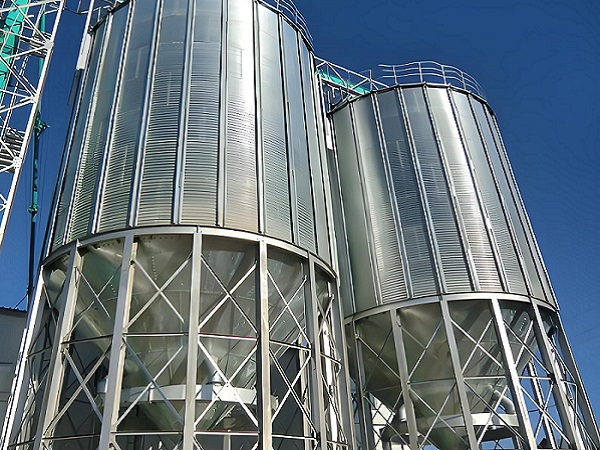
When designing a 1000-ton hopper-bottom grain silo, 45° and 60° are two frequently compared hopper-bottom angles. Customers are typically concerned with which angle allows for smoother unloading, which is more suitable for corn or rice, and whether using a 60° hopper-bottom will significantly increase silo costs.
These questions cannot be answered solely based on the type of grain. Even for silos of the same capacity, storing dry corn may require different hopper angles than storing whole rice. Grain moisture content, impurity levels, cone wall friction, outlet size, and unloading method all influence the final hopper angle selection.
When designing a hopper-bottom grain silo, COBAN considers the hopper-bottom angle in conjunction with the silo diameter, storage capacity, and the underlying conveyor system. A suitable hopper-bottom angle is not necessarily better the larger it is; rather, it should ensure stable grain unloading while avoiding unnecessary structural costs.
I. What are the differences between 45° and 60° hopper-bottom angles?
The hopper angle typically refers to the angle between the side wall of the hopper and the horizontal plane.
A 45-degree hopper hopper has a gentler cone wall slope, while a 60-degree hopper hopper has a steeper cone wall.

For conical buckets with the same top diameter and discharge port size, a vertical height of 60° is significantly greater than that of 45°. This structural difference not only affects unloading but also the amount of steel plate used, the height of the support legs, and the overall layout of the hopper.
| Comparison Projects | 45° Hopper | 60° Hopper |
|---|---|---|
| Cone wall slope: | Gentle | Steep |
| Cone vertical height: | Lower | Higher |
| Material slides along the wall surface | More sensitive to wall friction | Generally more advantageous |
| Cone steel plate area: | Relatively small | Relatively large |
| Manufacturing cost: | Generally lower | May increase |
| Applicable to: | Fluid materials with good flowability | Materials requiring strict control of stagnant material |
| Complete unloading capability: | Requires verification | Also requires verification |
It is important to emphasize that a 60° cone bottom does not necessarily result in a faster unloading speed than a 45° cone bottom. The actual discharge capacity is also limited by the outlet size, grain flowability, and the capacity of downstream conveying equipment.
II. What cone angle should be selected for different grains?
The flowability of grains is related to particle shape, surface roughness, moisture content, and impurities. COBAN can refer to the following angle range during the initial design phase, and then determine the final solution based on specific material conditions.
| Grain Types | Preliminary Reference Perspective | Main Design Considerations |
|---|---|---|
| Corn / Maize | 45°–60° | Crushed particles, moisture content, fine powder |
| Wheat | 45°–60° | Requirements for grain friction, impurities and air removal |
| Paddy Rice | 50°–60° | Rice husk roughness, straw impurities |
| Soybeans | 45°–60° | Liquidity, particle breakage |
| Barley | 50°–60° | Shelled grains, awns and impurities |
| Sorghum | 45°–60° | Fine powder ratio, outlet size |
1. Corn: Is 45°C enough?
 | Dry, clean whole corn kernels typically have good flowability. For a 1000 Ton Maize Hopper Bottom Silo, 45° can be considered a preliminary selection. If the corn undergoes multiple lifting and conveying processes, generating a large amount of broken particles and fine powder, the discharge conditions at the cone bottom need to be re-examined. |
Fine powder may accumulate locally at the bottom of the silo, increasing material adhesion and movement resistance. Even with a 60° conical bottom, bridging cannot be completely avoided when the outlet size is small or the material moisture content is high.
For standard dry corn silos, COBAN will first calculate the 45° option. If the customer requires frequent silo cleaning, low-residue unloading, or if the corn contains a large amount of broken particles, a 55° or 60° option will be further evaluated.
2. Wheat: Why doesn’t it necessarily need to be 60°?
 | Clean, dry wheat typically exhibits good grain flowability. For Wheat Hopper Bottom Silo, 45° can be considered a reasonable starting point for initial design. However, unloading performance will vary depending on wheat variety, moisture content, and impurities. |
If a 45° cone hopper already meets the requirements, using a 60° hopper might only increase the cone height and structural cost.
For grain silos that require frequent batch switching of wheat, it is also crucial to check for any residual dead corners at the bottom of the silo. In this case, the treatment of the outlet structure and the connection points to the inner wall may be just as important as the cone bottom angle.
3. Rice: Why is a steeper cone base often considered?
 | Paddy rice retains its husk on the surface and its grains are typically longer and thinner than wheat grains, with a relatively rougher surface. Under certain conditions, significant friction and mutual obstruction can occur between rice grains, especially when they contain straw and broken husks. |
Therefore, in its initial design for the Paddy Rice Hopper Silo, COBAN will focus on comparing 55° and 60° conical bottoms.
However, not all rice silos need to use a 60° bottom. Different rice varieties, moisture content, and cleaning processes will alter the actual flow patterns. For a 1000-ton rice silo, a comprehensive design considering the discharge port size, unloading frequency, and silo structure is also necessary.
4. Soybeans: Both flowability and kernel integrity must be considered
 | Soybean kernels are nearly spherical and tend to flow easily when dry and cleaned. Therefore, a 45° conical bottom can be a preliminary choice for the Soybean Hopper Bottom Silo. However, the design of the soybean silo should not only consider smooth unloading but also kernel breakage. |
If the outlet is too small, or if the conveying equipment below restricts the flow rate, high local pressure may form at the bottom of the cone. For seed soybeans, the discharge drop, impact, and mechanical damage during conveying should also be controlled.
Therefore, when choosing between 45° and 60°, both discharge stability and grain protection should be considered, rather than simply assuming that a larger slope is always better.
III. 1000-ton Hopper Bottom Grain Silo: How Much Structural Difference Does a 45° vs. 60° Height Create?
Taking a 1000-ton Hopper Bottom Grain Silo as an example, assuming the top diameter of the hopper is 10m and the outlet diameter is 0.5m.
The hopper height can be calculated using the following formula:

Where H is the vertical height of the cone, D is the diameter of the top opening, d is the diameter of the discharge port, and θ is the angle between the cone wall and the horizontal plane.
| Structural parameters | 45°conical bottom | 60°conical bottom |
|---|---|---|
| Target storage capacity: | 1000 tons | 1000 tons |
| Assumed top diameter: | 10m | 10m |
| Discharge outlet diameter: | 0.5m | 0.5m |
| Vertical height of the conical hopper: | 4.75m | 8.23m |
| Height increase relative to 45°: | — | 3.48m |
With the top and bottom diameters remaining constant, a 60° cone hopper is approximately 3.48m higher than a 45° cone hopper.
This means that in a 1000-ton grain silo, changes in the cone angle can significantly impact the lower support structure, the overall silo height, the unfolded area of the steel plates, and the on-site installation space.
Furthermore, the 60° cone hopper has a larger internal volume. If both designs are to meet the actual storage capacity of 1000 tons, the height of the cylindrical section needs to be recalculated; simply installing both cone hoppers under identical cylinders is insufficient.
Special Note: 1000 tons refers to the grain storage mass, not a fixed silo diameter. The 10m diameter mentioned above is only used to illustrate the impact of the cone angle on structural dimensions. Actual design needs to be determined based on grain bulk density, effective volume, silo dimensions, and structural loads.
IV. Besides grain type, what other factors determine the Hopper Angle?
1. Grain Moisture Content
Grains with higher moisture content may exhibit greater inter-particle adhesion, especially with higher concentrations of fine powder and impurities.
If the material has already shown significant clumping, increasing the cone bottom angle may not necessarily solve the blockage problem. In this case, priority should be given to determining whether the grain is suitable for direct storage and whether cleaning or drying is necessary.
2. Hopper Wall Friction
Hopper wall friction is a crucial factor affecting grain movement along the cone wall.
Even with the same 60° cone bottom, different steel plate surface conditions, connection methods, and internal wall protrusions can all alter material flow.
In its cone hopper design, COBAN considers the steel plate splicing positions, connectors, and outlet transition structures to minimize the formation of significant steps that obstruct material flow.
3. Outlet Size
The Hopper Outlet Size must be designed in conjunction with the cone angle.
If the outlet is too small, the grain may form a stable arch above the outlet, causing discharge interruption.
It’s important to note that particle bridging is related to material cohesion, particle size, outlet shape, and internal stress within the silo. Simply changing the angle from 45° to 60° cannot solve all clogging problems.
4. Discharge Method and Flow Rate
When using gravity discharge in a grain silo, the cone hopper guides the grain to the lower outlet.
However, the actual discharge capacity of the entire system is also limited by equipment such as gates, screw conveyors, and belt conveyors.
For example, a 30T/H conveyor system below a 1000-ton grain silo will not automatically increase the conveyor’s capacity to 50T/H by changing the cone hopper angle.
5. Silo Diameter and Support Structure
For a 1000-ton Hopper Bottom Steel Silo, the cone hopper is already a relatively large load-bearing structure.
Increasing the cone hopper angle will affect the cone plate geometry, load transfer path, and leg arrangement. Engineers need to recalculate the cone plate, reinforcing components, support nodes, and foundation, rather than simply adjusting the steel plate angle.
V. Does a 60° cone bottom always guarantee complete unloading?
Not necessarily.
In grain storage equipment, the two most common unloading flow patterns are Funnel Flow and Mass Flow.

A 60° cone is steeper and may facilitate overall flow, but its angle alone cannot determine whether it qualifies as a Mass Flow Hopper.
If customers have high requirements for first-in-first-out (FIFO), low residue, and frequent hopper changes, a specialized design should be developed, incorporating material flowability testing, wall friction, and outlet dimensions.
VI. How does COBAN select the angle for a 1000-ton Hopper Bottom Silo?
When designing a 1000-ton Hopper Bottom Silo, COBAN first considers the actual state of the grain before determining the hopper structure.
For example, if a customer plans to build a 1000-ton corn silo to store cleaned and dried whole corn kernels, with regular unloading via a bottom conveyor, engineers can first assess a 45° hopper bottom and calculate the outlet size and conveyor capacity.
If a customer plans to build a 1000-ton rice silo to store hulled rice and requires frequent emptying and batch switching, further comparison of the actual unloading conditions for 55° and 60° hopper bottoms is necessary.
For silos shared by multiple grains, the design must also consider the expected material with the worst flowability to avoid situations where unloading is normal for one grain but stagnation occurs when switching to other grains.
COBAN can design the hopper bottom, outlet, gate, and subsequent conveyor equipment as a complete system, ensuring the bottom unloading capacity matches the entire grain processing flow.
VII. Frequently Asked Questions about Grain Silo Hopper Angles
Is a 45° conical bottom suitable for a 1000-ton corn silo?
It can be used as a preliminary selection option. For dry, clean, and free-flowing corn, 45° offers some structural economics. However, the final calculation should consider the outlet size, material condition, and unloading requirements.
Is a 1000-ton rice silo necessarily equipped with a 60° angle?
Not necessarily. 60° can be considered as a solution requiring thorough evaluation, but its adoption depends on the rice variety, moisture content, impurities, wall friction, and discharge requirements.
Will changing the 45° conical bottom to 60° increase the storage capacity?
If the top diameter, outlet diameter, and cylinder height remain unchanged, the internal geometric volume of the 60° conical hopper will increase. However, for projects with a fixed design capacity of 1000 tons, the silo dimensions should be readjusted; the increased conical hopper volume should not be directly considered as additional effective storage capacity.
Does a larger conical bottom angle result in a faster unloading speed?
Not necessarily. A larger angle may improve material movement along the wall, but the actual unloading speed also depends on the outlet size, grain flowability, and the processing capacity of downstream equipment.
Conclusion
When choosing a Hopper Bottom Silo Angle, it’s not simply a matter of 45° being cheaper and 60° being better.
For dry corn, wheat, and soybeans with good flowability, a 45° option can be used as a starting point for evaluation. For hulled rice, barley, and grain silos with high requirements for unloading residue, the 55° and 60° options should be compared more closely.
Especially for 1000-tonnage cone-bottom grain silos, changes in angle will significantly affect the cone height, steel plate usage, and support structure. COBAN, during the design phase, considers grain characteristics, silo dimensions, and actual unloading requirements to determine the cone bottom angle, achieving a balance between stable unloading and reasonable cost.