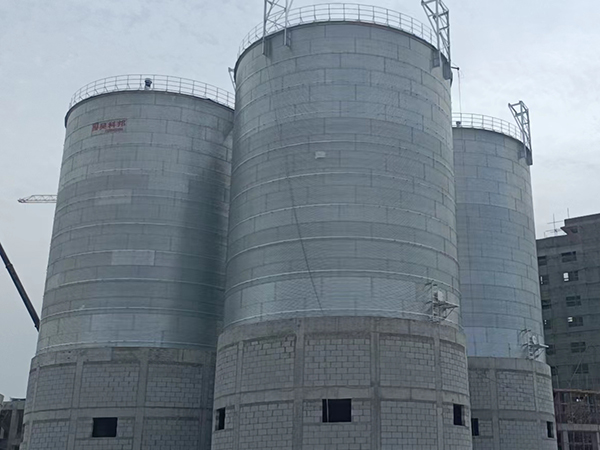
A 1,000-ton grain storage facility may look simple from outside: a steel silo standing on a concrete foundation with a few conveyors around it. In practice, however, building a reliable 1,000-ton grain storage facility requires much more than selecting a silo with a nominal capacity of 1,000 tons.
The silo must match the grain, the site, the foundation, the conveying system, the storage conditions and the customer’s daily operating requirements.
From an engineering point of view, we normally start with one question:
What will happen to the grain from the moment the truck arrives until the grain is finally removed from storage?
Once this grain flow is clear, the 1,000-ton silo and supporting equipment can be designed around it.
What Does a 1,000-Ton Grain Storage Facility Need to Handle?
The first mistake in many small storage projects is to look only at the storage capacity.
A 1,000-ton facility may be used for very different purposes.
A grain trader may receive dry maize, store it for several months and sell it later. A farm may need to store its own harvest. A feed mill may use the silo as a raw-material buffer and require frequent discharge. A rice mill may need separate storage for different batches of paddy.
These applications can use the same nominal storage capacity but require different equipment.
Before designing the silo, we normally establish:
- Grain type
- Incoming moisture
- Expected storage period
- Daily receiving quantity
- Required unloading rate
- Whether grain requires cleaning
- Whether drying is necessary
- Available site area
- Local wind and environmental conditions
- Future expansion plans
This information has a direct effect on the final design.
How Much Grain Can a 1,000-Ton Silo Actually Hold?
“1,000 tons” describes the grain mass, not the physical volume of the silo.
Different grains occupy different volumes because their bulk densities are different.
For preliminary planning, the relationship is:
Silo volume = Grain weight ÷ Bulk density
For example, if maize has a design bulk density of 0.72 t/m³:
1,000 ÷ 0.72 ≈ 1,389 m³
Paddy generally requires considerably more volume because its bulk density is lower.
| Grain | Typical planning density | Approx. volume for 1,000 t |
|---|---|---|
| Wheat | 0.75–0.80 t/m³ | 1,250–1,333 m³ |
| Maize | 0.70–0.75 t/m³ | 1,333–1,429 m³ |
| Paddy | 0.55–0.65 t/m³ | 1,538–1,818 m³ |
| Soybean | 0.70–0.75 t/m³ | 1,333–1,429 m³ |
These are planning figures rather than final structural dimensions. The final silo volume must be established from the actual grain characteristics and design filling level.
This is also why a customer should not compare two 1,000-ton grain silos by diameter alone.

Should a 1,000-Ton Project Use One Silo or Several Smaller Silos?
There is no universal answer.
A single silo provides a straightforward storage arrangement. Dividing the same total capacity into several silos gives the operator greater control over different batches.
For example:
| Arrangement | Total capacity | Typical reason |
|---|---|---|
| 1 × 1,000 t | 1,000 t | Simple bulk storage |
| 2 × 500 t | 1,000 t | Separate batches or grain grades |
| 4 × 250 t | 1,000 t | Greater flexibility for smaller lots |
Suppose a grain depot buys maize from different suppliers throughout the harvest season. Keeping everything in one silo may make batch management difficult.
On the other hand, if the facility handles a large, uniform quantity of the same grain, one larger silo can simplify the layout.
The correct question is therefore not “Which arrangement is cheapest?”, but “How will the grain actually be managed after it enters the facility?”
Flat-Bottom or Hopper-Bottom for 1,000 Tons?
This decision is closely related to the intended use of the grain.
A flat-bottom grain silo is commonly considered for larger-volume and longer-term storage. It uses a larger floor area and requires a mechanical unloading arrangement to remove grain remaining around the floor.
A hopper-bottom silo allows grain to flow downward through the hopper, making discharge and cleaning easier. However, the elevated support structure adds to the structural and civil requirements.
| Consideration | Flat-bottom | Hopper-bottom |
|---|---|---|
| Long-term storage | Suitable | Possible |
| Large storage volume | Very suitable | Less common |
| Gravity discharge | Limited | Strong advantage |
| Floor area | Larger | Smaller |
| Structural support | Ground-supported | Elevated structure |
| Complete unloading | Sweep system normally required | Easier |
For a commercial 1,000-ton grain storage facility, flat-bottom construction is often considered where the main objective is economical bulk storage.
But the final choice should follow the operating requirement rather than the capacity number alone.
Designing the Grain Flow Before Buying Equipment
This is where a storage project becomes an engineering project rather than simply a silo purchase.
A basic dry-grain operation might use:
Truck → Receiving Hopper → Cleaner → Elevator → Silo
The discharge side may be:
Silo → Bottom Outlet → Conveyor → Elevator → Truck
If the incoming grain is too wet for safe storage, the process changes:
Truck → Receiving → Pre-cleaning → Dryer → Cooling → Silo
The dryer should not be added simply because the project is called a “complete grain system.” Its inclusion depends on the actual moisture condition of the incoming grain.
The same principle applies to cleaning equipment.
If the harvested grain contains large amounts of straw, husk, dust and foreign material, pre-cleaning becomes important before the grain enters the storage section.
How Should the Receiving Capacity Be Selected?
A 1,000-ton silo does not mean that the receiving system needs a capacity of 1,000 tons per hour.
The handling capacity should be related to the customer’s harvesting and delivery pattern.
For example, imagine a facility receiving 200 tons of grain during a busy working day. If trucks arrive continuously for several hours, the receiving system needs enough capacity to keep the unloading process moving without creating a long queue.
This is why we normally ask customers:
- How many trucks arrive per day?
- What is the approximate truck capacity?
- How many hours per day will the facility operate?
- Is receiving seasonal or continuous?
- Will the silo be filled in one day or over several days?
The answers determine the appropriate grain conveyor capacity, bucket elevator capacity and receiving hopper size.
What Equipment Is Normally Connected to a 1,000-Ton Silo?
A practical system may contain the following:
| Equipment | Engineering purpose |
|---|---|
| Receiving hopper | Temporary receiving and feeding |
| Pre-cleaner | Removes large impurities before further handling |
| Bucket elevator | Vertical grain transportation |
| Belt conveyor | Horizontal transportation over longer distances |
| Screw conveyor | Controlled transfer or discharge |
| Grain cleaner | Removes finer impurities |
| Aeration fan | Helps manage grain temperature |
| Temperature system | Monitors conditions inside the grain mass |
| Sweep auger | Removes residual grain from a flat-bottom silo |
| Dust collector | Controls dust at selected transfer points |
| Electrical control panel | Controls equipment operation and protection |
Not every project requires all of these machines.
A common engineering mistake is to select equipment individually without checking whether the capacities match.
For example, if the bucket elevator can handle significantly more grain than the receiving conveyor, the elevator will spend much of its capacity waiting for grain. If the downstream conveyor is smaller than the elevator, it can become the actual bottleneck.
The machines should therefore be selected as one connected system.
The Foundation Comes Before the Silo
Once the silo size and structural design are established, the civil engineer can determine the foundation requirements.
A filled 1,000-ton silo places a very different load on the ground from an empty steel structure.
Foundation design needs to consider:
- Filled grain load
- Silo self-weight
- Roof and accessory loads
- Wind forces
- Local seismic requirements where applicable
- Soil bearing capacity
- Groundwater
- Anchor-bolt arrangement
- Local construction standards
The foundation should not be built from a generic drawing and adjusted later to suit the silo.
The preferred sequence is:
Silo structural data → Foundation load calculation → Civil design → Construction → Silo installation
Soil conditions are particularly important. Two sites can use identical 1,000-ton silos but require different foundation solutions because their ground conditions are not the same.
What Should Be Considered When Choosing the Silo Location?
The silo should not simply be placed wherever there is enough empty land.
The position should make the complete grain route as direct as practical.
Consider the relationship between:
- Truck entrance
- Receiving pit
- Cleaner
- Elevator
- Silo
- Dryer
- Discharge conveyor
- Finished-grain loading area
- Electrical room
- Maintenance access
A poorly arranged site can force grain to travel unnecessary distances, increasing conveyor length and the number of transfer points.
A well-planned layout can reduce structural work, equipment quantity and maintenance difficulty.
For customers planning additional storage later, the first phase should also leave suitable space for future silos.
How Is a 1,000-Ton Grain Silo Installed?
Once the foundation is ready, silo erection can begin.
For a galvanized steel silo, the installation team generally works from the lower structure upward.
The main work includes:
- Checking the foundation and anchor positions.
- Positioning the bottom components.
- Installing the first wall ring.
- Building the silo wall upward.
- Installing stiffeners and structural components.
- Installing the roof structure.
- Fitting roof sheets and ventilation components.
- Installing ladders, platforms and safety accessories.
- Connecting aeration equipment.
- Installing temperature cables and sensors.
- Connecting the unloading system.
The installation team must continuously check alignment during erection.
A small dimensional error near the bottom can become much more significant as the silo wall rises. This is why experienced installation work is not simply a matter of tightening bolts; alignment and structural checks are required throughout the assembly.

1000 Ton Grain Storage Silo Installed
Why Aeration Matters in a 1,000-Ton Grain Storage Facility
Putting grain into a silo is only the beginning of storage.
The grain remains a living biological material. Moisture migration, temperature changes and local hot spots can affect storage quality.
An aeration system allows controlled air movement through the grain mass.
The required airflow depends on:
- Grain type
- Grain moisture
- Storage temperature
- Local climate
- Storage duration
- Silo geometry
The fan should therefore be selected according to the actual storage conditions.
Temperature monitoring provides another layer of control. Instead of waiting until a problem becomes visible at the surface, the operator can monitor temperature at different points inside the stored grain.
For a facility intended for long-term storage, these systems should be treated as part of the storage design rather than optional accessories.
What Happens If the Grain Is Too Wet?
This question is especially important for maize and paddy storage projects.
A steel silo does not solve a moisture problem.
If grain arrives above the moisture level suitable for the intended storage period, the correct approach may be to clean and dry it before placing it into long-term storage.
A typical process is:
Wet Grain → Receiving → Cleaning → Drying → Cooling → Storage
The required dryer capacity depends on the amount of grain received and the amount of moisture that must be removed.
For example, a facility receiving harvested maize immediately after harvest may require a completely different process from a grain trader purchasing already-dried maize.
Therefore, when a customer says, “I need a 1,000-ton grain storage facility,” we also need to know whether the grain arrives dry or wet.
How Much Does a 1,000-Ton Grain Storage Facility Cost?
There is no meaningful single price for a complete 1,000-ton grain storage facility without defining the project scope.
The investment can include:
Silo + foundation + conveying equipment + cleaning + drying + aeration + temperature monitoring + electrical system + installation + transportation
A simple storage silo for already-clean and dry grain will have a very different project cost from a complete grain handling system with receiving, cleaning, drying and automatic transfer.
For this reason, a quotation for a 1,000-ton grain silo should clearly identify what is included.
When comparing suppliers, customers should check whether the quoted price includes:
- Silo body
- Roof
- Stiffeners
- Aeration floor
- Fan
- Temperature monitoring
- Discharge equipment
- Conveyors
- Elevator
- Cleaner
- Electrical controls
- Installation
- Foundation drawings
- Shipping
Comparing only the headline equipment price can produce a misleading result if two quotations have different scopes.
What Are the Most Common Engineering Problems?
From an installation perspective, several problems can usually be traced back to planning rather than the silo itself.
The foundation does not match the silo
Anchor positions, foundation diameter or elevation may not correspond to the final structural drawings.
Conveyors were selected independently
Different machines have different capacities, creating a bottleneck somewhere in the grain flow.
There is not enough maintenance space
Equipment may work correctly but become difficult to inspect, repair or replace.
The dryer was selected only by tonnage
Dryer capacity must also consider initial moisture, final moisture and operating hours.
No provision was made for future expansion
The first silo works, but adding a second silo later requires major changes to the conveying system.
Aeration was treated as an afterthought
The storage structure may be correct while the grain-conditioning system is inadequate for the intended storage conditions.
These problems are much easier to prevent during engineering than to correct after construction.
A Practical Example: Planning a 1,000-Ton Maize Storage Project
Suppose a customer wants to store approximately 1,000 tons of maize.
The project discussion might develop as follows:
Requirement: 1,000-ton maize storage
Incoming condition: Harvested maize with elevated moisture
Process: Receiving → cleaning → drying → cooling → storage
Storage: 1 × 1,000-ton galvanized steel silo
Monitoring: Temperature monitoring inside the silo
Storage protection: Aeration system
Discharge: Bottom unloading with mechanical grain transfer
Final destination: Truck loading or feed mill
This is already a much more useful engineering description than simply saying “1,000-ton silo.”
The equipment can now be sized around the actual maize flow.
What Should the Customer Prepare Before Requesting a Quotation?
A supplier can prepare a much more accurate proposal when the following information is available:
| Information | Example |
|---|---|
| Grain | Maize |
| Required capacity | 1,000 tons |
| Number of silos | 1 |
| Incoming moisture | Customer’s actual value |
| Required final moisture | Customer’s target |
| Storage period | Short/long term |
| Receiving volume | Tons/day |
| Required transfer rate | Tons/hour |
| Site location | Country and project site |
| Available space | Approximate dimensions |
| Drying required | Yes/No |
| Future expansion | Yes/No |
A site layout or simple land drawing is also useful.
The more accurately the operating conditions are described, the less likely the final design will need major changes after ordering.
From an Engineer’s Perspective, What Makes a 1,000-Ton Facility Work Well?
The quality of a grain storage project is not determined by the silo diameter or the thickness of the steel sheet alone.
A successful facility has several parts working together:
Correct storage volume
The silo must actually provide the required usable capacity for the selected grain.
Balanced grain handling
Receiving, conveying and discharge capacities need to work together.
Suitable civil engineering
The foundation must correspond to the structural and site conditions.
Controlled storage conditions
Aeration and temperature monitoring should match the grain and storage period.
Practical layout
Operators should be able to receive, store, inspect and discharge grain without unnecessary movement.
Maintainability
Motors, conveyors, sensors, fans and other components need reasonable access for inspection and maintenance.
Future planning
The layout should not prevent the customer from adding storage later.
Final Consideration Before Building a 1,000-Ton Grain Storage Facility
A 1,000-ton grain storage facility should be designed from the inside out: start with the grain and its movement, then determine the equipment and finally build the storage structure around that process.
The correct engineering sequence is generally:
Grain requirement → Storage capacity → Silo configuration → Grain flow → Equipment sizing → Site layout → Foundation → Installation → Commissioning
This approach prevents a common mistake: buying a 1,000-ton silo first and trying to determine afterward how the rest of the facility will work.
At COBAN, our engineering work starts with the customer’s grain, operating conditions and site rather than with a standard silo quotation. Once these conditions are clear, we can develop the silo dimensions, conveying arrangement, aeration system, unloading method and related equipment into one workable 1,000-ton grain storage solution.
The objective is not simply to build a silo that can hold 1,000 tons.
It is to build a facility in which 1,000 tons of grain can be received, stored, monitored and discharged as part of a practical daily operation.
Frequently Asked Questions About a 1,000-Ton Grain Storage Facility
1. How Much Does a 1,000-Ton Grain Silo Cost?
There is no fixed price for a 1,000-ton grain silo because the final cost depends on the silo design and the equipment connected to it. The grain type, silo diameter and height, steel specification, aeration system, unloading method and accessories all affect the quotation.
If the project includes conveyors, bucket elevators, grain cleaning, temperature monitoring, drying and electrical controls, the investment will be higher than the price of the silo alone.
For an accurate 1,000-ton grain silo price, the manufacturer should know the grain type, project location, required handling capacity and the equipment you want included.
2. What Are the Dimensions of a 1,000-Ton Grain Silo?
There is no universal diameter and height for a 1,000-ton grain silo. The dimensions are calculated according to the grain’s bulk density, required storage volume and structural design.
For example, 1,000 tons of paddy occupies more space than 1,000 tons of wheat because paddy has a lower bulk density. The available land, silo type and local wind or seismic conditions can also influence the final dimensions.
Therefore, a 1,000-ton grain silo dimension should be confirmed after the grain type and project conditions have been established.
3. How Much Land Is Needed for a 1,000-Ton Grain Storage Facility?
The land requirement is larger than the footprint of the silo itself. A complete facility also needs space for truck access, grain receiving, conveyors, bucket elevators, cleaning equipment, electrical equipment and routine maintenance.
If a dryer is included, additional space is required for the dryer and hot-air system. Customers planning to increase storage capacity later should also reserve space for additional silos and conveying equipment.
The best site layout keeps the grain flow as direct as possible while leaving sufficient access for operation and maintenance.
4. What Equipment Is Needed for a 1,000-Ton Grain Storage Facility?
A basic 1,000-ton grain storage system normally includes the silo, grain receiving equipment, conveying equipment, an unloading system, aeration and temperature monitoring.
Depending on the grain condition, the facility may also require a pre-cleaner, grain cleaner, dryer, dust collector and electrical control system.
The equipment should be selected according to the required grain flow rather than the storage capacity alone. Receiving capacity, conveying capacity and discharge capacity need to work together so that one machine does not become a bottleneck.
5. Do I Need a Grain Dryer With a 1,000-Ton Grain Silo?
Not every 1,000-ton grain storage project requires a dryer.
If the grain arrives at a moisture level suitable for the intended storage period, it can normally be cleaned and transferred into storage without an on-site drying process. If freshly harvested maize, paddy or other grain arrives with excessive moisture, drying may be necessary before long-term storage.
A typical wet-grain process is:
Receiving → Cleaning → Drying → Cooling → Silo Storage
The required dryer capacity should be calculated from the incoming grain quantity, initial moisture, target moisture and daily operating time.
6. How Long Does It Take to Build a 1,000-Ton Grain Storage Facility?
The project schedule depends on whether the customer needs only silo installation or a complete grain storage facility.
A complete project may involve engineering, foundation construction, silo manufacturing, equipment production, transportation, silo erection, conveyor installation, electrical work and commissioning.
The actual silo assembly can therefore represent only part of the total construction period. A project with a completed foundation and a simple storage configuration can move faster than a new facility requiring drying, cleaning, multiple conveyors and extensive civil work.
Before confirming a delivery schedule, the supplier should review the complete project scope and site conditions.