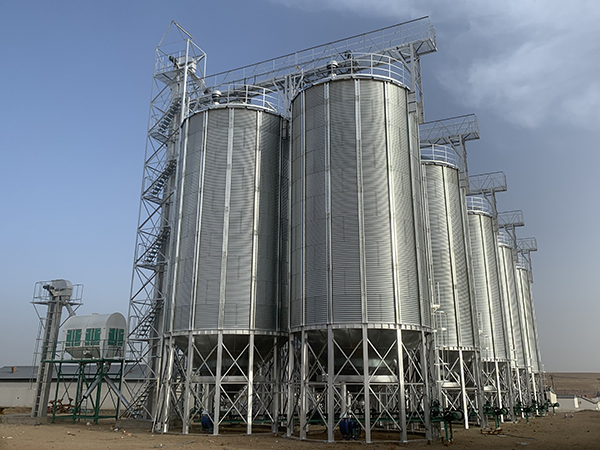
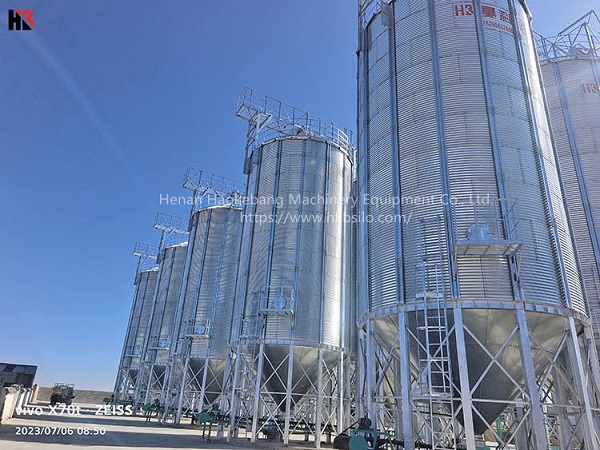
China is one of the world’s major producers and exporters of galvanized steel grain silos. For grain traders, farms, and grain processing companies in Africa, Southeast Asia, the Middle East, and South America, purchasing grain silos directly from China typically offers competitive equipment prices and flexible customization options.
However, buying a grain silo from China is not as simple as purchasing a piece of ordinary agricultural machinery.
A 5,000-ton capacity grain silo involves multiple aspects, including the silo structure, steel plate thickness, galvanization layer, windproof design, foundation engineering, conveying equipment, and on-site installation. Lack of clear technical details in the initial purchase contract often results in additional costs during equipment arrival, foundation construction, or installation.
Especially for customers importing grain silos for the first time, the real concern is not simply overpaying, but purchasing equipment that is incompatible with actual grain storage needs, the local environment, or site conditions.
Below, we will examine common technical and procurement issues in Chinese grain silo export projects and point out which mistakes should be avoided in advance.
1. The comparison only considers the price per ton of storage capacity, without comparing the actual supply range.
This is one of the most common misconceptions in international grain silo procurement.
Suppose you inquire with three Chinese suppliers about purchasing a 5,000-ton corn storage silo and receive the following quotes:
| Supplier | Equipment Quotation (Example) | Quotation Includes |
|---|---|---|
| A | US$85,000 | silo body, silo roof, and basic connecting parts |
| B | US$103,000 | Silo body, ventilation system, temperature measurement system, level gauge |
| C | US$125,000 | The silo body, ventilation, temperature measurement, and some inlet and outlet conveying equipment |
The amounts above are for illustrative purposes only and do not represent actual market prices.
If only the equipment cost is considered, A is clearly the cheapest. However, the client ultimately needs a usable grain storage system, not just steel plates and bolts.
For example, flat-bottomed silos typically also require consideration of bottom ventilation, cleaning equipment, discharge conveyors, and grain temperature monitoring systems. Whether these are included in the quote directly impacts the final project cost.

What should be done before purchasing?
Request quotes from each supplier using the same equipment list, listing at least the following:
- Silo body and roof structure, supporting columns, and fasteners.
- Ventilation fans, ventilation channels or ducts.
- Temperature measuring cables, material level monitoring equipment.
- Top-feeding equipment, bottom-discharge equipment.
- Cleaning machine, dust removal equipment, and necessary electrical control systems.
- Ocean shipping packaging, installation guidance, and on-site commissioning services.
For equipment not included, the supplier should be required to clearly indicate “Not Included.”
This is to determine the true differences between different quotes.
2. They only told the supplier they needed 5,000 tons of storage space, but didn’t specify what kind of grain they wanted to store.
For the same 5,000-ton storage capacity, the required silo volume differs for corn, wheat, rice, and soybeans.
The reason is simple: different grains have different bulk densities.
For example, using common design estimates:
| Grain Storage | Reference Bulk Density | Theoretical Volume Required to Store 5,000 Tons |
|---|---|---|
| wheat | 0.78 t/m³ | Approximately 6,410 m³ |
| corn/maize | 0.72 t/m³ | Approximately 6,944 m³ |
| soybeans | 0.75 t/m³ | Approximately 6,667 m³ |
| rice | 0.58 t/m³ | Approximately 8,621 m³ |
The bulk density is an example value; the actual value should be based on the grain variety, moisture content, and local testing data. The theoretical volume is not equal to the final designed silo capacity; the top stockpile, discharge margin, and available loading height must also be considered.
As can be seen, storing 5,000 tons of rice requires significantly more space than storing wheat.If a customer initially inquires about wheat but later plans to store rice, even if the silo itself has no quality issues, the expected tonnage may not be achieved.
Furthermore, the type of grain affects the silo wall pressure, discharge flowability, and ventilation system design; simply increasing the silo height cannot solve all capacity issues.
The correct approach: Specify the grain type, target tonnage, reference bulk density, moisture content upon entry, and whether different grains need to be rotated in the quotation document.
If the plan is to alternate between storing corn and soybeans in one silo, this should be determined during the structural design phase, rather than adjusting the purpose after equipment installation.
3. It is believed that the thicker the steel plate, the better the quality of the grain silo.
Overseas buyers frequently ask:
“What is the thickness of your steel plates? Another supplier’s are 0.5 mm thicker.”
While steel plate thickness is important, it cannot be used to judge the structural safety of the entire silo solely based on a single thickness figure.
Large galvanized steel silos do not use steel plates of uniform thickness from top to bottom.
Different heights of the silo walls bear different grain pressures, with the bottom walls typically bearing greater lateral pressure and structural loads. Therefore, engineers will configure silo wall panels, columns, and connectors with varying thicknesses based on the silo’s diameter, height, grain type, and design load.
What truly needs to be checked is the complete structural design, not just the single steel plate thickness provided by the salesperson.
When purchasing, it is recommended to request the following information from the supplier:
| Inspection Items | Key Verification Contents |
|---|---|
| Silo Wall Steel Plates | Thickness and Material of Different Silo Wall Layers |
| Reinforced Columns | Specifications, Quantity, and Layout |
| Silo Roof Structure | Roof Load, Support, and Connection Design |
| Connecting Bolts | Strength Grade, Anti-corrosion Treatment, and Quantity |
| Structural Calculations | Wind Load, Seismic Action, Grain Load, and Related Combinations |
It’s important to note that some quotes emphasize the thickness of the thickest bottom steel plate without informing the customer about the configuration of the other layers.
For example, a quote stating “Steel Thickness: 4.0 mm” doesn’t specify the actual steel plate configuration for the entire silo.
Requesting a silo wall thickness schedule from the supplier is more helpful than repeatedly asking about the maximum thickness.
4. The specifications of the galvanized layer were not verified; only the brightness of the steel plate surface was considered.
The corrosion resistance of galvanized steel silos largely depends on the zinc coating on the steel plate surface.
Common zinc coating specifications used by Chinese grain silo manufacturers include Z275, Z450, and Z600.
Here’s a detail that buyers often misunderstand:
Z275 does not refer to a zinc coating thickness of 275 micrometers, but rather to the nominal value of the total mass of the zinc coating on both sides of the steel plate, which is 275 g/m².
Z450 and Z600 use the same labeling method.
In humid, coastal, or corrosive industrial environments, the zinc coating specification is particularly important. However, it cannot be simply assumed that Z600 is suitable for all projects; the specific choice must be made based on the environmental corrosion level, design life, maintenance conditions, and cost.
It’s best to clarify three questions before purchasing:
- What are the specifications for the galvanized layer of the steel plate?
- Can the supplier provide material quality certificates for the corresponding batch?
- What anti-corrosion measures are used for cut edges, drilled holes, fasteners, and areas damaged on-site?
Furthermore, the corrosion resistance of the silo is not solely determined by the zinc coating. Aging of the sealing gaskets, leaks in the silo roof, and water accumulation at joints can also affect the silo’s service life.
5. Ignore wind loads and seismic conditions at the project site
Some customers believe that since a certain type of grain silo has already been exported to other countries, purchasing the same model will be fine.
This assumption is unreliable.
For example, a 2,000-ton grain silo installed in an inland, low-wind-speed area may have significantly different structural design requirements than a silo of the same capacity installed in a coastal typhoon-affected area, even if they appear identical in appearance and dimensions.
Especially when the silo is empty, the weight of the grain lacks the stabilizing effect, and the impact of wind loads on the silo, anchors, and foundation must be carefully calculated.
In seismic zones, the dynamic response of the silo and stored grain under seismic loads must also be considered.
When requesting a quote, do not only specify the country of the project. It is best to provide the specific city or installation location.
At the same time, require the supplier to clearly state the design codes used, basic wind speeds and their mean time intervals, ground roughness, and seismic design parameters. Wind speed definitions and code systems may differ between countries; one value cannot be directly copied to another set of codes.
For projects with mandatory local building codes or engineering approval requirements, the structural and foundation designs should be reviewed by engineers with local qualifications.
6. Civil construction should be arranged before the basic drawings are confirmed.
This is a costly mistake in grain silo projects that could be completely avoided beforehand.
Some clients, in an effort to shorten the construction period, have the construction team pour the concrete foundation during equipment manufacturing.
Only during the actual installation do they discover:
- The anchor bolt positions do not match the connection holes at the bottom of the silo.
- The dimensions of the foundation ring beam do not match the supplier’s drawings.
- The location of the silo bottom outlet conflicts with that of the underground conveyor.
- Insufficient space is provided for the ventilation duct or cleaning equipment.
These problems cannot usually be solved simply by drilling a few holes on site.
Especially for large, flat-bottomed grain silos, the foundation must not only bear the weight of the silo itself, but also the weight of the stored grain and the loads generated by wind, earthquakes, and other forces.
The bearing capacity of the foundation, settlement, and differential settlement are equally important.
The following work sequence is recommended:
- The supplier provides preliminary silo dimensions, foundation loads, and anchor bolt placement information.
- The local civil engineer completes the foundation design based on the geotechnical investigation report.
- Both parties verify the anchor bolts, discharge port, ventilation duct, and conveying equipment interfaces.
- After confirming the final construction drawings, foundation construction is arranged.
- Installation begins after the concrete reaches the specified strength and the embedded parts pass inspection.
Customers especially need to distinguish between two types of documents: the basic reference drawings provided by the supplier are not necessarily the same as the formal basic design drawings that can be directly constructed.
7. Whether to buy a flat-bottom or cone-bottom position depends solely on price.
When choosing between Flat Bottom Grain Silo and Hopper Bottom Grain Silo, the frequency of grain turnover, unloading method, and project scale should be considered first.
 Flat-bottomed grain silos Suitable for large-capacity, long-term or seasonal grain storage, they usually require supporting cleaning and bottom discharge equipment. |  Conical bottom grain silos Suitable for small to medium capacity, frequent discharge, and gravity unloading conditions, but the material flowability and cone design must be verified. |
For example, a feed mill that needs to prepare feed multiple times a day might prioritize the ease of discharge from a cone-bottom silo; while a grain trading company that centrally purchases large quantities of corn annually, stores it for several months, and then gradually sells it, typically needs to focus on evaluating large-capacity flat-bottom silos.
It’s also important to note that a cone-bottom silo does not mean that all materials can be discharged completely automatically. Material moisture content, powder ratio, cone angle, and outlet size can all affect discharge efficiency.
Purchasing Recommendation: Do not compare the prices of the two silo types in isolation; instead, consider the foundation, cleaning, conveying equipment, maintenance, and operating costs together.
8. The actual grain handling capacity for entering and leaving the warehouse was not confirmed in advance.
A 5,000-ton silo doesn’t necessarily mean it can quickly handle the loading and unloading of 5,000 tons of grain.
Assume the customer plans to receive 5,000 tons of corn within 48 hours.
Based on continuous operation, the theoretical average loading capacity should be at least:
5,000 ÷ 48 ≈ 104 tons/hour.
However, in actual projects, there are time constraints such as vehicle waiting, equipment changeover, cleaning, and downtime.
If calculated based on 20 effective operating hours per day for two consecutive days, the actual required average handling capacity increases to:
5,000 ÷ 40 = 125 tons/hour.
At this point, if the supplier only configures an 80-ton/hour elevator and conveyor, even if the silo itself fully meets the design requirements, the entire grain receiving system still cannot meet the customer’s time schedule.
The following should be confirmed before procurement:
- How many tons of grain are expected to be received daily?
- Will the grain arrive by truck, train, or port conveyor system?
- How many hours will it take to complete the silo loading process?
- Are multiple silos required for simultaneous feeding or discharging?
- What grain bulk density does the conveyor system’s rated capacity correspond to?
Especially for customers purchasing multiple silos simultaneously, it is crucial to confirm the capacity matching between the elevator, scraper conveyor, and distributor.
Silo capacity addresses how much grain can be stored, while the conveyor system capacity addresses how quickly the grain can enter and leave the warehouse. The two should not be confused.
9. Ignoring ventilation and temperature monitoring systems, assuming that the grain is safe once it’s placed in the warehouse.
For customers planning long-term storage of corn, wheat, or rice, ventilation and temperature monitoring systems should not be considered only after the silo installation is complete.
Grain is affected by factors such as moisture content, temperature, impurities, and air conditions within the silo during storage.
If the moisture content of the grain entering the silo is high, or if localized temperature anomalies occur, simply sealing the silo cannot prevent mold and quality loss.
However, it cannot be simply assumed that a larger fan power will result in better ventilation.
Actual ventilation design needs to consider the grain stack height, the required ventilation volume per unit of grain, grain layer resistance, duct layout, and local climate conditions.
A common mistake is comparing only the kilowatt rating of the fan motor without checking the actual airflow under the design static pressure.
For example, two fans using the same 18.5 kW motor may have significantly different airflow and static pressure performance.
When purchasing, it is recommended to request the supplier to provide fan performance curves, design ventilation volume, duct layout, and temperature monitoring point placement plan.
It is also important to clarify that ventilation is mainly used to regulate the temperature of stored grain and related storage conditions, and cannot replace the necessary drying treatment of grain before it is put into storage.
10. They only asked for FOB or CIF prices, without calculating the total cost of the equipment to the site.
When purchasing grain silos from China, the ex-factory price of the equipment is typically only a portion of the overall project investment.
Large silos, in particular, are transported in parts; silo walls, columns, roof structures, bolts, and other accessories need to be sorted, packaged, and reassembled at the destination.
Before signing a contract, customers should carefully distinguish the costs and risks associated with different trade terms.
| Cost Items | Issues to be confirmed before procurement |
|---|---|
| Equipment Costs | Does it include all necessary machinery and accessories? |
| Sea Freight | How many containers are needed? Are there any oversized shipments? |
| Import Costs | What are the customs duties, import VAT, and customs clearance fees? |
| Port Costs | Are there any terminal handling, warehousing, and demurrage charges? |
| Inland Transportation | What are the costs from the port to the installation site? |
| Civil Engineering Costs | Are foundations, pits, and embedded parts to be constructed separately? |
| Installation Costs | Who bears the costs of workers, hoisting equipment, accommodation, and engineers? |
For example, when receiving a CIF quote, customers should understand that CIF typically does not include import customs clearance at the destination port, import duties, and inland transportation costs to the construction site.
Furthermore, under CIF terms, the seller is responsible for arranging and paying for the agreed ocean freight and insurance, but the point of risk transfer is not when the goods arrive at the destination port.
For customers importing for the first time, it is recommended to obtain a preliminary packing list and the estimated container quantity from the supplier to verify costs with the local freight forwarder.
11. The specific scope of the installation service has not been confirmed.
Chinese grain silo suppliers often include in their quotations:
Installation Guidance Available.
This statement itself is not problematic, but different suppliers may interpret installation guidance completely differently.
Some suppliers only provide installation manuals and remote technical support; some can send engineers to the site for guidance; and others can provide a complete installation team.
The costs and scope of responsibility for these three types of services differ significantly.
Customers should confirm the following before signing the contract:
First, who is responsible for the actual installation?
Is the engineer sent by the supplier a site supervisor or someone who directly undertakes the installation work? How many local workers are needed, and what skills do they possess?
Second, who provides the construction equipment?
The installation of large grain silos may require cranes, scaffolding, lifting equipment, torque tools, and other construction equipment. These usually need to be prepared separately based on the project plan.
Third, what items are included in the installation cost?
The responsible party should be clearly identified for engineer salaries, airfare, visas, accommodation, transportation, and on-site allowances.
Fourth, how are installation problems handled?
For example, if there are issues such as misaligned silo wall connections, poor sealing, or malfunctioning electrical equipment, both parties should clearly define their responsibilities for troubleshooting, rectification, and acceptance.
When undertaking overseas grain silo projects, COBAN typically discusses arrangements for on-site installation guidance, commissioning, and operational training by engineers, taking into account the project scale and local construction conditions. Specific service details and fees are subject to the project contract.
12. Before making payment, the supplier’s actual manufacturing capabilities were not verified.
China has grain silo manufacturers and trading companies specializing in equipment exports.
Trading companies don’t necessarily mean poor product quality, but customers should be clear about who they are contracting with and who the actual manufacturing plant is.
If a supplier claims to be a Grain Silo Manufacturer, request their factory address, videos of the production workshop, photos of the equipment in production, and relevant quality documents.
When possible, it’s best to conduct an on-site factory visit or commission a third-party factory audit.
The focus shouldn’t just be on the size of the factory; it’s also important to verify:
- Does the company possess the capability for silo wall panel forming, punching, and related production?
- Who is responsible for the structural design and engineering drawings?
- Where are the steel and galvanized materials sourced?
- Does the company have procedures for dimensional inspection, material traceability, and outgoing inspection?
- Are there verifiable delivery records for completed overseas projects?
Another important consideration is whether the supplier can provide complete structural drawings, equipment interface diagrams, and installation documentation.
If the sales staff consistently fails to answer basic engineering questions such as foundation load, silo dimensions, and discharge methods, and is unable to arrange for technical personnel to communicate with them, the client should carefully assess their project execution capabilities.
13. Ignoring the acceptance criteria, warranty scope, and delivery details in the contract
A purchase contract containing only product name, quantity, and total price is insufficient to manage a complete grain silo project.
Especially in cross-border procurement, if missing parts, non-compliant specifications, or shipping damage are discovered only after the equipment arrives at the destination port, the time cost of replacing the parts may exceed the price of the parts themselves.
It is recommended to specify the following in the contract appendix:
| Contract Items | Suggested Contents |
|---|---|
| Technical Specifications | Capacity, Dimensions, Materials, Galvanized Coating, Design Conditions |
| Supply List | Quantity, Model, and Accessories for Each Item |
| Delivery Terms | Incoterms Version, Delivery Location, Time, and Transportation Responsibility |
| Quality Inspection | Factory Inspection Items, Material Certificates, and Tolerances |
| Packaging Requirements | Part Numbers, Moisture Protection, Packing List |
| Warranty Terms | Start Date, Duration, Exclusions, and Claims Process |
| Technical Documents | Installation Drawings, Operation Manual, Electrical Diagrams, and Maintenance Data |
Before the equipment leaves the factory, you can request the supplier to provide packaging photos, a packing list, and the serial numbers of major parts.
For large projects, a pre-shipment inspection can be arranged to check whether the quantity, specifications, appearance, and documentation are consistent with the contract.
However, it is important to understand that pre-shipment inspection cannot completely replace structural design review and on-site installation acceptance.
A truly useful checklist for purchasing grain silos in China
If you are contacting Chinese suppliers, you can use the checklist below. It not only helps compare quotes, but also helps clients identify unresolved issues in the inquiry documents
- Grain varieties, target capacity, and design bulk density have been identified.
- The selection criteria for flat-bottomed or cone-bottomed silos have been confirmed.
- Silo dimensions, layered steel plate thickness, and galvanizing specifications have been obtained.
- Local wind load, seismic load, and design code requirements have been confirmed.
- Foundation design responsibilities and foundation load data have been identified.
- Ventilation, temperature monitoring, and silo cleaning equipment configurations have been verified.
- The actual handling capacity of the elevators and conveyors has been confirmed.
- A complete scope of supply and exclusion list has been received.
- Transportation, customs clearance, foundation, and installation costs have been calculated.
- The manufacturing plant and quality inspection capabilities have been verified.
- Responsibilities for installation guidance, commissioning, and training have been identified.
- Contracts, warranty, acceptance, and delivery documents have been confirmed.
Finally: Choosing a Chinese Grain Silo Supplier: More Than Just a Price Quote
The decision to purchase a grain silo may only take a few weeks, but once installed, it typically requires years of service.
During this process, clients should focus on whether the supplier can provide a suitable engineering solution based on the grain type, storage capacity, local climate, and site conditions, and whether they can seamlessly integrate drawings, equipment, installation, and after-sales service.
For a 5,000-ton grain storage project, saving a few thousand dollars in equipment procurement costs may not offset losses from basic rework, insufficient conveying capacity, or missing parts during shipping.
COBAN, as a Chinese grain silo manufacturer and supplier, can provide configuration solutions for flat-bottom silos, cone-bottom silos, and related conveying, ventilation, and monitoring equipment according to clients’ grain storage needs. They also assist clients in confirming silo dimensions, equipment interfaces, installation requirements, and scope of supply before procurement.
For clients importing grain silos from China for the first time, the most valuable procurement practice is to first confirm the technical solution, then compare equipment prices, and finally calculate the overall project implementation cost. This avoids leaving problems overlooked during the procurement phase to be resolved on-site.