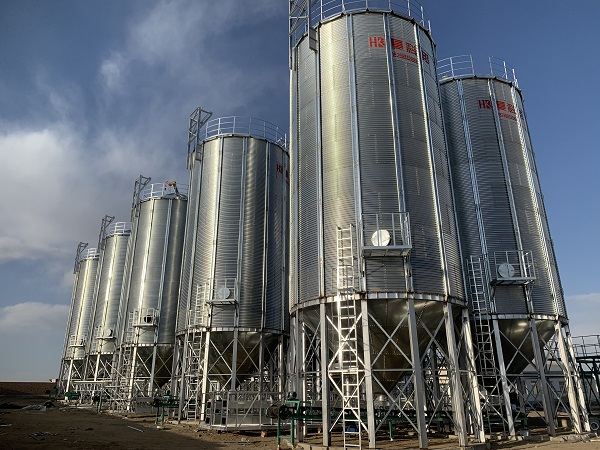
With the development of industrialized production and the global logistics system, efficient, clean and safe storage methods have become a common demand in the international market. Steel silos are constantly upgrading in line with this trend. From single silos to large group silo projects, they can maintain stable performance in different climates, humidity levels and usage environments, meeting customers’ comprehensive requirements for capacity, durability and economy.

The materials and structure of steel silo
The overall performance of a steel silo depends on the quality of the material and the structural design. Mainstream steel silos are usually composed of the following parts:
1. Warehouse material
Steel silos are typically made of the following types of steel:
- Galvanized steel sheet: It is made by hot-dip galvanizing process, forming a stable zinc layer on the surface. It has excellent oxidation resistance and corrosion resistance, and is the most commonly used material in the grain and feed industry.
- Carbon structural steels (such as Q235 and Q345) : They feature high strength and good toughness, and are widely used in load-bearing rings, foundation flanges, beams, columns and other structural positions.
- Stainless steel plate: It is used in highly corrosive environments or occasions with high food-grade requirements, such as the storage of chemical raw materials or high-humidity coastal areas.
High-quality materials can significantly reduce the corrosion rate of the warehouse, extend the service life of the structure, and ensure long-term stable operation.
2. Main structural composition
(1) Wall structure of the warehouse
The wall of the silo is made by joining rolled or profiled steel plates together and can be processed by either bolted or welded methods.
- Bolted type (assembled type) : Fast on-site installation speed, convenient for maintenance and replacement.
- Welded type: It has stronger overall sealing performance and is mostly used for liquid materials or large-capacity warehouses.
(2) Warehouse roof system
The top of the warehouse is usually composed of conical or spherical structures, bearing the loads of rain and snow as well as internal pressure. Top warehouse configuration
- Manholes and access ports
- Ventilation device
- Pressure relief device (optional upon request)
(3) Foundation and support structure
Steel silos mostly adopt reinforced concrete foundations, including ring beams or integral slab foundations, to ensure the stability of the silo body. According to the capacity and loading and unloading methods, auxiliary facilities such as steel structure platforms, stairs and guardrails can be configured.
(4) Unloading and conveying system
Steel silos can be matched with:
- Screw conveyor
- Bucket elevator
- Pneumatic conveying system
- Fluidized bottom plate (powder silo
Different systems can be flexibly combined according to the fluidity of materials and customer demands.

Installation and commissioning of steel silo
The installation of steel silos requires a professional team to carry out and strictly abide by relevant construction standards. The overall process usually includes:
1. Foundation construction
- Design the bearing capacity of the foundation based on geological exploration data.
- Ensure that the flatness, strength and positional error of the concrete foundation are controlled within the standard range.
- Pre-embed the anchor bolts and conduct multiple verifications.
2. Installation of the warehouse
- Assemble each section from the bottom to the top of the warehouse in the designed sequence.
- After the steel plates are rolled into arcs by a plate rolling machine, they are connected by bolts or welding.
- Apply the specified torque to the bolt connection points to ensure strength and sealing.
3. Installation on the warehouse roof
- First, assemble the warehouse roof on the ground and hoist it into place as a whole.
- Adjust the center position and fix it.
4. Installation of ancillary systems
Including electrical control systems, conveying equipment, ventilation equipment, grain condition monitoring systems, escalator guardrails, etc.
5. Debugging process
- Check whether the electronic control system and equipment linkage are stable.
- Conduct no-load and light-load trial runs;
- Check the indicators such as the sealing of the warehouse body, the operation of the fan, and the temperature rise of the motor;
- Complete the overall acceptance and put it into use.
The use and maintenance of steel silo
Proper use and maintenance can effectively extend the service life of steel silos.
Precautions for use
- When materials are put into the warehouse, they should be kept uniform to avoid force deviation of the warehouse body.
- Regularly inspect the ventilation equipment to ensure that the temperature and humidity inside the warehouse are within a safe range.
- Set the loading and unloading speed according to the characteristics of the materials to avoid blockage or impact.
2. Key points for daily maintenance
- Check the anti-corrosion coating of the warehouse body: If rust is found, it should be cleaned up in time and anti-corrosion materials should be reapplied.
- Monitor structural connection points: including bolt tightening force, weld integrity, steel beam deformation, etc.
- Clear the residual materials in the warehouse: to prevent mold, pests and water vapor condensation.
- Maintain the ventilation and detection system: Keep the air ducts unobstructed and calibrate the sensors regularly.
3. Regular professional maintenance
A comprehensive inspection is usually conducted every 12 months, including:
- The thickness of the warehouse wall and the degree of corrosion
- Foundation settlement condition
- The operational performance of the top structure and the unloading system
Timely maintenance can effectively prevent potential safety hazards such as fatigue and local damage to the warehouse body.
The advantages of Kebang steel silo
As a professional supplier of steel silo, Kebang (a sample enterprise) provides high-standard warehousing solutions for global customers with its mature technology and strict quality control. Its core advantages include:
1. High-quality materials
Coban selects high-standard galvanized steel plates and structural steel. Its zinc layer thickness, tensile strength and other key indicators meet the requirements of international engineering specifications, making the warehouse body more reliable in terms of corrosion resistance and long-term stability.
2. Independent design and engineering capabilities
The company has a professional structural design team that can carry out localized customized design based on the climate, wind load, snow load and seismic parameters of different countries to ensure that the project complies with local safety standards.
3. Modular production and rapid installation
Coban adopts modular manufacturing methods to significantly shorten on-site construction time. Standard warehouses can be installed in just a few days, and large projects can also be delivered in a short period of time, improving customers’ overall operational efficiency.
4. Complete system integration capability
In addition to warehouse manufacturing, Kebang can also provide:
- A complete set of equipment for the conveying system
- Ventilation system and grain condition monitoring
- Automatic control system
- Platform, staircase, dust removal and other supporting facilities
Provide customers with truly one-stop solutions.
5. Rich experience in international engineering
Kebang products have been applied in regions such as Asia, Africa, South America and the Middle East. Practical project experience in different environments makes the product more competitive in terms of durability, safety and maintenance convenience.
Conclusion
As an important infrastructure of modern industrial warehousing systems, the design, materials and construction quality of steel silos directly affect storage safety and operating costs. Choosing reliable suppliers and a complete engineering solution is an important prerequisite for ensuring the long-term stable operation of the project.
Through systematic design, high-quality materials, modular production and international engineering capabilities, Coban Steel Silos provides reliable storage solutions to global customers to meet the warehousing needs of multiple industries from grain, feed to chemical materials.
If you need to know more about the model, capacity planning or project quotation, you can contact our engineering team at any time. We will provide professional technical support and customized solutions for your project.