Calculating Silo Capacity
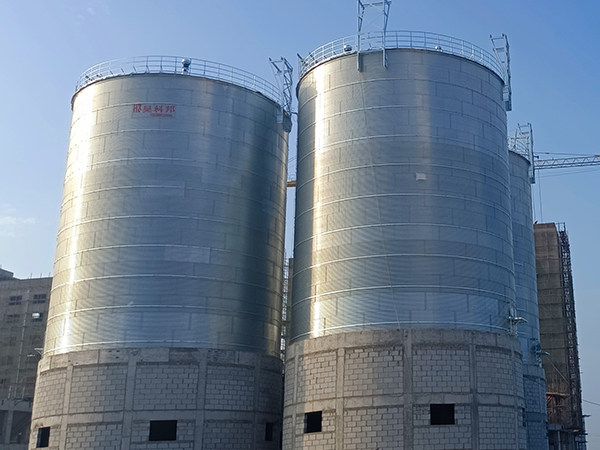
Silo capacity is primarily determined by diameter, height, and structural type. The most common type is a steel cylindrical silo, whose theoretical volume can be calculated using the formula:
V=π×(D/2)2×H
Where D represents the silo diameter, and H represents the height.
A steel silo with a diameter of 12 meters and height of 20 meters has a theoretical capacity of approximately 2,260 cubic meters. Taking wheat as an example (with a density of about 0.75 tons per cubic meter), the actual storage capacity would be around 1,600 to 1,700 metric tons. It’s worth noting that in practice, we usually leave some extra space – the actual storage volume is typically slightly less than the theoretical maximum to accommodate ventilation systems and maintain safety margins.
The Impact of Different Grain Varieties on Silo Capacity
Different grain varieties have significantly different densities, so the weight of grain that can be stored in the same silo volume also varies:
Corn: The bulk density is about 0.70 tons/cubic meter.
Wheat: The bulk density is about 0.75 tons/cubic meter.
Soybeans: Bulk density approximately 0.72 tons/cubic meter.
Rice: Bulk density is lower, approximately 0.60 tons/cubic meter.
If rice is stored in the same steel silo, the actual capacity will usually be about 15% to 20% less than wheat or corn stored. It can be seen that when planning silos, grain warehouses and farms need to reasonably evaluate the capacity according to different types of grain to ensure that there will be no insufficient storage and avoid overflow of warehouses.
Matching Silo Capacity with Storage Scale
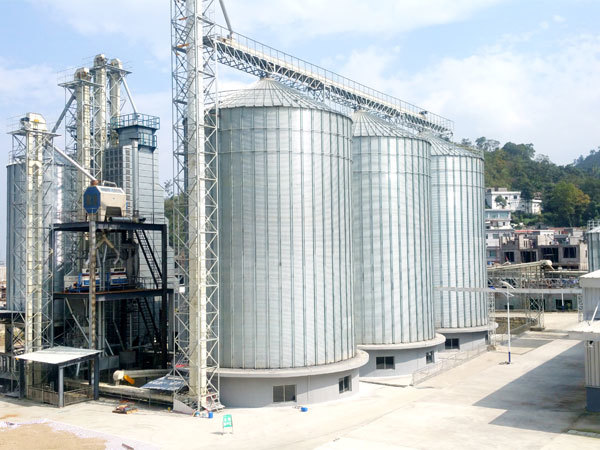
In actual applications, choosing a silo of silo needs to combine planting area, output and sales model.
Small and medium-sized farms
Usually choose silos of 500 to 2,000 tons to meet the seasonal storage of grain.
Grain purchasing stations or processing plants
Generally, steel silos of more than 3,000 tons are selected to ensure annual supply.
National grain depots
Dozens of silos are typically built in groups, with individual silos sometimes exceeding 5,000 tons.
For example, if a farm with an annual grain production of 10,000 tons is equipped with two 2,000 tons and two 1,500 tons silos, it can cover the main storage grain needs and achieve flexible classification management.
Design Factors Affecting Silo Capacity
In addition to volume and grain type, silo design also influences actual grain storage capacity:
Conical bottom design
Improve grain unloading efficiency, reduce residues, and improve space utilization.
Ventilation and temperature control
A suitable system can keep grain dry and extend its storage life.
Automated Management
Through temperature measurement and monitoring equipment, real-time monitoring of warehouse conditions is provided, improving management efficiency.
A well-designed steel silo not only improves storage efficiency but also ensures grain quality.
Economic Benefits of Silo Investment
Investing in steel silos offers multiple economic benefits for farms and grain depots:
Reduced Loss
Reduce pest and mold losses than traditional storage methods.
Increased Efficiency
Mechanized loading and unloading saves manpower and time.
Stable Profits
With sufficient silo capacity in the market, farmers and enterprises can delay sales and obtain higher profits.
Statistics show that steel silos can keep the loss rate below 1%, while traditional storage often experiences losses of 5% to 10%.
Case Study: 5,000-ton Steel Silo Application
In Southeast Asia, many companies often build steel silos with a single warehouse capacity of 5,000 tons. This type of silos are about 28 meters in height and 16 meters in diameter. Taking corn as an example, 5,000 tons of grain can be stored at one time, which is equivalent to the annual output of a medium-sized farm. Through centralized storage and batch sales, enterprises not only ensure stable supply, but also obtain profits through market price difference.
How to Choose the Appropriate Silo Capacity?
To select the appropriate silo, follow these steps:
Determine the production volume
Estimate the total capacity required based on the planted area and annual yield.
Consider the grain variety
Different grains vary greatly in density, requiring precise calculation.
Allow for headroom
It is recommended to increase storage space by 10% to 15% based on demand.
Consider scalability
Modular silo clusters are preferred to facilitate future expansion.
Summary
The amount of grain storage in the silo is mainly affected by three factors: diameter, height and internal structural design. The bulk density of different grain types will also lead to capacity differences. Taking the common small and medium-sized steel silos as an example, the grain storage volume is usually between 500 and 2,000 tons. Large silos have stronger grain storage capacity, generally reaching more than 3,000 tons, and some super-large silos can even store 5,000 tons of grain. Rational planning of silo capacity can not only ensure the safety of grain storage, but also effectively improve the economic benefits of warehousing.
With the development of modern agriculture, it has become a trend to build efficient steel silos. It is not only a grain storage tool, but also an important guarantee for improving production efficiency and market competitiveness. Choosing the right silo capacity means that grain storage management has reached a higher level.
Website: https://www.cobansilo.com/
Mobile: +8615518705783
Email: info@kbsilo.com