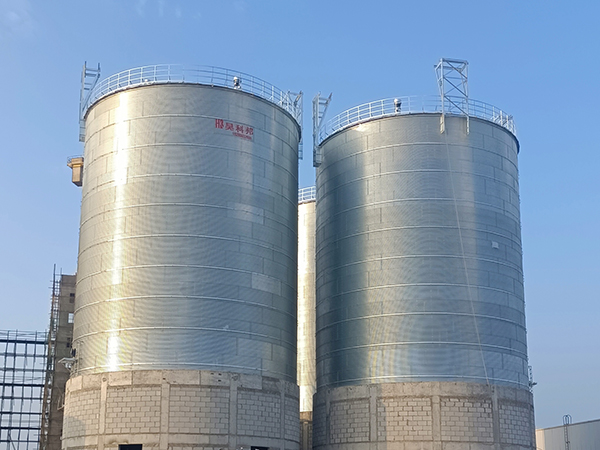
What is a rice silo
Rice silo are specialized grain storage equipment used for large-scale storage of husked or shelled rice. Their core function is to provide a long-term stable and safe preservation environment for rice to prevent mold, pests, condensation and quality deterioration. Compared with traditional grain silos, silos have the advantages of good sealing, high storage density and high degree of automation. Therefore, they are widely adopted in the modern agricultural industrial chain, especially in grain processing enterprises, port logistics centers, agricultural cooperatives and food processing enterprises.
The main body of the silo is usually made of galvanized steel plate or stainless steel plate, which has strong corrosion resistance and structural strength. With the increase in global food security awareness and the upgrade of modern logistics and warehousing methods, rice silos have become the mainstream storage technology in the field of grain warehousing. To understand why this shift is happening, read our analysis on [Rice Storage Silo: A Core Solution for Efficiency, Safety, and Quality Assurance]
Types of rice silo
According to different structures and construction methods, rice silos are mainly classified into the following types:
Assembled steel plate silo
It is made by joining galvanized steel plates through bolts, with a short installation period and convenient maintenance. It is currently the most widely used type in overseas markets.
Welded steel plate silo
The cylinder is formed by integral welding. It has high structural strength and strong sealing performance, but the construction period is long. It is mostly used for large grain depots and dock storage.
Reinforced concrete silo
Concrete pouring is adopted, which is costly but highly durable, and is often seen in national reserve grain depots.
FRP silo
It is light in weight and has outstanding anti-corrosion performance, and has market potential in some humid areas. If your project is located in high-risk zones, ensure you understand [how to prevent post-harvest rice loss in tropical climates] before deciding on the construction type.”
For export-oriented grain storage projects, considering transportation costs, construction convenience and maintenance expenses, assembled steel plate silos undoubtedly have more advantages.

Conical bottom silo vs. flat-bottom silo
Rice silos can be classified into conical bottom silos and flat bottom silos based on their bottom structure, each with its own applicable scenarios:
Conical bottom silo
The conical bottom structure enables rice to flow out naturally by gravity, which can prevent mechanical damage during the transportation of stored grains and is suitable for enterprises that need frequent discharging and turnover.
Main advantages
- The discharge is smooth with no residue
- The equipment has a high degree of automation
- It is conducive to rapid loading and transportation
Main applications: Grain traders, grain processing plants, port logistics and warehousing centers.
Flat-bottomed silo
The bottom of the flat-bottomed silo is a concrete base plate, which requires the use of a grain discharge machine or a grain sweeping machine for unloading. It is suitable for long-term or fixed storage.
Main advantages
- Stable structure and larger capacity
- Suitable for super-large grain storage depots
- The unit storage cost is relatively low
Main applications: National reserve depots, large-scale grain processing enterprises, and centralized long-term storage facilities.
When making a choice, a comprehensive judgment should be made based on the frequency of material input and output, storage period, construction site and operation mode.
The main uses of rice silo
Long-term storage of grain
It is used for storing rice or finished rice to ensure the quality of the grain and reduce losses.
Ensure food security
Through scientific storage, the risks of mold, pest infestation and heat caking can be reduced, and the level of food security can be improved.
Improve logistics efficiency
Silos can achieve mechanized conveying, cleaning and unloading, reducing labor costs and improving throughput efficiency. These operational improvements highlight the primary [benefits of choosing a rice silo for rice storage] in competitive markets.”
Supply of raw materials for grain processing
As a stable raw material warehouse for processing enterprises, it enhances the planning and guarantee of production.
Export trade reserve
It has sealing properties and traceability, which is conducive to standardized management and international trade communication.
Factors to consider before purchasing rice silo
When setting up or purchasing rice silos, the following key factors must be evaluated in advance:
Storage capacity requirements
The capacity of a single warehouse and the total reserve should be determined in combination with the business scale and future expansion plans. Generally, it is calculated based on the annual throughput, turnover rate and reserve cycle.
Bulk density and grain condition safety design
The state of grain storage is affected by temperature, humidity, ventilation and aeration systems. It is necessary to ensure that the silo has grain condition monitoring, ventilation cooling and insect-proof equipment to reduce quality risks.
Structural materials and anti-corrosion performance
It is recommended to give priority to high-strength galvanized steel sheets (such as 275g/m² or higher coating) to ensure long service life and reduce maintenance costs.
Degree of automation
This includes the warehousing loading system, discharging system, cleaning system, and temperature and humidity detection system, which should be evaluated based on personnel input and management methods.
Local installation conditions
Factors such as construction site foundation, transportation convenience, climate conditions, power configuration, etc. need to be evaluated to ensure smooth equipment installation and stable operation.
Supplier qualifications and after-sales service
International procurement should pay more attention to the manufacturer’s engineering experience, project cases, technical support capabilities, and whether the supply of spare parts is convenient.
Summary
Rice silos are indispensable key facilities in the modern grain storage and transportation system. Their application can significantly improve storage efficiency, ensure grain quality, and meet export trade and processing needs. Whether you choose a cone-bottom silo or a flat-bottom silo, you need to comprehensively consider many aspects such as operation mode, storage cycle, automation requirements and local conditions. For foreign trade users, choosing a supplier with rich experience and the ability to implement international projects will greatly reduce risks and ensure long-term stable operation of the project.
Ready to take the next step in your project? [Explore our professional-grade rice storage silo systems] for customized designs tailored to your specific storage capacity and site conditions.”