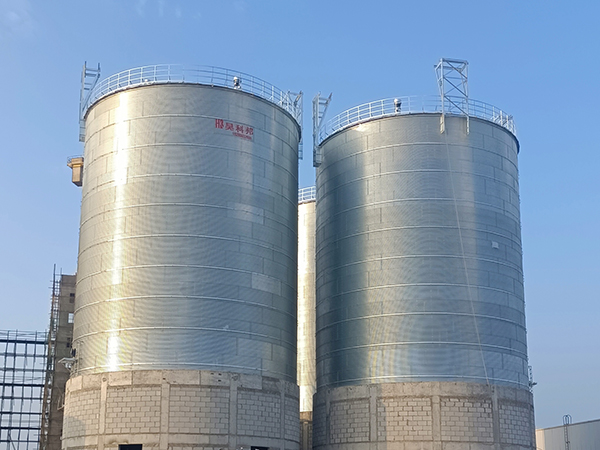
Basic structure and classification of grain silo
Grain silo are vertical storage tanks specially used for storing bulk grains (such as corn, wheat, soybeans, etc.). They are mainly composed of cylinder walls, silo tops, silo bottoms, feeding and discharging systems, and measurement and control equipment. According to different structural forms and uses, grain silos can be divided into the following categories:
Flat-bottom silos:
Suitable for long-term storage, usually equipped with a ring discharging system and mechanical ventilation devices;
Conical-bottom silos:
Suitable for short-term turnover or rapid loading and unloading, the bottom is mostly a conical structure with an angle of 60° or 45°;
Prefabricated steel plate silos:
Assembled with hot-dip galvanized corrugated steel plates, the silo height and diameter can be flexibly adjusted according to actual needs.
Concrete silos:
Commonly used in large factories or ports, with higher structural strength and durability.
There are significant differences in the design heights of different types of grain silos, which need to be considered in combination with storage requirements and project site conditions.

Common height ranges of grain silo
The height and diameter of grain silos are designed in proportion, generally based on storage capacity. The following are common specifications and corresponding height ranges in the industry:
| Storage Capacity | Diameter (m) | Height (m) |
|---|---|---|
| 100 tons | 4.5–5.0 | 6–8 |
| 500 tons | 6.0–7.5 | 12–16 |
| 1000 tons | 8.0–9.0 | 18–22 |
| 2000 tons | 10–12 | 25–30 |
| Over 5000 tons | 14–20 | 35–45+ |
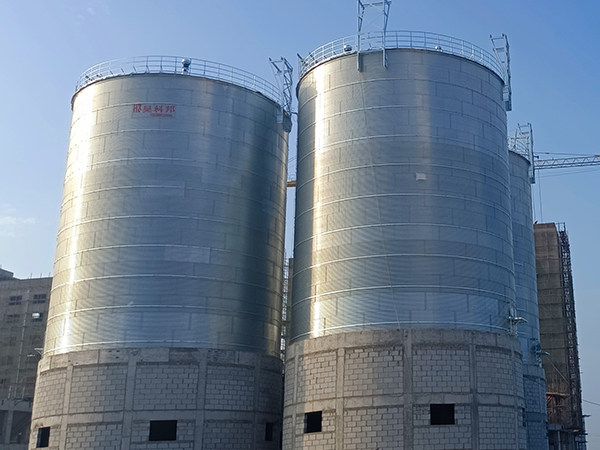
Generally speaking, the larger the storage capacity of a single warehouse, the higher the height of the grain silo. In large-scale grain processing enterprises or national grain reserve projects, the height of some silos can even reach more than 50 meters. It is worth noting that the increase in the height of grain silos will put higher requirements on the foundation design, wind and earthquake resistance level and ventilation system.
Key factors affecting the height design of silo
Although the height of grain silos can be customized according to needs, the design is not the higher the better. The following aspects are the core factors that determine the height of silos:
Storage capacity and land restrictions
If the project is limited in land, the design unit will usually “increase” the height of the silo to achieve a larger storage capacity. For example, in ports or urban grain depots, high-barrel design is often used to improve the unit land use efficiency.
Material fluidity and unloading requirements
The higher the height of the silo, the greater the gravitational potential energy of the material, which is convenient for natural discharge, but it also puts more stringent requirements on the cone bottom angle, arch breaking equipment, etc. For some grains that are not easy to flow, too high silos will increase the risk of blockage.
Structural stability and climatic conditions
In areas with strong winds or frequent seismic activities, if the grain silos is designed too high, there may be hidden dangers of structural stability. To ensure safety, it is usually necessary to thicken the cylinder structure and enhance the foundation strength, which will increase the overall construction cost accordingly.
The impact of height on the performance of grain silo
The height of grain silos is not only a reflection of storage capacity, but also directly affects its operating efficiency and management methods:
Ventilation and temperature control efficiency
High silos are prone to temperature stratification, and need to be equipped with multi-point temperature measurement systems and efficient ventilation ducts;
Discharging speed control</h3><p>The higher the silo, the greater the weight of the grain, the faster the discharging speed, but the control accuracy needs to rely on automatic control systems;
Maintenance and clearance difficulty
High silos have large internal space, and regular maintenance and clearance operations are complicated, requiring supporting professional equipment such as clearance robots.
Therefore, while pursuing height, it is necessary to equip corresponding intelligent management systems to ensure the safety and efficiency of grain storage.
Actual case reference: Examples of high silo construction at home and abroad
In a large grain processing plant in northern China, a group of steel grain silos with a single silos capacity of 10,000 tons and a height of 42 meters were built, which effectively improved the seasonal turnover capacity of the enterprise. A rain cover and intelligent ventilation module are installed on the top to achieve 24-hour temperature and humidity monitoring in the warehouse.</p>
In an international aid grain storage project in Ethiopia, in order to save land, the construction party adopted a 15-meter diameter and 30-meter high combined grain silo group, and equipped it with automatic weighing, discharging and early warning systems, which effectively improved the regional grain storage capacity and management efficiency.
The above cases show that in different application scenarios, the height design of grain silos must not only meet the capacity target, but also take into account safety, economy and maintainability.
Conclusion: The significance of scientifically determining the height of grain silo
There is no uniform standard for the height of grain silos, which needs to be determined comprehensively based on storage capacity, site conditions and operation mode. Enterprises should scientifically set the height of silos based on actual needs to improve grain storage efficiency and reduce maintenance costs. It is recommended that in the early stages of the project, a manufacturer with professional qualifications provide a customized design solution to ensure both technical and economic benefits.
Website: https://www.cobansilo.com/
Mobile: +8615801054617
Email: william@cobansilo.com