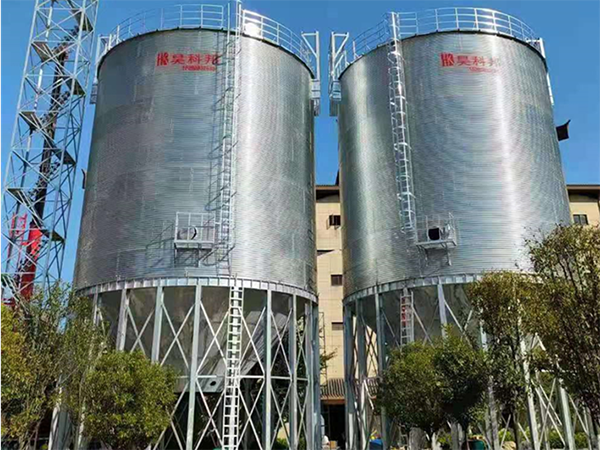
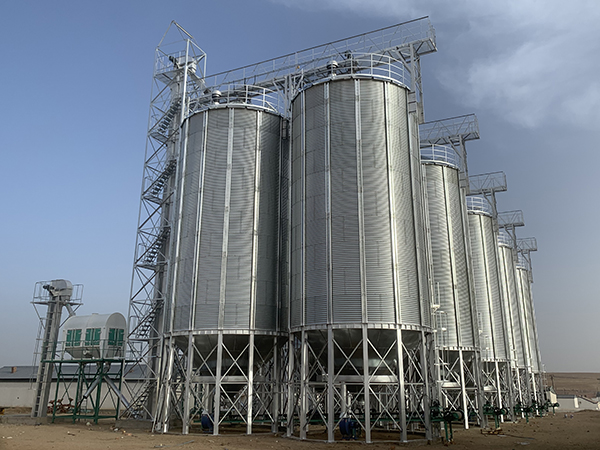
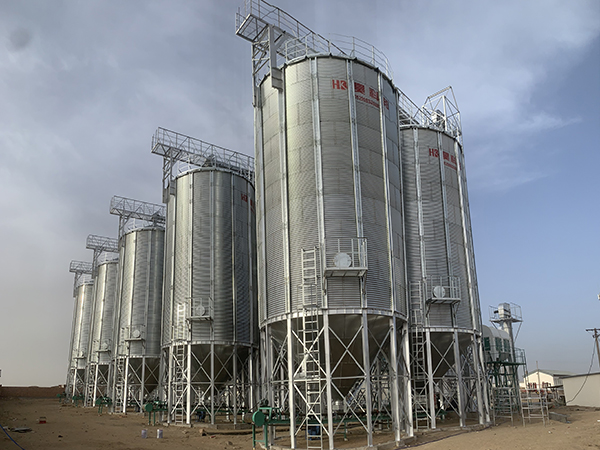
In a flat-bottom grain silo, grain enters from the top and is typically discharged mostly by gravity and the bottom outlet. However, as the grain level decreases, the grain around the central outlet at the bottom is discharged first, while the grain further away cannot flow automatically by gravity alone.
This is where the Sweep Auger (also known as a Silo Sweep Auger) comes in.
It’s not an ordinary horizontal conveyor auger, but a specialized machine designed for the final stage of grain discharge in flat-bottom silos. After the main grain is discharged, it moves gradually towards the center along the bottom of the silo, continuously pushing the remaining grain to the central outlet, reducing manual cleaning work.
From a grain silo design engineer’s perspective, the value of the Sweep Auger lies not only in discharging the remaining grain, but more importantly, in making the entire flat-bottom silo discharge process more complete, safe, and controllable.
The following section details the equipment structure, working principle, actual operation, design selection, and common problems.
1. What Is a Sweep Auger in a Flat Bottom Grain Silo?

A Sweep Auger is a rotary conveyor system installed on the floor of a flat-bottomed grain silo.
It typically consists of a long shaft with helical blades, a drive unit, a support structure, and related safety protection components. Installed near the silo floor, the equipment rotates gradually around a central area during operation, pushing any remaining bulk grains such as corn, wheat, rice, and soybeans to the central discharge port.
It’s important to note a key concept:
The Sweep Auger is not the main conveyor system responsible for discharging all the grain from the silo; rather, it’s responsible for clearing residual grains that the main discharge system cannot remove by gravity.
During normal unloading, the entire system usually consists of two phases:
| Grain Discharge Stage | Main Working Equipment | Working Objectives |
|---|---|---|
| Stage 1 | Center Gravity Discharge | Discharges most of the grain through the central discharge port. |
| Stage 2 | Sweep Auger | Pushes the remaining grain from the bottom and perimeter of the silo to the central discharge port. |
Therefore, the Sweep Auger is an important component of the Flat Bottom Grain Silo complete unloading system.
2. Main Components of a Sweep Auger System
An industrial-grade Grain Silo Sweep Auger is not simply composed of a single auger. Different silo types, diameters, stored grain varieties, and discharge capacities will influence the specific structural design.
The following is a breakdown of the actual equipment structure.
2.1 Auger Flighting – Spiral Blades

The helical blades are the components of the Sweep Auger that actually perform the conveying function.
As the helical shaft rotates, the blades move relative to the grain, conveying the grain along the helical shaft towards the central discharge area.
Blade design needs to consider:
- Blade Diameter: Determines the effective conveying space and conveying capacity of the equipment.
- Pitch: Affects the theoretical axial conveying volume per revolution.
- Thickness: Related to load-bearing capacity, wear resistance, and service life.
- Material: Selects appropriate steel based on grain type, equipment load, and wear conditions.
- Flight Shape: Affects the gripping, pushing, and conveying efficiency of the grain.
Here’s a design issue that’s easily overlooked:
Larger helical blades aren’t necessarily better.
If the blade diameter is too small, it may not be able to effectively handle deeper layers of residual grain; if the diameter is too large, it will increase the drive load and place higher demands on the silo bottom clearance, equipment weight, and structural strength.
Therefore, the size needs to be determined by considering both the silo diameter and the expected thickness of the residual grain.
2.2 Drive Motor and Gearbox

The drive unit provides the rotational power required by the Sweep Auger.
It typically consists of the following components:
- Electric Motor: Provides power.
- Gearbox: Reduces engine speed and increases output torque.
- Drive Shaft: Transmits rotational power.
- Coupling: Connects power transmission components.
Why is a speed reducer needed?
Because the Sweep Auger needs to operate continuously under significant grain resistance. Its primary focus is not on achieving high rotational speeds, but rather on obtaining sufficient torque to allow the propeller blades to stably push the grain.
When there is a large amount of grain remaining at the bottom of the silo, or when the grain has become compacted after long-term storage, the starting resistance may increase significantly.
If the motor power and the speed reducer’s output torque are insufficient, starting difficulties, overload, or even equipment shutdown can easily occur.
2.3 Center Pivot

The Center Pivot is a key structural element of the Sweep Auger, allowing it to rotate around the center of the silo bottom.
It provides rotational positioning for the equipment, enabling the screw conveyor to advance gradually along the silo bottom from the periphery towards the central discharge area.
The design of the center pivot point requires careful consideration:
- Radial load during equipment rotation.
- Stability of the screw shaft and supporting structure.
- Wear at the central connection point.
- Spatial fit with the central discharge port.
If the central fulcrum is not installed in the correct position, it may cause the equipment’s rotation trajectory to deviate, affecting the cleaning effect.
2.4 Support Wheels and Skids

When operating at the bottom of a grain silo, the Sweep Auger needs to maintain a reasonable operating height.
Some parts of the equipment use support wheels, while others use slippers or other support structures.
They primarily perform three tasks:
- Supports a portion of the weight of the screw conveyor mechanism.
- Controls the distance between the screw blades and the bottom of the hopper.
- Reduces friction and unnecessary structural deformation during equipment operation.
It is particularly important to emphasize here that the support structure cannot be designed simply based on ground contact.
The silo floor has issues such as splicing, bolted connections, and localized unevenness. If the clearance at the bottom of the equipment is unreasonable, problems may arise such as blades colliding with the floor, localized wear, or incomplete removal of residual grain.
2.5 Safety Protection System
The sweeper in an industrial grain silo is a mechanical device with rotating parts, and safety precautions cannot be ignored.
Common configurations include:
- Motor overload protection.
- Emergency stop device.
- Rotating parts protection.
- Locking and tagging (LOTO) maintenance measures.
- Interlocking with the main discharge equipment.
The specific configuration needs to be determined based on the equipment structure, project safety specifications, and on-site control system.
3. How Does a Sweep Auger Work? Detailed Explanation of its Working Principle
This is the core of the entire system.
Many customers know that the Sweep Auger can clean leftover grain from flat-bottomed silos, but they don’t understand exactly how it moves, or why a single screw conveyor can clean the entire bottom of a circular silo.
In reality, it involves two distinct movements:
- Auger Rotation: The screw shaft rotates, pushing the grain axially.
- Circular Sweeping: The entire cleaning mechanism gradually rotates around the center of the bin bottom, allowing the screw blades to cover residual grain in different locations.
These two actions, when combined, constitute a complete clearance process.
3.1 Step 1 – Gravity Discharge: First Remove the Main Grain
When unloading grain from a silo begins, the central discharge port at the bottom is opened first.
Due to gravity, the grain above the central discharge port flows downwards into the bottom conveyor system.
As grain is continuously discharged, a downward-extending flow area gradually forms inside the silo.
However, unlike conical-bottom silos, flat-bottom silos lack a sloping structure at the bottom, preventing all the grain on the outer edges from moving towards the center under its own weight.
Therefore, even after the central area is discharged, a significant amount of grain remains on the outer edges.
This is why flat-bottom silos require a Sweep Auger.
3.2 Step 2 – Start the Sweep Auger
Once gravity discharge is largely complete, the mechanical cleaning phase begins.
At this point, the Sweep Auger starts operating.
One end of the device is located near the central pivot point, while the other end extends to the perimeter of the grain silo. As the helical blades rotate, grain is continuously drawn into the helical conveying area and moves axially towards the central discharge area.
Simultaneously, the cleaning mechanism gradually rotates around the center.
It should be noted that the circular movement method may differ between Sweep Augers designed by different manufacturers.
- Some units use drive wheels to propel the equipment along the bottom of the silo.
- Some units use a central drive mechanism to simultaneously rotate and propel the equipment.
- Some units employ an automatic propulsion structure, completing the circumferential silo cleaning process step by step according to the equipment design.
Therefore, it cannot be simply assumed that all Sweep Augers use the exact same driving method.
3.3 Step 3 – Convey the Residual Grain Toward the Center
This is the stage where the Sweep Auger truly comes into play.
As the helical blades rotate, they continuously contact the grain in front, pushing it towards the center along the conveying direction.
It can be understood as a long-distance spiral collection device installed at the bottom of a grain silo.
Its working logic is as follows:
Sweep Auger delivery path
Surrounding grain
Grain remaining around the silo floor
↓
The spiral blades contact and propel the grain
Rotating auger flighting collects grain
↓
Conveying along the helical axis
Axial conveying toward the center
↓
Entering the central discharge port
Grain enters the center sump
↓
Grain is discharged from the bottom conveyor
Transferred to the downstream conveyor
Here’s a key design consideration:
The Sweep Auger’s conveying capacity must match the processing capacity of the central discharge port and the bottom conveyor.
If the grain being pushed by the Sweep Auger exceeds the discharge capacity of the lower conveyor, grain accumulation may occur in the central area, increasing the equipment’s operating load.
Therefore, the design must consider not only the power of the auger itself but also the coordination of the entire grain unloading system.
3.4 Step 4 – Rotate Around the Silo Floor
The Sweep Auger doesn’t operate continuously in one fixed position.
It needs to cover the entire silo floor area, therefore its working position must gradually change around the center.
Assuming a flat-bottomed silo has a diameter of 20 meters, the sweeping auger’s working range needs to cover the area from near the center to close to the silo wall.
As the equipment rotates continuously, grain originally located in different areas on the periphery is gradually collected and transported to the center.
This mode of movement has a distinct characteristic:
The circumferential speed of the Sweep Auger and the rotational speed of the screw shaft are two different parameters.
- The rotational speed of the auger shaft affects the grain conveying capacity.
- The circumferential movement speed affects the cleaning time and cleaning coverage efficiency at each location.
If the equipment moves too quickly in a circular motion, it may not be able to process the grain in front of it sufficiently; if it moves too slowly, it will prolong the entire unloading cycle.
Therefore, the automatic propulsion mechanism, drive torque, and screw conveyor capacity need to be comprehensively designed.
3.5 Step 5 – Complete the Mechanical Unloading
After the Sweep Auger completes its designed circumferential cleaning, the amount of grain remaining at the bottom of the silo will be significantly reduced.
However, it should be noted that the Sweep Auger does not guarantee absolutely zero residue at the bottom of the silo.
A reasonable operating clearance must be maintained between the blades and the bottom plate. The silo bottom structure, local unevenness, grain characteristics, and equipment structure will all affect the final residue level.
For projects requiring further cleaning, the final cleaning must be completed manually or mechanically, following the equipment manufacturer’s specifications, after all power equipment has been shut down and energy isolation completed.
4. How Does a Sweep Auger Work With the Complete Silo Unloading System?
In actual grain storage projects, the sweeper does not operate independently.
It must form a complete Grain Silo Unloading System in conjunction with equipment such as the central discharge port, bottom conveyor, and elevator.
Equipment coordination of a complete grain unloading system
| equipment | Main function |
|---|---|
| Center Discharge Outlet | Grain discharged by gravity and grain conveyed by the auger during the clearing process. |
| Slide Gate | Control the discharge port switch and grain flow rate |
| Sweep Auger | Collect residual grain from the outer perimeter of the silo. |
| Bottom Screw Conveyor | The grain from the central discharge area is transported outwards. |
| Drag Chain Conveyor | Responsible for horizontal grain transport over long distances |
| Bucket Elevator | Elevate the grain to the next processing or transport location. |
| Electrical Control System | Control equipment start/stop, interlocking and operation protection |
Recommended system working logic
Flat Bottom Grain Silo
Flat-bottomed grain silos store grain
Gravity Discharge
Gravity discharge is first completed at the central discharge port.
Sweep Auger
Mechanical collection of surplus grain from the surrounding area
Bottom Conveyor
Transporting the grain from the bottom of the warehouse
Bucket Elevator / Next Process
Entering the drying, cleaning, processing or other storage stages.
In actual projects, the bottom conveyor can be either a screw conveyor or a scraper conveyor, depending on the grain silo layout, conveying distance, and required throughput.
The most important aspect of engineering design is not simply increasing the capacity of a single piece of equipment, but ensuring the continuous matching of the entire unloading system.
For example, if a customer requires the discharge of 100 tons of corn per hour, then a comprehensive calculation of the sweep auger, central discharge port, bottom conveyor, and subsequent lifting equipment is necessary; a simple selection of a sump-cleaning auger based solely on 100 T/H is insufficient.
5. Different Types of Sweep Augers
Not all flat-bottomed grain silos use the same cleaning auger.
Depending on the drive method, level of automation, and equipment structure, different designs are possible.
 | 1. Manual or Tractor-Driven Sweep Auger This type of equipment is powered externally or manually controlled. It has a relatively simple structure and is suitable for some small to medium-sized grain silos. Specific operation methods depend on the manufacturer’s design. |
 | 2. Automatic Sweep Auger Equipped with an automatic drive and propulsion mechanism, it can complete the bottom cleaning of the silo step-by-step according to the designed program, reducing the need for manual adjustments. It is suitable for larger-scale grain storage facilities. |
 | 3. Heavy-Duty Sweep Auger Designed for larger silos, higher loads, or specific grain handling conditions, with a focus on the auger blades, drive shaft, support structure, and drive torque. |
For large commercial grain silos, automated cleaning systems are generally more worthwhile consideration because the equipment operation frequency, silo size, and manual cleaning costs may be higher.
However, the degree of automation is not the only selection criterion; it must also be determined in conjunction with the project investment budget, equipment maintenance conditions, and actual grain unloading frequency.
6. How to Choose the Right Sweep Auger for a Flat Bottom Silo?
For grain silo manufacturers, selecting a Sweep Auger shouldn’t be based solely on motor power or equipment price.
The real factors affecting the equipment’s performance are silo size, grain characteristics, cleaning capacity, and the compatibility with the entire unloading system.
Below are some key aspects that COBAN considers when designing a flat-bottom silo cleaning system.
6.1 Silo Diameter
The diameter of the grain bin directly affects the length and circumferential working range of the Sweep Auger.
| Silo Diameter | Issues to consider during design |
|---|---|
| 6–10 m | Spiral length, drive configuration, and bottom clearance |
| 10–15 m | Equipment support, rotational stability and conveying capacity |
| 15–20 m | Transmission load, structural strength and automatic propulsion |
| 20–30 m | Long-distance transportation, equipment stability and system coordination |
| 30 m以上 | Large-scale grain unloading equipment, segmented design and overall grain unloading solution |
The above outlines the engineering design considerations for grain silos of different diameters and does not represent fixed equipment specifications or universal selection standards. Specific dimensions need to be determined based on the silo type and the manufacturer’s equipment series.
Why does the design of the cleaning system require greater caution for larger grain silos?
Because as the equipment length increases, the stress on the auger shaft, transmission stability, and operating resistance all change.
Especially for large flat-bottomed silos, simply increasing the auger shaft length without simultaneously considering shaft stiffness, support positions, and driving capacity may lead to deformation, vibration, or decreased conveying efficiency during long-term operation.
6.2 Grain Type
Different grains vary in their flowability, particle shape, bulk density, and frictional properties.
These differences directly affect the operating load of the Sweep Auger.
| Grain Type | Selection considerations |
|---|---|
| Maize / Corn | Particle size, bulk density and conveying load |
| Wheat | Flowability, dust and blade wear |
| Paddy Rice | Particle integrity and breakage during transport |
| Soybean | Particle shape, friction and conveying stability |
| Sorghum | Particle size and flow characteristics |
For example, although corn and rice are both common bulk grains, their grain shape and physical properties are different.
If a grain silo needs to store multiple grains, the Sweep Auger cannot be selected based on only one type of grain during the design phase.
The drive load and conveying capacity should be calculated based on the most unfavorable actual operating conditions.
6.3 Required Unloading Capacity
The auger for clearing inventory needs to be properly matched with the downstream equipment.
For example:

Another easily overlooked issue needs to be considered:
When the grain initially begins to discharge, the gravity flow rate may be relatively high; however, during the Sweep Auger stage, the grain distribution and equipment load will continuously change.
Therefore, the entire system should be designed based on actual operating conditions, rather than simply dividing the total grain silo capacity by the unloading time to determine the specifications of all equipment.
6.4 Floor Structure
The Sweep Auger operates directly from the bottom of the silo, therefore the silo design will also affect its performance.
Key areas to check:
- Flatness of the bottom steel plate of the silo.
- Location and dimensions of the central discharge port.
- Installation height of the cleaning auger.
- Central support point and connection structure.
- Space available for the bottom conveyor channel.
- Equipment inspection and maintenance conditions.
For newly built grain silos, it is best to determine the Sweep Auger installation plan during the grain silo design phase.
If the cleaning system is considered after the grain silo is built, problems such as mismatched central support points, insufficient bottom space, or the need to readjust the discharge port structure may arise.
7. Common Sweep Auger Problems and Their Solutions
From a practical equipment usage perspective, problems with Sweep Augers are often not simply motor failures.
Frequently, equipment selection, grain condition, mechanical installation, and downstream conveying capacity all affect operational results.
Below are some common scenarios.
 | Problem 1: Sweep Auger Cannot Move Forward Possible causes:
Engineering Solution: Inspect the drive unit, transmission system, and the condition of the grain in front. Refer to the equipment manual to determine if there is an overload or mechanical obstruction; forcing the equipment forward will not resolve the issue. |
 | Problem 2: Grain Remains on the Silo Floor Possible Causes:
Engineering Solution: Check the equipment installation height, blade structure, and silo floor flatness. If caking is present, also check the grain moisture content, storage time, and internal storage conditions. |
 | Problem 3: Motor Overload During Operation Possible Causes:
Engineering Solution: Check the motor current, reducer, bearings, and transmission connections. Recalculate the drive parameters based on the actual grain load. If an overload occurs, stop the machine for inspection immediately; do not repeatedly force restart it. |
 | Problem 4: Grain Accumulates Around the Center Outlet Possible Causes:
Engineering Solution: Check the actual capacity of the center outlet and bottom conveyor, and re-coordinate the operating parameters of the cleaning auger and downstream conveyor system. |
A special reminder:
If the Sweep Auger malfunctions, it must be shut down, the power supply isolated, and a lockout/tagout completed according to the equipment manufacturer’s specifications before any inspection.
Do not enter the chamber to adjust, move, or clean the propeller blades while the equipment is running.
8. Sweep Auger vs. Hopper Bottom Silo: What Is the Difference?
Many customers consider both Flat Bottom Silos and Hopper Bottom Silos when purchasing grain silos.
One of the biggest differences between the two is the method of grain discharge from the bottom.
 Flat Bottom Silo
|  Hopper Bottom Silo
|
| Comparison | Flat Bottom Silo | Hopper Bottom Silo |
|---|---|---|
| Bottom Structure | Flat floor | Conical hopper |
| Main Discharge | Gravity discharge | Gravity discharge |
| Sweep Auger | Commonly required | Usually unnecessary |
| Residual Grain | Mechanical recovery needed | Generally less |
| Foundation | Large flat floor foundation | Hopper support foundation |
| Typical Application | Large-volume storage | Smaller or process-oriented storage |
So, which type is better suited to your project?
If a client plans to build a commercial grain storage facility with a capacity of 5,000 tons, 10,000 tons, or even larger, flat-bottom silos typically offer better capacity and structural economics.
If a client prioritizes rapid unloading, frequent refilling, and reduced cleaning work, then cone-bottom silos are also worth considering.
Ultimately, the decision should be made based on a combination of storage capacity, unloading frequency, geological conditions, investment budget, and project layout, rather than assuming that one type of silo is better for all projects.
9. Safety Requirements When Operating a Sweep Auger
Sweep augers are critical safety devices in grain silo unloading systems.
Unlike conventional screw conveyors installed in enclosed pipelines, sweep augers operate inside grain silos, posing risks of entanglement, entanglement, and mechanical injury to personnel due to their rotating screw components.
Especially as the grain gradually empties, the auger’s operating speed and motion may change, increasing the risk of injury to personnel.
The US OSHA provides a clear safety definition for sweep augers: Under applicable grain storage facility operating standards, hazardous machinery must be electrically isolated, locked, and tagged when personnel enter the grain silo.
The following safety requirements must be incorporated into equipment design and project operating procedures:
| Safety Item | Requirement |
|---|---|
| Equipment Guard | Install protective devices according to equipment requirements. |
| Electrical Protection | Configure appropriate electrical protection |
| Emergency Stop | Set appropriate emergency stop measures. |
| Equipment Interlock | Reasonable configuration of equipment operation interlocks |
| Maintenance | Maintenance after shutdown and completion of power isolation |
| Silo Entry | Strictly enforce warehouse entry permits and safety procedures. |
| Grain Entrapment | To prevent people from getting caught in moving food or being buried. |
⚠️ Important Safety Warning
Never enter a grain silo while the sweep auger or other dangerous unloading equipment is operating.
Personnel are not permitted to enter the working area of a running sweep auger. Equipment maintenance, cleaning, and personnel entry into the silo must be performed following complete shutdown, energy isolation, and safety clearance procedures.
The sweep auger must never be treated as a regular conveying device that can be operated by personnel inside the silo.
10. Frequently Asked Questions About Sweep Augers
Q1. What is the main purpose of a sweep auger in a grain silo?
Its main purpose is to collect grain remaining on the flat silo floor after gravity discharge and move it toward the center discharge opening. It reduces the need for manual grain recovery.
Q2. Does a sweep auger remove all the grain from a flat bottom silo?
It removes most of the residual grain within its designed working range. However, a small amount may remain because of floor irregularities, operating clearances and grain characteristics. Final cleaning may still be necessary under safe, isolated conditions.
Q3. Does every flat bottom grain silo need a sweep auger?
For a flat-bottom silo designed for mechanical unloading, a sweep auger is a common and practical solution. Other recovery methods are possible, but the complete unloading arrangement should be determined during the silo design stage.
Q4. Can a sweep auger work before gravity discharge is completed?
Normally, the main gravity discharge should be completed first. Starting the sweep auger while a large quantity of grain remains can create unnecessary mechanical resistance and increase equipment load. Always follow the specific manufacturer’s operating sequence.
Q5. What determines the power of a sweep auger motor?
The required motor power depends on auger length, screw diameter, grain characteristics, grain resistance, rotational speed, transmission efficiency and the design of the drive mechanism.
A large silo does not automatically require a motor with a particular power rating. Engineering calculations are necessary.
Q6. Can one sweep auger be used for different grain types?
Yes, provided the equipment is designed for the relevant materials and operating conditions. Corn, wheat, rice and soybeans have different physical properties, so the actual working load needs to be considered.
Q7. How long does it take for a sweep auger to empty a silo?
There is no universal unloading time. It depends on silo diameter, residual grain quantity, auger capacity, drive speed and the downstream conveying system.
Q8. Is an automatic sweep auger better than a manual one?
An automatic system can reduce operator intervention and improve operating convenience, especially in large commercial grain storage facilities. However, investment cost, maintenance requirements and the availability of local technical support should also be considered.
Q9. Can a sweep auger be installed in an existing flat bottom silo?
In some cases, yes. However, the existing center outlet, floor arrangement, silo diameter, supporting structure and installation access must be checked before confirming compatibility.
Q10. Can COBAN supply a complete grain silo unloading system?
Yes. COBAN can coordinate flat-bottom grain silos with sweep augers, center discharge outlets, screw conveyors, drag chain conveyors, bucket elevators and electrical control systems to provide a complete grain storage and unloading solution.
11. COBAN Flat Bottom Silo Unloading System
In a large-scale grain storage project, clients should not simply purchase a steel silo, but rather a complete grain storage and unloading system capable of long-term stable operation.
When designing a Flat Bottom Grain Silo project, COBAN considers the silo structure, bottom discharge, cleaning system, and subsequent conveying equipment together.
Our design work mainly includes:
1. Silo Structure Design
Determining the silo diameter, height, slab thickness, reinforcing ribs, and foundation load requirements based on storage capacity, grain type, and project site conditions.
2. Sweep Auger Selection
Determining the structural form, drive method, and installation scheme of the cleaning auger based on the silo diameter, grain characteristics, and cleaning requirements.
3. Grain Discharge System
Coordinating the central discharge port, gate, and bottom conveying equipment to ensure smooth integration of gravity discharge and mechanical cleaning.
4. Complete Grain Handling Integration
Connecting the grain silo to bucket elevators, scraper conveyors, belt conveyors, cleaning equipment, and drying equipment according to project needs.
5. Installation and Commissioning
We provide equipment installation guidance, system commissioning, and operation training to help customers establish a complete grain storage and unloading process.
Conclusion
A Sweep Auger may appear to be just a screw conveyor installed inside a flat-bottom grain silo, but it has a crucial impact on the overall unloading efficiency of the silo.
It uses a rotating screw shaft and a circumferential sweeping action to gradually collect the grain remaining at the bottom of the silo after gravity discharge, bringing it to the central discharge port, where it is then conveyed out of the silo by the bottom conveyor system.
For large-scale grain storage projects, a well-designed Sweep Auger not only reduces manual cleaning work but also improves grain recovery efficiency, making the entire unloading system more complete.
If you are planning a flat-bottom grain silo project with a capacity of 1,000 tons, 5,000 tons, or 10,000 tons or more, don’t wait until the silo is built to consider the cleaning system. The coordination between the Sweep Auger, the central discharge port, and the bottom conveyor system should be determined during the project design phase.
COBAN can design a cleaning and conveying solution tailored to your grain silo’s capacity, diameter, stored raw materials, and target unloading capacity.