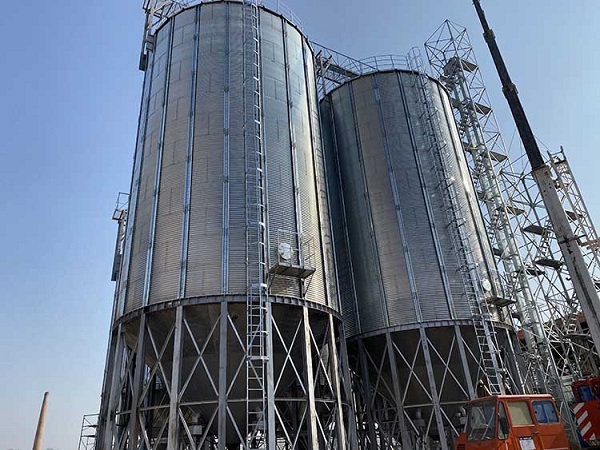
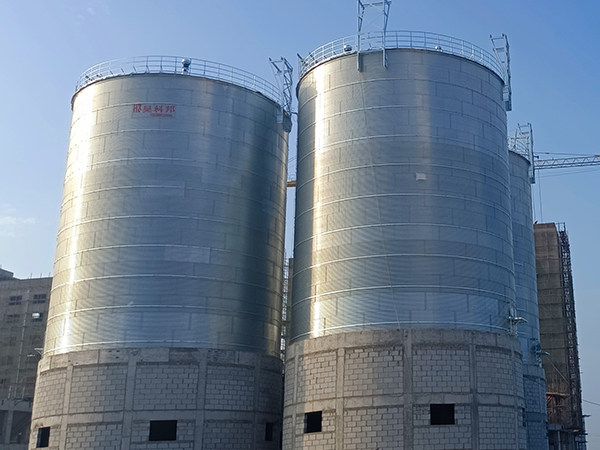
Overview of the Basic Structure of a Steel Silo
The steel silo is mainly composed of a cylinder, a top cover, a base, and a ventilation and grain unloading system. The cylinder is usually made of high-strength galvanized steel plates to ensure corrosion resistance and load-bearing capacity. The 500-ton steel plate silo is designed to meet the needs of large-capacity grain storage, and to take into account both loading and unloading convenience and safety. The overall structure is compact and convenient to install, and is suitable for medium and large farms or grain storage enterprises.
500-ton Steel Silo Dimensions Analysis
A standard 500-ton steel plate silo can hold about 500 tons of grain. Taking wheat as an example, the bulk density is about 0.75 tons/cubic meter and the theoretical volume is about 667 cubic meter. Generally, the diameter of this silo is 8 to 10 meters and the height is about 10 to 12 meters. However, the designs of different manufacturers will be somewhat different, and the actual size will be adjusted due to the safety gap, ventilation ducts and grain unloading ports. Before use, it is best to plan the grain storage space reasonably based on the actual site and grain types.
Example Dimensions:
Diameter: about 9 meters
Height: about 11 meters
Theoretical volume: 667 cubic meters
Grain storage volume: about 500 tons (wheat is an example)
These dimensions not only ensure the capacity of grain storage, but also leave sufficient space for operation, and also facilitate the installation of conveying equipment and automation systems. They are a design that takes into account both safety and efficiency.

Relationship between Grain Storage Capacity and Grain Type
The amount of grain storage in the steel plate silo not only depends on the volume, but also on the type of grain. Corn is lighter than wheat, and requires a little more space when loading the same capacity; rice is lighter, and the actual capacity can be reduced by 10% to 15%. When purchasing silos, the capacity should be planned reasonably based on actual grain storage needs and grain types to avoid insufficient storage or waste.
Space Planning and Installation Recommendations
500 ton steel silo are usually suitable for medium-sized farms or grain warehouses. During installation, sufficient space should be left around it for easy mechanical operation, ventilation and heat dissipation and daily maintenance. The foundation must be flat and have sufficient bearing capacity, and pay attention to rainwater discharge and corrosion prevention. If used in combination with multiple cylinders, reasonable arrangement will not only improve the efficiency of grain storage, but also facilitate batch unloading and automated management.
Application Advantages and Economic Benefits
Choosing a 500-ton steel silo offers the following advantages:
High sealing
Effectively protects against moisture and pests, reducing grain loss.
Long service life
The steel plate has strong corrosion resistance and wind resistance, and can be used for more than 20 years.
Easy to Operate
Combined with an automatic grain unloading system, it enables fast loading and unloading, improving labor efficiency.
Space-Saving
Compared with bulk warehouses, it covers a small area and is easy to manage centrally.
Quick Return on Investment
Effectively reduces grain loss and labor costs, resulting in significant long-term economic benefits.
Summary
The 500-ton steel silo is very practical in modern farm grain storage. It has a diameter of about 9 meters, a height of about 11 meters, and a theoretical volume of about 667 cubic meters, which is suitable for the grain storage needs of medium and large farms. When purchasing, you should plan in combination with grain types, storage environment and operating convenience to give full play to the best economic benefits. This silo is a good choice for farms that pursue safety, efficiency and durability.