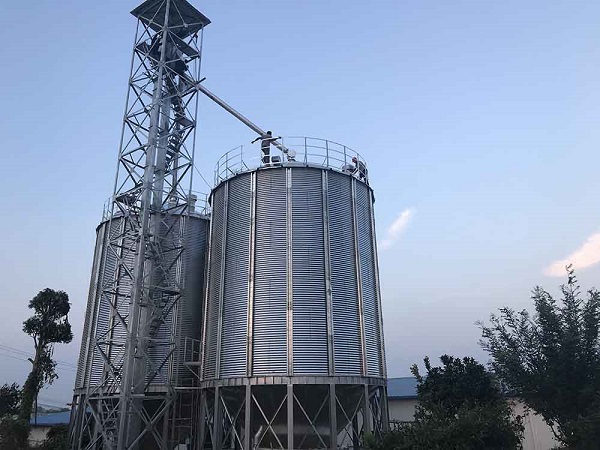
This guide skips the fluff to focus on the technical red lines: correcting Janssen’s pressure formulas for real-world flow, preventing roof condensation, and choosing coatings that actually last 40 years. It is written for the EPC leads and engineers who have to sign off on the safety of these structures.
What Is Grain Silo Design?
At its core, silo design is about more than just standing up a steel cylinder. It is a high-stakes calculation of how a biological mass interacts with a structural shell. If you get the grain flow mechanics wrong, the structure buckles; if you ignore environmental control, the inventory rots. This guide bridges the gap between theoretical math and the actual reality of managing thousands of tons of bulk grain over the long term.

Silo Types & Selection
Flat Bottom Silo
- Large capacity (1,000–20,000+ tons)
- Long-term storage
- Lower cost per ton
Hopper Bottom Silo
- Small to medium capacity
- Frequent discharge
- Gravity unloading
Steel vs Concrete Silo
| Material Type | Advantages (ROI & Engineering) | Limitations (Operational) |
|---|---|---|
| Steel Silo | Fast installation; modular scalability; significantly lower initial CAPEX. | Higher thermal conductivity (requires active ventilation). |
| Concrete Silo | Extended structural lifespan; superior thermal stability for grain cores. | High CAPEX; protracted construction timelines (28-day curing). |
Storage Capacity Calculation
Capacity is determined by volume and bulk density:
Capacity (tons) = Volume (m³) × Bulk Density (kg/m³) / 1000
| Grain Variety | Standard Bulk Density (kg/m³) |
|---|---|
| Wheat | 780 – 820 |
| Corn (Maize) | 720 – 760 |
| Soybean | 730 – 750 |
| Paddy Rice | 560 – 600 |
* Values represent international storage standards at 12%-14% moisture content.
Structural Design Considerations
Grain silos operate under dynamic loads. Wall pressure is calculated using Janssen’s theory:
σh = (γR / μk) × (1 – e-μkz/R)
| Grain Variety | Bulk Density (kg/m³) | Friction Angle (°) | Pressure Coeff. (k) | Wall Friction (μ) |
|---|---|---|---|---|
| Wheat | 800 | 27° | 0.42 | 0.30 |
| Corn (Maize) | 750 | 30° | 0.45 | 0.35 |
| Soybean | 740 | 25° | 0.40 | 0.32 |
| Paddy Rice | 580 | 35° | 0.50 | 0.40 |
Note: Parameters calculated based on Janssen’s Theory for structural load verification.

Foundation Design
Foundation failure is the most common cause of silo accidents. Key principles include:
- Soil bearing capacity verification
- Differential settlement < 0.001D
- Reinforced concrete raft foundation
- Drainage system around perimeter
Grain Flow & Hopper Angle
Two major flow patterns exist: mass flow and funnel flow. Mass flow is preferred.
| Grain Variety | Min. Hopper Angle (Gravity Flow) |
|---|---|
| Wheat | 45° |
| Corn (Maize) | 50° |
| Soybean | 48° |
| Paddy Rice | 55° |
* Angles are optimized for galvanized steel surfaces. High-moisture grain may require additional steepness.
Aeration & Moisture Control
Aeration removes biological heat and prevents condensation.
Typical airflow rate: 0.1 – 0.3 m³/min/ton
| Monitoring Parameter | Operational Safe Range |
|---|---|
| Moisture Content | < 13.5% |
| Internal Temperature | < 25°C |
| CO₂ Concentration | < 600 ppm |
Note: Parameters are based on long-term storage protocols for maize and wheat to prevent biological respiration spikes.
Material & Corrosion Protection
| Coating Type | Salt Spray Resistance (h) | Recommended Application |
|---|---|---|
| Z275 (Standard) | 800 | Arid / Dry Inland Areas |
| Z600 (Heavy Galv.) | 1500 | Standard Industrial Zones |
| Zn-Al-Mg (ZM) | 3000 | Coastal / High Humidity |
| Polyurea Coating | 5000+ | Chemical / Extreme Corrosive |
* Performance based on ISO 9227 neutral salt spray testing protocols.
Safety Standards & Failure Prevention
- Explosion vent panels
- Isolation valves
- Pressure relief ducts
- OSHA / EN compliance
Smart & AI Integration (2026 Trend)
- Temperature sensors
- Moisture probes
- CO₂ detectors
- AI-based energy optimization
Typical ROI: +20% CAPEX, 3–5 years payback.

Technical Engineering FAQ
Advanced insights into 2026 grain storage technology.
Engineering Checklist
- Dynamic discharge load verified (1.5–2.0)
- Differential settlement < 0.001D
- Aeration capacity calculated
- Corrosion class defined
- Safety systems installed
- Future expansion reserved
Struggling with Silo Performance?
If you are dealing with persistent condensation issues or planning a high-capacity storage facility, don’t leave your structural safety to chance. Get professional support today.
Free localized load calculations & coating durability assessments for project inquiries.