For a grain storage project in Kenya, choosing a silo is not simply a matter of deciding between 500 tons, 1,000 tons, or 5,000 tons.
The more important question is how the silo will perform under Kenya’s actual grain, climate, handling, and storage conditions.
Maize is particularly important in Kenya, while wheat, rice, sorghum, barley and other grains are also handled by farms, grain traders, cooperatives, processors, feed mills and commercial storage facilities. Research covering Kenya’s major maize-growing zones has found that insects, mould, moisture and rodents are among the major causes of storage losses, with warmer and more humid areas generally facing greater pest-related losses.
This is why a Kenya grain silo design should be developed around four connected factors:
Storage capacity → grain condition → climate → aeration and handling system
A silo with a large nominal capacity but inadequate aeration, poor moisture control or unsuitable unloading equipment can still become a poor storage investment.
1. Why Grain Silo Design in Kenya Requires Local Consideration
Kenya does not have one uniform grain-storage climate.
Conditions differ considerably between areas such as the western maize-growing regions, central highlands, eastern drylands and coastal areas. Research on maize storage in Kenya has found higher pest-related losses in warmer and more humid zones, while losses tend to be lower in dry areas and high-altitude regions.
This creates an important design principle:
The same grain silo specification should not automatically be applied to every Kenyan project.
For example, a commercial maize storage facility in a relatively humid area may require more attention to grain moisture, aeration and temperature monitoring than a similar-capacity installation in a dry region.
Kenya vs. Other Grain Storage Markets
| Factor | Kenya | Drier regions | Highly humid tropical regions |
|---|---|---|---|
| Main concern | Moisture, insects, mould, temperature | Grain heating and insects | Moisture, condensation, mould |
| Common grain | Maize, wheat, rice, sorghum | Wheat, maize, barley | Maize, rice, paddy |
| Aeration importance | High | High | Very high |
| Moisture management | Critical | Critical | Extremely critical |
| Temperature monitoring | Recommended | Recommended | Strongly recommended |
| Corrosion protection | Important | Important | Especially important |
| Roof/rainwater protection | Important | Moderate–high | Very important |
| Grain cleaning before storage | Essential | Essential | Essential |
Kenya therefore sits somewhere between dry-climate and humid-climate storage requirements. The exact silo configuration should be determined by the project location rather than the country name alone.
2. How Much Grain Silo Capacity Do You Need in Kenya?
Capacity is normally the first question from a Kenyan customer:
- 500 ton grain silo
- 1,000 ton grain silo
- 2,000 ton grain silo
- 3,000 ton grain silo
- 5,000 ton grain silo
- 10,000 ton grain silo
But the correct capacity should not simply equal the size of one harvest.
A better calculation considers:
Annual grain intake + storage period + inventory rotation + peak receiving volume + future expansion
For example, a grain trader receiving 5,000 tons of maize during a short harvest period does not necessarily need one 5,000-ton silo. Several smaller silos may provide better operational flexibility.

Typical Capacity Planning
| Silo Capacity | Suitable Kenyan Application |
|---|---|
| 100–300 tons | Small farms, seed storage, small grain collection |
| 500 tons | Commercial farms, cooperatives, small grain depots |
| 1,000 tons | Grain traders, commercial farms, feed mills |
| 2,000 tons | Grain collection centers, processors, commercial storage |
| 3,000–5,000 tons | Large grain traders, milling/feed operations |
| 10,000 tons+ | Commercial grain storage and large-scale grain depots |
These are planning ranges, not fixed rules. The final silo number and size should be calculated from the customer’s annual throughput and storage strategy.
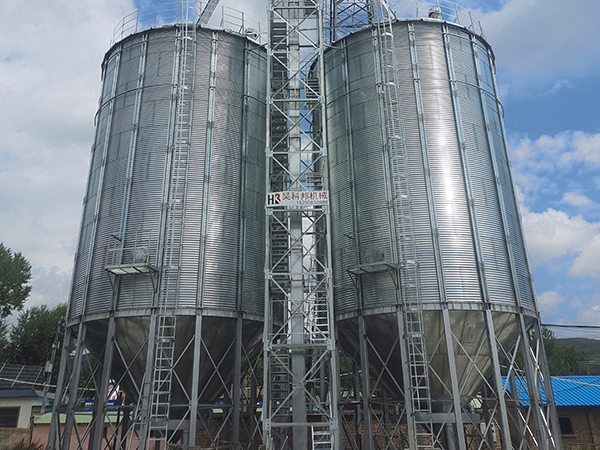
COBAN currently manufactures galvanized steel grain silos across a broad capacity range, with both flat-bottom and hopper-bottom configurations available.
3. One Large Silo or Several Smaller Silos?
This is particularly important for Kenyan grain traders and commercial storage operators.
Suppose a customer wants approximately 5,000 tons of storage capacity.
There are several possible designs:
| Configuration | Main Advantage | Suitable Situation |
|---|---|---|
| 1 × 5,000 tons | Simple system, lower equipment duplication | One major grain type |
| 2 × 2,500 tons | Better batch separation | Different purchasing batches |
| 5 × 1,000 tons | High flexibility | Grain trading and frequent turnover |
| Mixed capacities | Flexible inventory management | Commercial grain center |
Several silos can be more useful when the customer needs to separate:
- different maize batches
- different moisture levels
- different grain qualities
- different suppliers
- seed from commercial grain
- old inventory from newly received grain
For a Kenyan grain trader, storage flexibility can sometimes be more valuable than simply maximizing tons per silo.
4. Maize Storage Is a Major Design Consideration in Kenya
Maize deserves particular attention when designing a maize storage silo in Kenya.
Kenyan studies have documented substantial storage losses associated with insects and other storage problems, particularly in warmer and more humid environments. One large community-based study covering six maize-growing zones reported estimated losses from major storage pests of around 36% overall, with substantial regional variation. These figures are farmer-estimated losses rather than a universal physical-loss rate, so they should not be treated as a guaranteed loss level for every farm.
The practical lesson for silo design is straightforward:
Do not put poorly dried or poorly cleaned maize into a large silo and expect the silo itself to solve the problem.
A commercial maize storage system should normally include:
- Grain receiving
- Pre-cleaning
- Drying when required
- Final cleaning
- Storage
- Aeration
- Temperature monitoring
- Controlled discharge
- Regular inspection
Kenya’s agricultural guidance also recommends that dried and cleaned shelled maize be stored in suitable metal silos or hermetic storage systems.
5. Grain Moisture Comes Before Aeration
One of the most common mistakes in grain storage is treating aeration as a substitute for drying.
It is not.
Grain drying and grain aeration perform different jobs.
| System | Main Purpose |
|---|---|
| Grain dryer | Removes significant excess moisture |
| Aeration fan | Controls grain temperature and storage conditions |
| Roof vent | Allows air movement and helps release heat/moisture |
| Temperature cable | Detects temperature changes inside grain |
| Grain cleaner | Removes foreign materials and impurities |
If freshly harvested maize enters the silo with excessive moisture, simply increasing fan capacity is not a proper solution.
The grain should first be brought to an appropriate storage condition. Research in Kenya has also shown that grain moisture is closely connected with mould and mycotoxin risk during storage.
For this reason, COBAN’s engineering approach is to consider the dryer + cleaner + silo + aeration system as one storage process, rather than designing the silo independently.
6. Aeration Design for Kenyan Grain Silos
Aeration is one of the most important technical areas in a grain silo design for Kenya.
The objective is not simply to install the largest possible fan.
The aeration system needs to provide sufficient airflow through the grain mass without creating an unnecessarily high operating cost.
A complete aeration system may include:
- Aeration fans
- Aeration floor
- Air ducts
- Ventilation openings
- Roof vents
- Temperature cables
- Temperature monitoring system
- Control cabinet
What Does Aeration Actually Do?
During storage, grain can develop localized temperature differences.
For example:
warm grain → temperature migration → condensation → moisture accumulation → mould/heating risk
Proper aeration helps operators manage grain temperature and reduce the likelihood of localized deterioration.
The system becomes particularly important when:
- grain is stored for several months
- ambient temperature changes considerably between day and night
- the stored maize enters the silo at different temperatures
- storage capacity is large
- the facility operates commercially
7. Aeration Should Be Designed According to Grain, Not Just Silo Capacity
A common quotation mistake is:
“5,000-ton silo = X kW fan.”
That approach is too simplistic.
Fan selection should consider factors such as:
- Grain type
- Bulk density
- Grain depth
- Silo diameter
- Storage temperature
- Initial grain condition
- Target airflow
- Local climate
- Expected storage duration
- Required cooling performance
For example, wheat, maize and paddy do not necessarily require identical aeration configurations even when the nominal storage capacity is the same.
Example of the Design Logic
5,000-ton maize silo
↓
Determine silo diameter and grain depth
↓
Determine required airflow rate
↓
Calculate pressure drop through grain
↓
Select suitable fan and motor
↓
Design aeration floor/ducts
↓
Install temperature monitoring
This is much more reliable than selecting a fan based only on the silo tonnage.

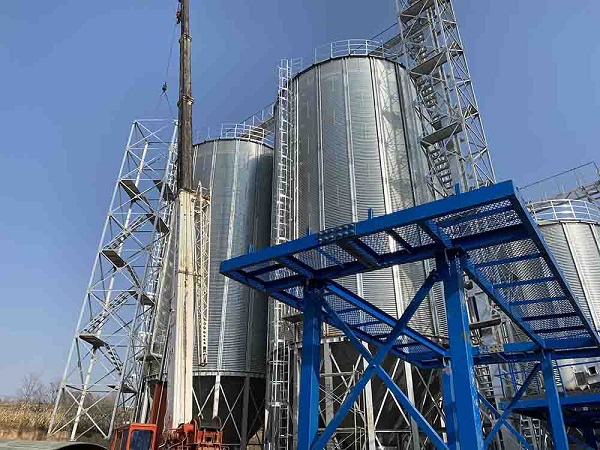
Kenya Silo Installation Site
8. Flat Bottom or Hopper Bottom Silo for Kenya?
The choice depends heavily on how the grain will be used.
Flat Bottom Grain Silo
Flat-bottom silos are generally more suitable for large-volume, longer-term grain storage.
They are commonly considered for:
- Commercial grain depots
- Grain traders
- Grain reserves
- Large farms
- Grain collection centers
- Milling plants
COBAN’s current flat-bottom range includes configurations from approximately 1,000 tons upward, with larger custom systems available. (COBAN Grain Silo)
Hopper Bottom Grain Silo
Hopper-bottom silos are more convenient when grain needs to be discharged frequently.
They are particularly useful for:
- Feed mills
- Seed plants
- Grain drying systems
- Smaller storage systems
- Frequent loading and unloading
| Requirement | Flat Bottom | Hopper Bottom |
|---|---|---|
| Large capacity | Excellent | More limited |
| Long-term storage | Excellent | Good |
| Frequent discharge | Good | Excellent |
| Gravity unloading | Limited | Excellent |
| Initial cost per ton | Generally lower at large capacity | Generally higher |
| Cleaning after discharge | Requires sweep system | Easier |
| Feed mill integration | Good | Very good |
For a Kenyan commercial grain depot storing thousands of tons for several months, flat-bottom silos are often the logical starting point. For a feed mill receiving and consuming grain continuously, hopper-bottom silos can be more practical.
9. Galvanized Steel Is Important in the Kenyan Environment
A galvanized steel grain silo in Kenya needs to withstand more than grain pressure.
The design also needs to account for:
- Rainfall
- Humidity
- Wind
- Temperature variation
- Corrosion
- Foundation conditions
- Local transportation and installation conditions
COBAN uses hot-dip galvanized corrugated steel sheets for its standard grain silo systems, with zinc coating options selected according to project requirements.
The exact material and coating specification should not be selected simply because a customer asks for “galvanized silo.”
The engineering team should evaluate:
site climate + expected service life + structural loading + maintenance conditions
This becomes particularly important in humid areas and locations exposed to frequent rainfall.
10. Kenya’s Regional Climate Should Influence Silo Design
Kenya’s geographic diversity means that a silo designed for one region should not automatically be copied into another.
Western Kenya
The western maize-growing areas generally require strong attention to:
- Moisture
- Humidity
- Insects
- Mould
- Aeration
- Grain drying
Research has identified western Kenya as an important area for maize storage losses, with moist mid-altitude areas showing particularly high estimated pest losses.
Central Highlands
Higher-altitude areas can have different temperature and humidity patterns.
Here, the design focus may shift toward:
- Seasonal temperature variation
- Moisture control
- Rain protection
- Appropriate aeration scheduling
Eastern and Semi-Arid Areas
In drier regions, moisture conditions may be less challenging in some seasons, but the project still needs to control:
- Grain temperature
- Dust
- Insects
- Heat load
- Safe storage during long holding periods
Coastal Kenya
The coastal environment requires particular attention to:
- High humidity
- Corrosion protection
- Condensation
- Rainwater management
- Grain moisture
Therefore, “Kenya grain silo” should never be treated as one single climate specification.
11. Grain Temperature Monitoring Should Be Part of the Design
For large commercial silos, temperature monitoring is not simply an optional convenience.
A temperature cable system allows operators to identify abnormal temperature changes inside the grain mass.
This is particularly valuable because a problem may begin inside the grain before there is an obvious external sign.
A typical monitoring system can identify:
temperature rise → possible hot spot → inspection → aeration/corrective action
COBAN can integrate temperature monitoring with the silo system and, where required, connect monitoring with a centralized control system.
For large Kenyan grain storage facilities, this is especially useful when operators need to manage multiple silos simultaneously.
12. Don’t Forget Grain Cleaning and Dust Control
A grain silo is only one part of the storage system.
Before grain enters the silo, cleaning can remove:
- Straw
- Chaff
- Broken grain
- Dust
- Stones
- Foreign materials
This matters for both grain quality and equipment operation.
Kenyan research on off-farm grain storage has associated lower losses with practices including cleaning and drying grain before storage and timely pest control.
For a commercial facility, the process can therefore be designed as:
Truck Receiving → Pre-Cleaning → Drying → Fine Cleaning → Bucket Elevator → Distributor → Silo → Aeration → Temperature Monitoring → Discharge
This is much more effective than purchasing a silo as an isolated piece of equipment.
13. Design the Silo Around How the Kenyan Customer Operates
Two customers may both ask for a 2,000-ton grain silo, but their actual systems can be completely different.
Customer A — Grain Trader
Receives maize from farmers → stores for several months → sells according to market conditions.
Recommended design priorities:
- Large flat-bottom silo
- Strong aeration
- Temperature monitoring
- Flexible discharge
- Grain cleaning
- Multiple silos if different batches need separation
Customer B — Feed Mill
Receives maize → cleans → stores → consumes continuously in feed production.
Recommended priorities:
- Hopper-bottom or suitable flat-bottom storage
- Fast discharge
- Screw/chain conveyor
- Bucket elevator
- Level monitoring
- Automated conveying
- Integration with feed mill
Customer C — Grain Collection Center
Receives grain from multiple farmers → cleans/drys → stores → dispatches later.
Key priorities:
- Receiving capacity
- Cleaning
- Drying
- Multiple storage silos
- Batch separation
- Accurate inventory control
This is why silo capacity alone is not enough to prepare a proper quotation.
14. What Should a Kenya Grain Silo Project Include?
For a complete commercial project, the equipment list may look like this:
| Equipment | Function |
|---|---|
| Grain Receiving Pit | Receives grain from trucks |
| Grain Cleaner | Removes impurities |
| Grain Dryer | Reduces excessive moisture |
| Bucket Elevator | Vertical grain conveying |
| Chain/Belt Conveyor | Horizontal transfer |
| Rotary Distributor | Distributes grain into silo |
| Steel Grain Silo | Main storage |
| Aeration Fan | Grain cooling and ventilation |
| Temperature Cable | Internal temperature monitoring |
| Level Indicator | Measures grain level |
| Screw Conveyor | Controlled discharge |
| Silo Sweep Auger | Removes remaining grain |
| Dust Collector | Controls dust during handling |
| PLC Control System | Centralized operation |
COBAN can integrate these systems according to the customer’s actual process instead of supplying only the steel silo.
15. What Makes COBAN’s Approach Suitable for Kenya?
COBAN has been manufacturing grain storage equipment since 2008 and operates a 32,000 m² grain silo workshop. Its grain storage systems are designed for different grain types, capacities and climatic conditions, with engineering support covering silo design, manufacturing, installation guidance and commissioning.
For a Kenyan customer, the practical advantage is not simply buying a grain silo from a manufacturer.
It is being able to work with a supplier that understands the complete storage process.
COBAN can provide:
- Galvanized steel grain silo manufacturing
- Capacity and dimension design
- Flat-bottom silo systems
- Hopper-bottom silo systems
- Aeration systems
- Temperature monitoring
- Grain cleaning
- Grain drying
- Grain conveying
- Dust collection
- PLC control
- Installation drawings
- Installation guidance
- Commissioning support
- After-sales technical support
COBAN’s current market information also identifies Kenya among the countries where its silo solutions have been supplied. (COBAN Grain Silo)
For African projects, COBAN also has project experience including 3 × 2,000-ton maize silos in Zambia, 4 × 3,000-ton grain silos in Mauritania, 2 × 4,000-ton + 1 × 300-ton grain storage in Angola, and 2 × 500-ton silos in Togo. These projects demonstrate experience with different African grain-storage capacities and operating conditions, although they should not be presented as Kenyan installations. (CobanMachinery)
If COBAN has a specific completed Kenya installation that is being used on the website, its actual project data and photographs should be presented separately rather than combining it with projects from other African countries. This keeps the case-study information factual and verifiable.
16. Why Local Climate Experience Matters More Than a Standard Silo Model
A standard silo catalogue can tell you:
Diameter × height × volume = capacity
But a proper engineering proposal needs to answer much more:
- What grain will be stored?
- What is the incoming moisture?
- What is the target storage moisture?
- How long will the grain remain in storage?
- What is the annual throughput?
- How frequently will the silo be filled?
- How frequently will it be emptied?
- What is the local climate?
- What is the local wind condition?
- What foundation will be used?
- What aeration airflow is required?
- Is drying required?
- Is temperature monitoring required?
- How will grain move between receiving, drying and storage?
- Will the customer expand the facility later?
This is the difference between selling a steel silo and engineering a grain storage system.
17. A Practical Kenya Grain Silo Design Checklist
Before requesting a quotation for a grain storage silo in Kenya, prepare the following information:
| Item | Information Required |
|---|---|
| Project Location | County / town |
| Grain | Maize, wheat, rice, sorghum, etc. |
| Total Capacity | Tons |
| Number of Silos | Required or to be designed |
| Storage Period | Days / months |
| Incoming Moisture | Approx. % |
| Target Moisture | Required storage condition |
| Daily Receiving | Tons/day |
| Daily Discharge | Tons/day |
| Aeration | Required / to be designed |
| Temperature Monitoring | Required / optional |
| Automation | Manual / semi-auto / automatic |
| Existing Equipment | Dryer, cleaner, conveyors, etc. |
| Future Expansion | Yes / No |
Once these parameters are known, the silo diameter, height, aeration system, conveying capacity and equipment configuration can be calculated much more accurately.
18. Final Recommendation for Kenyan Grain Storage Projects
For Kenya, a good grain silo design should not focus only on “How many tons can it hold?”
It should answer four questions:
1. Can the silo hold the required volume?
This determines the number, diameter and height of the silos.
2. Can the grain enter the silo in suitable condition?
This determines the need for cleaning and grain drying.
3. Can the grain remain stable during storage?
This determines the aeration, ventilation and temperature-monitoring system.
4. Can the grain be moved efficiently?
This determines the receiving pit, elevators, conveyors, distributors and discharge equipment.
The most reliable Kenya grain storage solution is therefore not simply a galvanized steel tank. It is a coordinated system in which capacity, grain moisture, climate, aeration, monitoring and material handling are designed together.
For a Kenyan customer comparing grain silo manufacturers, grain silo suppliers, maize storage silos, commercial grain storage systems, 1,000-ton/2,000-ton/5,000-ton grain silos or complete grain storage projects, this approach provides a much more useful basis for investment than comparing silo prices alone.
COBAN’s role is to start from the customer’s grain and operating conditions, then develop the appropriate silo configuration and supporting equipment around the actual project requirements. (COBAN Grain Silo)