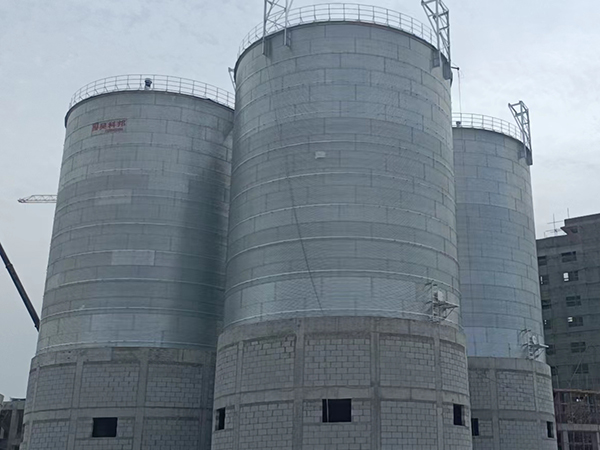
Designing a grain silo is far more than choosing a cylinder and filling it with grain. A properly engineered silo must balance capacity optimization, structural safety, material flow behavior, and environmental factors. Poor design leads to issues like grain spoilage, structural failure, uneven discharge, and costly downtime.
This guide provides a professional, engineering-oriented overview of grain silo design calculations, including capacity formulas, load analysis, practical parameters, and real-world considerations.
1. Fundamentals of Grain Silo Design
Grain silo design involves three key dimensions:
- Storage capacity (volume & mass)
- Structural load (vertical + lateral pressures)
- Discharge and flow behavior
A well-designed silo must ensure:
- Uniform load distribution
- Smooth grain flow
- Structural integrity under full and empty conditions
- Resistance to wind, seismic, and thermal effects
2. Silo Capacity Calculation
2.1 Basic Volume Formula
For a typical cylindrical silo with a conical roof, total volume is:
- Cylinder volume
- Roof (cone) volume
Using the standard formulas:
Total Volume:
V = Vcylinder + Vroof
Vcylinder = πr2h
Vroof = (1/3)πr2hr
Where:
- ( r ) = radius (m)
- ( h ) = cylinder height (m)
- ( h_r ) = roof height (m)
2.2 Converting Volume to Storage Capacity
Grain is stored by mass (tons), not volume.
Capacity (tons): Capacity = V × ρ
Where:
- V = volume (m³)
- ρ = bulk density (kg/m³)
2.3 Typical Bulk Density of Grains
| Grain Type | Bulk Density (kg/m³) | Tons/m³ |
|---|---|---|
| Wheat | 720–780 | 0.72–0.78 |
| Corn (Maize) | 680–750 | 0.68–0.75 |
| Rice | 560–650 | 0.56–0.65 |
| Soybean | 700–770 | 0.70–0.77 |
2.4 Example Calculation
Silo dimensions:
- Diameter: 10 m
- Height: 20 m
- Roof height: 3 m
Step 1: Volume
- Radius = 5 m
Cylinder:
V = π × 52 × 20 = 1570 m3
Roof:
V = (1/3) π × 52 × 3 = 78.5 m3
Total:
V ≈ 1648.5 m3
Step 2: Capacity (Corn)
Capacity = 1648.5 × 0.72 ≈ 1187 tons

3. Load Analysis in Silo Design
Grain silos experience complex loads, not just static weight.
3.1 Vertical Load (Dead Load)
This is the weight of stored grain:
Vertical Load (Pv):
Pv = ρ × g × h
Where:
- ρ = grain density
- g = gravity (9.81 m/s²)
- h = grain height
3.2 Lateral Pressure (Janssen Theory)
Unlike liquids, grain exerts non-linear lateral pressure due to friction with walls.
Janssen equation:
Horizontal Load (Ph):
Ph = (μ k / (ρ g R)) × (1 – e-R μ k h)
Where:
- Ph = horizontal pressure
- R = hydraulic radius
- μ = wall friction coefficient
- k = lateral pressure ratio
Key Insight:
- Pressure does NOT increase linearly with depth
- It reaches a maximum asymptotic value
3.3 Load Types Summary
| Load Type | Description |
|---|---|
| Dead Load | Grain weight |
| Live Load | Maintenance, workers |
| Wind Load | External lateral force |
| Seismic Load | Earthquake effect |
| Thermal Load | Expansion/contraction |
| Discharge Load | Uneven flow stress |
3.4 Critical Design Scenario
The most dangerous condition is often:
Partial discharge (eccentric flow)
This can cause:
- Uneven wall pressure
- Buckling
- Structural failure
4. Key Design Parameters
4.1 Diameter vs Height Ratio
| Type of Silo | Height/Diameter Ratio |
|---|---|
| Short silo | < 1.5 |
| Medium silo | 1.5 – 3 |
| Tall silo | > 3 |
4.2 Wall Material Thickness
Typical galvanized steel thickness:
| Capacity Range | Thickness |
|---|---|
| < 1000 tons | 2–4 mm |
| 1000–5000 tons | 4–8 mm |
| > 5000 tons | 6–12 mm |
4.3 Hopper Angle
For proper flow:
| Grain Type | Minimum Hopper Angle |
|---|---|
| Corn | 35–45° |
| Wheat | 30–40° |
| Rice | 40–50° |
5. Grain Flow Considerations
Two main flow patterns:
5.1 Mass Flow
- Entire grain moves uniformly
- No dead zones
- Best for quality
5.2 Funnel Flow
- Only central flow channel
- Risk of:
- Mold
- Bridging
- Segregation
Engineering Recommendation:
Prefer mass flow design for high-value grain storage
6. Environmental & Safety Factors
6.1 Ventilation
- Prevent moisture buildup
- Maintain grain quality
6.2 Temperature Monitoring
- Avoid hotspots
- Prevent spoilage
6.3 Explosion Protection
Grain dust is highly explosive
Required:
- Explosion vents
- Dust control systems

silo capacity
7. Case Study: Medium-Scale Grain Storage
Project: Feed processing plant
| Parameter | Value |
|---|---|
| Capacity | 3000 tons |
| Grain | Corn |
| Diameter | 14 m |
| Height | 25 m |
Design Highlights:
- Corrugated galvanized steel
- Aeration system installed
- Temperature monitoring cables
- Mass flow hopper
Result:
- Reduced spoilage by 18%
- Improved unloading efficiency by 25%
8. Why Choose COBAN for Grain Silo Projects
As a professional manufacturer in grain storage systems, COBAN provides:
8.1 Engineering Expertise
- Advanced structural calculations
- Customized silo capacity design
- Compliance with international standards
8.2 High-Quality Materials
- Hot-dip galvanized steel
- Corrosion resistance > 25 years
8.3 Integrated Solutions
- Silo + dryer + conveying systems
- Turnkey feed and grain storage projects
8.4 Smart Systems
- Temperature monitoring
- Aeration control
- Automation integration
9. Hot Markets for Grain Silos
Grain silo demand is rapidly growing in:
| Region | Key Drivers |
|---|---|
| Southeast Asia | Rice & feed industry growth |
| Africa | Food security projects |
| South America | Large-scale maize storage |
| Middle East | Strategic grain reserves |
| Eastern Europe | Grain export infrastructure |
10. FAQ – Grain Silo Design
Q1: How do I choose the right silo capacity?
Answer:
Consider:
- Daily processing volume
- Storage duration
- Harvest season fluctuations
Q2: What is the most important factor in silo design?
Answer:
Load calculation and grain flow behavior
Q3: Why is lateral pressure critical?
Answer:
Because it determines:
- Wall thickness
- Structural safety
Q4: What causes silo failure?
Answer:
- Uneven discharge
- Poor design calculations
- Overloading
- Weak foundation
Q5: How long does a steel silo last?
Answer:
With proper maintenance:
20–30 years or more
11. Conclusion
Grain silo design is a multidisciplinary engineering task involving structural mechanics, material science, and agricultural processing. Accurate silo capacity calculation and load analysis are critical to ensure safety, efficiency, and long-term performance.
Whether you are building a small farm storage system or a large industrial grain facility, investing in proper design and professional engineering support will significantly reduce risks and improve operational efficiency.