Before diving into the base designs, you might want to review our [Ultimate Technical Selection Guide for Metal Grain Silos] to understand the engineering standards required for 2026.

Technical Deep Dive: More Than Just a Shape
The difference between these two silos starts at the foundation but extends to the very engineering of the steel structure.
Flat Bottom Silos: The Heavy-Duty Giant
Flat bottom silos are the backbone of large-scale grain terminals and national reserves.
Engineering Detail: COBAN flat bottom silos utilize high-tensile galvanized steel plates (with coating options of $275g/m^2$ to $450g/m^2$ depending on the site’s salinity and humidity).
Aeration Excellence: Because the floor is flat, we design complex U-shaped or fully perforated aeration ducts embedded in the concrete. This ensures uniform airflow to prevent “hot spots” in massive grain piles of up to 15,000 tons.
The Unloading Challenge: Gravity handles about 70-80% of the discharge. The remainder requires a Sweep Auger, a specialized mechanical arm that rotates $360^{\circ}$ to push the residual grain to the center discharge point.
Hopper Bottom Silos: The Faster Choice
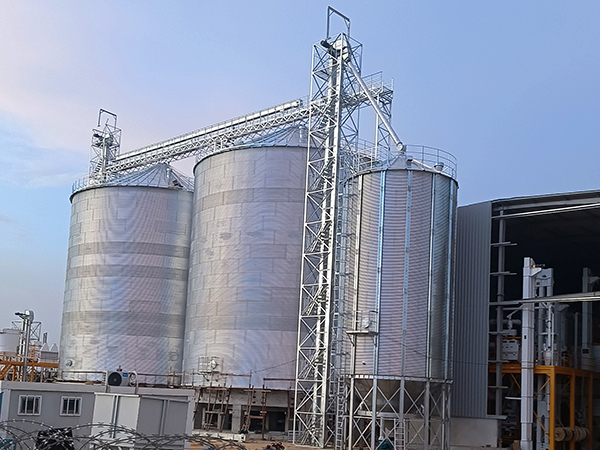
If you need to move grain every few days—like in a feeding line or a flour mill—a hopper silo is the only practical option. It sits on steel legs, using a cone base to let gravity unload everything automatically.
The 45° vs. 60° Rule: We don’t guess the angle. For dry corn or wheat, a 45° slope is standard. But for “sticky” materials like soybean meal or high-moisture paddy that tend to bridge, you need a 60° cone. This ensures the grain actually flows instead of getting stuck.
The Support Legs: In a hopper silo, the entire 1,500-ton load is concentrated on the steel pillars. To prevent buckling, we use Grade 8.8 high-strength bolts and heavy-duty cross-bracing. It’s built to stay vertical during high winds and earthquakes.
Self-Cleaning: This is the main reason to buy a hopper. Because there’s no flat floor, gravity clears out 100% of the grain. You get a “First-In, First-Out” (FIFO) flow without paying anyone to climb inside with a broom or shovel.
Technical Reality: Why the Base Design Matters
The Hopper Angle: It’s not just a funnel. We use a 45° angle for free-flowing grains like dry corn and wheat. But if you’re handling soybean meal or high-moisture paddy—materials that tend to stick—you need a steeper 60° cone. This ensures everything flows out smoothly without getting clogged.
Built to Handle the Pressure: In a hopper silo, the entire weight sits on the steel legs. This is a massive amount of pressure. To handle this, COBAN uses Grade 8.8 high-strength bolts and heavy-duty leg bracing. We engineer these specifically to stand firm against high winds and seismic shakes.
Unloading Without the Mess: The biggest win with a hopper silo is that it cleans itself. Because of the steep cone, gravity pulls everything out—no grain gets stuck in the corners. You don’t have to waste time sending guys inside with brooms or shovels to clear out residue. It’s a “First-In, First-Out” setup that just works, saving you from the headache of manual labor.
Comparison Table: Selection Metrics

The Hidden Cost Analysis: Beyond the Price Tag
When comparing quotes, many buyers only look at the “Silo Price.” However, the Total Cost of Ownership (TCO) tells a different story:
Foundation Costs: Flat bottom silos require significantly more concrete and steel rebar for the base. Hopper silos have a smaller footprint but require deeper pilings to handle the concentrated pressure of the support legs.
Labor & Energy: If your facility empties its silos more than 10 times a year, the electricity and labor required to operate a sweep auger in a flat bottom silo will quickly surpass the higher upfront cost of a hopper bottom silo.
Cross-Contamination: For seed producers, the cost of “contamination” (remnants of a previous batch) is catastrophic. A hopper silo’s self-cleaning nature eliminates this risk entirely.
Critical Buyer Alert: Choosing the right silo type is only half the battle. Many suppliers offer these designs at “discount” prices by compromising on steel grade and bolt strength. Before you sign any contract, read our 2026 Silo Procurement Guide: Why Some Quotes are 20% Cheaper to protect your investment.
Environmental & Crop Adaptability
Handling the Humidity (Southeast Asia & Africa)
If you’re building in hot, sticky climates, your grain is basically “breathing” and sweating all the time.
Flat Bottom Silos: You can’t just leave the grain sitting there. You absolutely need a temp-cable system. We usually space sensors every 2 to 3 meters. Why? Because in that heat, if you don’t catch a “hot spot” early, you’ll lose tons of grain to mold before you even smell it.
Hopper Bottom Silos: These have a natural edge in wet areas. Since the silo is up on legs, air flows right underneath the base. This keeps the grain away from the damp ground and stops soil moisture from “climbing” into your product. It’s a simple way to keep the bottom layer dry without extra fans.
Crop-Specific Advice
Paddy/Rice: Due to its abrasive husk and moisture sensitivity, 60° Hopper Silos are recommended for processing stages.
Wheat/Corn: For long-term commercial trade, Flat Bottom Silos offer the best ROI for volume.
Success Stories from the Field
Case Study A: The Industrial Feed Mill (Nigeria)
Challenge: A mill needed to switch between corn and soy daily.
Solution: COBAN installed a battery of 6 x 500-ton Hopper Bottom Silos.
Result: The client eliminated manual cleaning entirely, saving 40 labor hours per week and preventing any risk of batch mixing.
Case Study B: The Export Terminal (Indonesia)
Challenge: Storing 15,000 tons of corn for export.
Solution: Two 7,500-ton Flat Bottom Silos with specialized wide-diameter aeration fans.
Result: The corn was maintained at a steady 28 °C despite external temperatures of 35 °C , preserving export quality for 6 months.

Frequently Asked Questions (FAQ)
Conclusion: Engineering Your Success
Choosing between a flat bottom and a hopper bottom silo is a balance of Volume vs. Velocity.
If you need to store massive amounts for a long time, go Flat.
If you need to move grain quickly and automatically, go Hopper.
At COBAN (Henan COBAN Machinery Equipment Co., Ltd.), we don’t just sell silos; we engineer storage ecosystems.
Our team provides full site evaluations, foundation drawings, and global installation support.
Don’t leave your harvest to chance.
Free Custom Layouts • Site-Specific Engineering • Global Support