
Differences in basic structures
The most obvious difference between cone-bottom silos and flat-bottom silos is the bottom design. Manufacturers shape the bottom of a cone-bottom silo like an inverted cone and usually construct it at an angle between 45 and 60 degrees. This design allows the material to slide down completely by its own weight, making discharge particularly convenient. In contrast, the bottom of a flat-bottom silo is flat. It often requires the use of a bin sweeper or vibrator during unloading; otherwise, material residue is likely to remain.
From the perspective of appearance ratio, cone-bottom silos are usually “thin and tall” in shape. Their height-to-diameter ratio typically ranges between 1.5 and 2.5. Flat-bottom silos appear “short and fat”, and this ratio is usually around 0.8 to 1.2. This structural difference directly affects their applicable scenarios and usage effects.
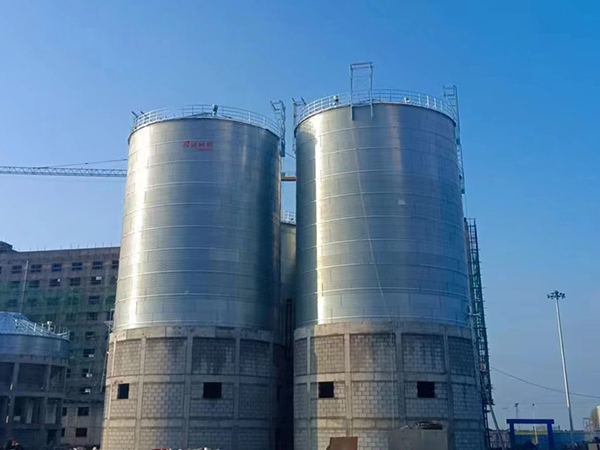
Comparison of functional characteristics
Unloading efficiency
Operators can achieve an unloading speed of 20–50 tons per hour with a cone-bottom silo, depending on the material characteristics. When relying on mechanical assistance, a flat-bottom silo operates with 30%–40% lower efficiency. The residual rate of powdered materials in cone-bottom silos is less than 0.5%. In comparison, flat-bottom silos can have a residual rate ranging from 3% to 8%.
Construction cost
Comparison of Φ15m silos: The cone-bottom silos uses 15%-20% more steel, but eliminates the need for clearing equipment; the flat-bottom silo has a 12%-15% lower foundation cost, but space for equipment installation needs to be reserved.
Applicable materials
Preferred solutions for cone-bottom silos: granular materials with good fluidity (such as grain, plastic particles), materials that are easy to agglomerate (need to be combined with fluidizing devices); flat-bottom silos are more suitable for fibrous materials (such as straw) and ultra-high viscosity materials (such as asphalt).
Key points of operation and maintenance
The cone bottom silos needs to focus on monitoring the stress of the cone bucket weld (UT testing is recommended every six months), and a vibration anti-arch device needs to be added when the moisture content of the material is greater than 15%
The flat-bottom silo should have a defined equipment maintenance cycle, with the scraper chain replaced every 2000 hours. Additionally, the operator needs to equip the silo wall with a wear-resistant lining that is at least 8mm thick.

Selection decision matrix
Consideration dimensions Cone bottom silos advantage scenario Flat bottom silo advantage scenario Investment budget Long-term operation project Short-term temporary storage Material characteristics Liquidity A-B type particles C-D type special materials Automation requirements Fully automatic process Semi-automatic/manual intervention Site restrictions Adequate vertical space Low structure required
Industry data shows that in the field of grain storage, cone-bottom silos account for 78%, according to China’s grain silo census data in 2024. In contrast, flat-bottom silos still hold a market share of 62% in the chemical industry.


