If you are struggling with whether steel silo are “expensive”, a short answer is: In the long run, its cost per ton of grain storage is the lowest, but the initial investment will vary greatly depending on your specific needs. Here are the budget details you need to know and the reasons behind them.

Market price overview: Pricing logic based on “tonnage”
In international trade, we usually estimate costs based on storage capacity (metric tons). However, the unit price is not linear – the larger the capacity, the more obvious the scale effect, and the lower the cost per ton.
Small warehouses (under 500 tons) : The proportion of engineering design costs is relatively high. The price is usually between 120 and 200 US dollars per ton (about 850 to 1,400 yuan per ton).
Medium-sized warehouses (500 tons – 2,000 tons) : This is the “golden range” for commercial farms and medium-sized processing plants. The price is usually stable at 100 to 150 US dollars per ton (about 700 to 1,000 yuan per ton).
Large industrial warehouses (over 5,000 tons) : This falls under large-scale engineering projects. Although the total price is high, the cost per ton can be reduced to $80 – $110 (about 550-800 yuan per ton).
Read: How long do grain silos last?
What exactly drives costs? (Secrets Beyond Steel)
When you see that the quotations of two seemingly “identical” steel plate silos differ by tens of thousands of yuan, the tricks are usually hidden in the following four factors:
Differences in warehouse types: Prefabricated vs. spiral vs. welded
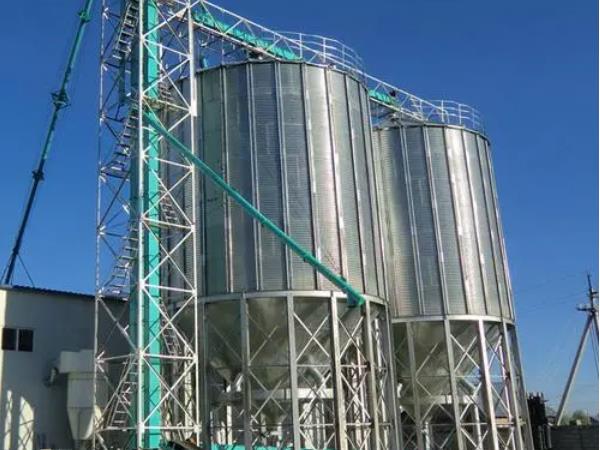
1. Prefabricated (bolted) steel silos: The global standard for export trade. They are convenient for containerization and transportation, and due to the use of fully galvanized sheets, they have extremely strong anti-corrosion performance.
2. Spiral (Lipp) steel silo: It is formed by on-site interlocking by a dedicated unit. It has excellent air tightness (suitable for fumigation and pest control), but it requires professional equipment to enter the site, and the labor and construction costs are relatively high.
Material thickness and galvanized coating
Not all steels are the same. Steel plates with a galvanizing content of 275g/m² are definitely cheaper than those with a galvanized content of 450g/m². If you are in a coastal area with high humidity and try to save money by reducing the galvanized layer, the warehouse body may rust within five years. We usually recommend checking the steel grade (such as S350GD or Q345B) – when you are stacking thousands of tons of grain, the yield strength of the steel is of vital importance.
“Hidden” infrastructure: Foundation and ventilation
The main body of the steel plate silo often accounts for only 60% to 70% of the total project cost. You must reserve the following budget:
1. Civil engineering: Concrete foundation or steel cone bottom.
2. Ventilation system: fans, air ducts and temperature measurement cables. Without these, the grain will heat up and deteriorate, and your investment will vanish in an instant.
Geographical Location and Logistics
Transporting “air” is very expensive. Although we will have the panels nested together during the design to save space, if your construction site is very remote, the crane rental fee and the travel expenses of the professional installation team will increase the total cost by 15% to 20%.
 Installation site of prefabricated steel silo in Indonesia
Real case cost estimation (Reference price)
To give you a more intuitive feeling, let’s take a look at three typical scenarios:
Scene A: Upgrading of a small farm (with a capacity of approximately 500 tons)
1. Target: Local farmers or small feed mills.
2. Estimated cost: 60,000-85,000 US dollars (approximately 400,000-600,000 RMB).
3. Note: At this scale, the cost proportion of the discharge screw conveyor and the foundation cleaning equipment is relatively high.
Scene B: Commercial grain turnover warehouse (with a capacity of approximately 1,000 tons)
1. Target: Grain traders or medium-sized food processing enterprises.
2. Estimated cost: 110,000-150,000 US dollars (approximately 800,000-1.1 million RMB).
3. Note: This budget usually includes a relatively complete temperature measurement and monitoring system and high-capacity bucket elevators to achieve rapid loading and unloading.
Scene C: Industrial-grade large-scale grain depots (with a capacity of over 10,000 tons)
1. Object: National reserve grain depots or port terminals.
2. Estimated cost: Over 1,000,000 US dollars (approximately over 7 million RMB).
3. Note: This is the complete industrial factory level. It includes heavy-duty corridors, PLC automatic control systems and advanced dust removal systems.
Money-saving tips from industry insiders
As a professional, I always advise my clients to look at the total cost of ownership (TCO) rather than just the initial quote.
Demand matching, no overdesign
If you only store dry corn, there is no need to pursue ultimate airtightness as you would for storing flammable chemical powder. However, the thickness of the bottom ring plate must not be compromised – that is where the pressure is the greatest.
The “local + imported” combination model
Sometimes, standard structural steel (such as brackets) is purchased locally, while core high-strength galvanized sheets and ventilation technology are imported from professional large factories, which can save a large amount of transportation costs.
Request a detailed disassembly quotation sheet
Professional manufacturers should provide a detailed list of “plates + processing + spare parts + transportation + installation”. If the other party only offers a “fixed price”, be extremely cautious – they might have tampered with the thickness of the steel plate.
Prioritize investment in intelligence
Adding a sensor system worth several thousand dollars might help you preserve food worth tens of thousands of dollars. In the grain industry, data is always cheaper than losses.
Summary
Is investing in grain steel plate silos a huge expense? Yes. However, compared with the common 10% to 15% grain loss in traditional flat warehouses or open-air storage, a well-constructed steel plate silo can usually recoup its cost by reducing losses within 3 to 5 years.
Do you have a specific grain storage project plan? I can help you assess your capacity requirements or provide you with a more detailed list of technical specifications. You are welcome to inform me of your “tonnage requirements” and “types of grain” at any time. I am more than willing to offer you professional advice.