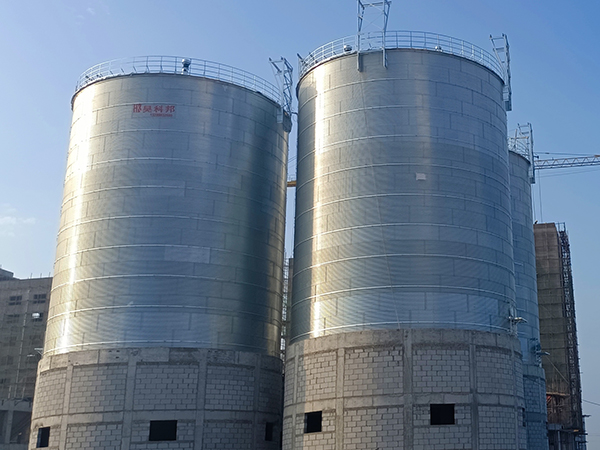
200 Ton Grain Silo
COBAN grain silos are designed to ensure safe storage, stable ventilation, and long-term grain preservation under different climate conditions. Each silo system can be customized based on capacity, grain type, and project requirements for optimal storage performance and reliability.

200 Ton Grain Silo
Product Type:200 Ton Grain Silo
Storage Capacity:Approx. 200 Metric Tons
Material:Galvanized Steel
Application:Maize, Wheat, Rice, Barley, Sorghum
Optional Systems:Aeration, Temperature Monitoring, Conveying & Unloading
- Customized Capacity Design
- High Strength Galvanized Steel
- ISO Certified Manufacturing
- Global Installation Support
Applications
Corn Storage
Wheat Storage
Rice Storage
Soybean Storage
Feed Storage
Commercial Grain Storage
Product Details & Technical Information
A 200 Ton Grain Silo is a compact steel grain storage solution designed for farms, grain traders, feed mills, rice mills, maize processors, and other agricultural businesses that need reliable storage without investing in a large-capacity grain storage system.
For many medium-sized farms and processing facilities, 200 tons is a practical storage capacity. It can be used as a single storage unit or combined with several silos to create a larger grain storage center.
COBAN supplies galvanized steel grain silos with configurable diameters, heights, aeration systems, temperature monitoring, unloading equipment, and conveying systems according to the grain type, storage capacity, site conditions, and project requirements.
What Is a 200 Ton Grain Silo?
A 200 ton grain silo is a vertical grain storage bin designed to hold approximately 200 metric tons of grain under the specified storage conditions.
Unlike a conventional flat warehouse, grain is stored vertically inside the silo. This reduces the ground area required for storage and makes it easier to integrate mechanical conveying, aeration, temperature monitoring, and automated grain handling.
A typical 200 ton grain silo system may include:
- Galvanized steel silo body
- Roof and roof access components
- Stiffeners and structural supports
- Hopper or flat-bottom discharge system
- Aeration floor or ventilation system
- Temperature monitoring cables and sensors
- Grain inlet and outlet
- Ladder and safety cage
- Inspection manhole
- Grain conveying equipment
- Level sensor
- Cleaning and maintenance access
The exact configuration should be determined by the grain being stored and the customer’s handling requirements rather than simply selecting a silo by capacity.


200 Ton Grain Silo at a Glance
| Item | Typical Specification |
|---|---|
| Storage capacity | Approx. 200 metric tons |
| Silo type | Galvanized steel grain silo |
| Main application | Maize, wheat, rice, barley, sorghum and other bulk grains |
| Structure | Corrugated galvanized steel panels with stiffeners |
| Storage method | Vertical bulk grain storage |
| Aeration | Optional / designed according to grain and climate |
| Temperature monitoring | Optional, recommended for long-term storage |
| Discharge | Gravity or mechanical unloading depending on silo design |
| Grain handling | Bucket elevator, screw conveyor, belt conveyor or drag conveyor |
| Installation | Bolted assembly on reinforced concrete foundation |
Important: A 200-ton rating is not the same as the exact geometric volume of the silo. Grain bulk density, allowable fill level, safety margin, roof space, and silo design all affect the final dimensions.
How Much Grain Can a 200 Ton Silo Actually Hold?
The answer depends on the bulk density of the grain.
For example, maize, wheat and rice do not occupy the same volume at the same weight. This is why professional silo selection should start with the required tonnage and grain type instead of selecting a diameter first.
Typical bulk density ranges can be used for preliminary engineering calculations:
| Grain | Approx. Bulk Density | Approx. Volume for 200 t* |
|---|---|---|
| Maize / Corn | 680–750 kg/m³ | 267–294 m³ |
| Wheat | 720–800 kg/m³ | 250–278 m³ |
| Paddy Rice | 550–600 kg/m³ | 333–364 m³ |
| Sorghum | 700–750 kg/m³ | 267–286 m³ |
| Barley | 600–700 kg/m³ | 286–333 m³ |
*Approximate calculation only. Actual silo sizing should consider grain moisture, bulk density, filling efficiency, freeboard, structural load, and the required operating capacity.
This distinction is important when comparing a 200 ton grain silo for sale from different suppliers. Two silos advertised as “200 tons” may have different dimensions and working capacities because their design assumptions are different.
Why Choose a 200 Ton Grain Silo?
1. Practical Capacity for Medium-Sized Grain Operations
A 200-ton silo sits between small farm storage and large commercial grain storage.
It is suitable when a customer needs enough storage to handle seasonal harvests but does not yet require a 500-ton or 1,000-ton storage unit.
It can also be used as one module in a larger storage project.
For example:
- 1 × 200 t = 200 t total storage
- 2 × 200 t = 400 t total storage
- 3 × 200 t = 600 t total storage
- 5 × 200 t = 1,000 t total storage
Using multiple silos provides better grain separation and allows different grain lots to be stored independently.
2. Better Grain Management Than Bulk Warehouse Storage
A steel grain silo is not simply a large container.
The silo can be integrated with:
- Aeration
- Temperature monitoring
- Grain level detection
- Mechanical conveying
- Automatic unloading
- Dust collection
- Grain cleaning
- Control systems
This allows the operator to manage grain quality more systematically.
For long-term storage, grain temperature is one of the most important parameters to monitor. A localized temperature increase can indicate moisture migration, insect activity, or grain deterioration.
3. Compact Vertical Storage
A 200 ton grain storage silo uses vertical space rather than spreading grain across a large warehouse floor.
This can be particularly useful where land is expensive or the customer wants to leave sufficient space for:
- Grain receiving
- Truck circulation
- Drying equipment
- Cleaning equipment
- Conveyors
- Future silo expansion
The actual site footprint depends on the selected silo diameter, foundation design, conveyors, access platforms, and maintenance clearances.
200 Ton Grain Silo for Different Grain Types
A 200 ton silo can be designed for different bulk agricultural commodities, but the storage conditions are not identical.
200 Ton Maize Silo
Maize is one of the most common applications.
For maize storage, the system should normally consider:
- Grain moisture at loading
- Initial grain temperature
- Aeration requirements
- Temperature monitoring
- Insect control
- Discharge performance
For maize harvested at high moisture, the grain should normally be dried to a suitable storage moisture level before long-term storage. A silo should not be treated as a substitute for a grain dryer.
200 Ton Wheat Silo
Wheat can be stored efficiently in a 200 ton steel silo when moisture and temperature are controlled.
For wheat storage, attention should be given to:
- Grain cleanliness
- Moisture uniformity
- Temperature distribution
- Aeration
- Insect activity
200 Ton Paddy Rice Silo
Paddy has a lower bulk density than many cereal grains, so the required storage volume can be larger for the same 200-ton weight.
For paddy storage, the project should consider:
- Moisture content
- Grain temperature
- Aeration
- Storage duration
- Grain handling damage
200 Ton Sorghum or Barley Silo
Sorghum and barley can also be stored in galvanized steel silos. The final silo design should be based on their bulk density, flow characteristics and storage conditions.
What Equipment Does a 200 Ton Grain Silo Need?
A silo can be purchased as a basic storage structure or integrated into a complete grain handling system.
For a commercial installation, we normally recommend considering the following equipment together.
| Equipment | Main Function | Recommendation |
|---|---|---|
| Steel silo | Grain storage | Required |
| Aeration system | Removes heat and moisture | Recommended |
| Temperature sensors | Monitors grain temperature | Recommended |
| Level sensor | Indicates grain level | Optional |
| Bucket elevator | Vertical grain transport | Project dependent |
| Belt/drag conveyor | Horizontal transport | Project dependent |
| Screw conveyor | Controlled grain transfer | Project dependent |
| Dust collector | Controls grain dust | Recommended for larger systems |
| Grain cleaner | Removes impurities | Before storage |
| Grain dryer | Reduces excessive grain moisture | Required when incoming grain is too wet |
The most important point is that the silo should be considered as part of a grain storage system, rather than as an isolated steel structure.
200 Ton Grain Silo Aeration and Temperature Monitoring
For customers planning medium- or long-term grain storage, aeration and temperature monitoring deserve special attention.
Aeration
Aeration moves ambient air through the grain mass to help control grain temperature.
The required aeration rate depends on:
- Grain type
- Grain moisture
- Storage period
- Local climate
- Silo diameter
- Grain depth
- Desired cooling strategy
There is no single fan size that is correct for every 200-ton silo.
For this reason, fan selection should be calculated according to the actual project rather than copied from another installation.
Temperature Monitoring
A temperature monitoring system normally uses sensor cables installed vertically inside the silo.
The system can help identify:
- Hot spots
- Uneven temperature distribution
- Temperature increases
- Potential moisture migration
- Possible insect activity
For a customer investing in a 200 ton grain storage silo, temperature monitoring is a relatively small part of the total project cost but can provide significant value during long-term storage.

200 Ton Grain Silo Dimensions
There is no universal dimension for a 200 ton silo.
The final diameter and height depend on:
- Grain type
- Bulk density
- Required working capacity
- Roof configuration
- Maximum filling height
- Foundation conditions
- Aeration design
- Discharge method
- Local wind and seismic conditions
- Transportation and installation requirements
For this reason, it is better to select the capacity first and dimensions second.
A professional supplier should provide a silo drawing showing:
- Overall height
- Silo diameter
- Roof height
- Shell height
- Foundation diameter
- Inlet and outlet positions
- Ladder position
- Aeration arrangement
- Conveyor interface
- Maintenance access
Galvanized Steel Construction
For outdoor grain storage, galvanized steel is widely used because it provides a practical balance between structural strength, corrosion resistance, installation convenience, and service life.
A typical galvanized steel silo consists of corrugated steel panels reinforced by vertical stiffeners.
The important specifications are not limited to the steel plate thickness.
When comparing a 200 ton steel silo, customers should also ask about:
- Steel grade
- Zinc coating
- Panel thickness
- Stiffener size
- Bolt and nut quality
- Roof structure
- Wind load
- Seismic load
- Foundation design
- Corrosion protection
A thicker plate does not automatically mean a better silo. The complete structural design must be considered.
How Is a 200 Ton Grain Silo Installed?
A typical installation follows several major stages.
Step 1: Foundation Preparation
The reinforced concrete foundation must be designed according to the silo diameter, grain load, local soil conditions, wind load and seismic requirements.
Step 2: Bottom Structure Installation
The base components and bottom structure are installed and aligned.
Step 3: Silo Wall Assembly
Galvanized steel panels are assembled layer by layer and connected with structural bolts.
Step 4: Roof Installation
The roof structure, roof panels, access openings and safety components are installed.
Step 5: Aeration and Instrumentation
Aeration ducts, fans, temperature cables and sensors are installed according to the selected system.
Step 6: Conveying System Connection
The silo is connected with the bucket elevator, conveyor, cleaner, dryer or other upstream/downstream equipment.
Step 7: Inspection and Commissioning
Before grain loading, the silo structure, bolts, discharge system, sensors, fans and conveying equipment should be inspected and tested.
How Much Space Is Needed for a 200 Ton Grain Silo?
The silo itself only represents part of the required project area.
Customers should reserve additional space for:
- Truck loading and unloading
- Grain receiving
- Conveyors
- Bucket elevators
- Dryer and cleaner
- Electrical control cabinet
- Maintenance access
- Worker safety access
- Future expansion
For example, if two or three 200-ton silos are installed together, the layout can be planned around a common conveying line rather than treating each silo as a completely independent system.
This can reduce repeated equipment and make future expansion easier.
200 Ton Grain Silo Price: What Affects the Cost?
Customers searching for 200 ton grain silo price often expect one fixed number. In practice, the final project price depends on the configuration.
The main cost factors include:
| Cost Factor | Impact on Price |
|---|---|
| Silo body and steel quantity | High |
| Galvanization specification | Medium–High |
| Roof and structural configuration | Medium |
| Aeration system | Medium |
| Temperature monitoring | Medium |
| Discharge system | Medium |
| Conveying equipment | High for complete systems |
| Grain cleaner | Project dependent |
| Grain dryer | Project dependent |
| Electrical/control system | Project dependent |
| Freight and destination | High for overseas projects |
| Foundation and civil works | Site dependent |
| Installation | Site dependent |
Therefore, a useful 200 ton grain silo quotation should clearly separate the silo body, accessories, grain handling equipment, electrical system, transportation, installation and civil works.
This makes different supplier quotations much easier to compare.
Is a 200 Ton Grain Silo Right for Your Project?
A 200-ton silo is generally worth considering when:
- Your storage requirement is around 200 tons per batch or storage unit.
- You want to move from warehouse storage to bulk grain storage.
- You need better grain temperature management.
- You want mechanical loading and unloading.
- You expect to expand storage capacity later.
- Your operation handles maize, wheat, rice, barley, sorghum or similar bulk grains.
It may not be the best choice if your actual requirement is only a few tons or if you need very large commercial storage. In those cases, a smaller grain bin or a multi-silo system may be more economical.
One 200 Ton Silo or Several Smaller Silos?
This is an important engineering decision.
Suppose the required total storage is 400 tons.
You could install:
Option A: 1 × 400 ton silo
or
Option B: 2 × 200 ton silos
The second configuration costs more in silo structure and accessories, but it provides better flexibility.
| Consideration | 1 × 400 t | 2 × 200 t |
|---|---|---|
| Initial silo cost | Lower | Higher |
| Grain separation | Limited | Better |
| Storage flexibility | Moderate | High |
| Different grain varieties | Less convenient | Easier |
| Maintenance flexibility | Lower | Higher |
| Future operation | Simple | More flexible |
For customers handling different grain varieties, different harvest dates, or different moisture levels, multiple smaller silos can sometimes provide better operational control.
200 Ton Grain Silo for Farms and Commercial Storage
For Farms
A 200 ton grain silo can provide temporary or seasonal storage after harvest.
The farmer can:
- Harvest the grain.
- Clean the grain.
- Dry it when necessary.
- Transfer it into the silo.
- Monitor grain temperature.
- Aerate when required.
- Store until the preferred selling period.
This approach gives the farm greater control over grain handling instead of immediately selling the crop after harvest.
For Grain Traders
Grain traders can use several 200-ton silos to separate commodities according to:
- Grain type
- Supplier
- Harvest date
- Moisture level
- Quality grade
- Customer requirements
This is particularly useful when grain is purchased from multiple farms.
For Feed Mills
A 200-ton silo can serve as a raw material storage unit for maize, wheat, sorghum or other feed ingredients.
Multiple silos can be connected to a common conveying system and feeding line.
The silo capacity should be matched with the feed mill’s daily consumption rather than selected independently.
200 Ton Grain Silo Project Configuration
A typical medium-scale grain storage system can be arranged as:
Truck Receiving → Grain Cleaner → Grain Dryer → Bucket Elevator → 200 Ton Grain Silo → Aeration & Temperature Monitoring → Conveyor → Processing / Loading
For dry grain that does not require drying, the dryer can be removed from the process.
For a larger storage center:
Receiving Pit → Cleaner → Dryer → Elevator → Multiple 200 Ton Silos → Conveyors → Processing / Truck Loading
This modular approach allows the customer to add storage capacity later.
Why Work With COBAN for a 200 Ton Grain Silo?
From an engineering perspective, the silo itself is only one part of the project.
The more important question is whether the storage system works correctly after installation.
For a 200-ton project, COBAN can assist with:
- Grain storage capacity planning
- Silo selection
- Silo layout
- Steel silo design
- Aeration configuration
- Temperature monitoring
- Grain conveying
- Grain cleaning
- Grain drying
- Electrical control
- Installation guidance
- Commissioning support
The final configuration can be developed according to the customer’s grain type, required capacity, moisture condition, climate, site dimensions and desired automation level.
200 Ton Grain Silo FAQ
What is a 200 ton grain silo?
A 200 ton grain silo is a bulk storage structure designed to store approximately 200 metric tons of grain. It is commonly used for maize, wheat, rice, barley, sorghum and other dry bulk grains.
How many cubic meters is a 200 ton grain silo?
It depends on grain bulk density. For preliminary calculations, 200 tons of maize may occupy roughly 267–294 m³, while 200 tons of paddy may require approximately 333–364 m³. The final silo volume should include operational freeboard and design allowances.
What grain can be stored in a 200 ton silo?
A properly designed silo can store maize, wheat, paddy rice, barley, sorghum and other bulk grains. The aeration and handling system should be selected according to the specific grain.
Does a 200 ton grain silo need a dryer?
Not always. If incoming grain already meets the required storage moisture, a dryer may not be necessary. If harvested grain has excessive moisture, drying should normally be completed before long-term storage.
Does a 200 ton silo need aeration?
For long-term grain storage, aeration is generally recommended because it helps control grain temperature. The fan and airflow design should be calculated according to grain type, climate and storage conditions.
How long can grain be stored in a 200 ton silo?
There is no fixed storage period. Storage life depends on grain moisture, temperature, cleanliness, insects, aeration, initial grain quality and monitoring. A silo can support long-term storage, but good storage management remains essential.
Can several 200 ton silos be installed together?
Yes. Multiple 200-ton silos can be connected through shared elevators and conveyors to form a 400-ton, 600-ton, 800-ton or larger grain storage system.
How do I get a 200 ton grain silo quotation?
For an accurate quotation, provide the grain type, required capacity, location, number of silos, desired storage period, whether drying is required, and whether you need aeration, temperature monitoring and automatic conveying.
Get a 200 Ton Grain Silo Designed for Your Grain
A 200-ton silo should not be selected only by looking at the storage tonnage.
The correct design depends on grain type + bulk density + moisture + climate + storage period + site conditions + loading/unloading method.
If you are planning a 200 ton grain storage silo, send us the following information:
1. Grain type: maize, wheat, rice, paddy, barley, sorghum, etc.
2. Capacity: 200 tons or total project capacity
3. Number of silos: 1, 2, 3 or more
4. Location: country and city
5. Incoming grain moisture: if known
6. Storage period: short-term or long-term
7. Required equipment: aeration, temperature monitoring, dryer, cleaner, conveyors, automation, etc.
Based on these details, the silo diameter, height, structure, aeration system, unloading arrangement and supporting equipment can be selected more accurately for the actual project.
Request A Quote
Tell us your capacity, grain type, and project location. We will design a turnkey solution for you.