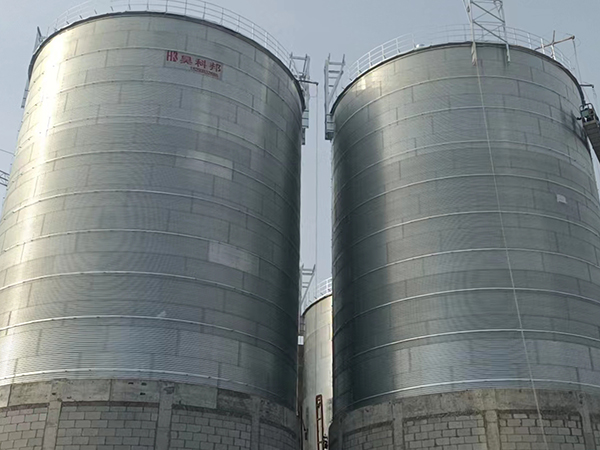
Buying a grain silo is not simply a matter of choosing a storage capacity and comparing prices.
A silo may remain in service for 20 years or longer, so a small mistake during the purchasing stage can affect grain quality, operating costs, maintenance, and even the safety of the entire grain storage facility.
From our engineering experience, many problems that appear after installation actually come from decisions made much earlier—when the buyer was comparing silo manufacturers and quotations.
Before placing an order, I recommend asking the grain silo manufacturer the following 10 questions.
1. What Grain and Storage Conditions Is the Silo Designed For?
The first question should not be “How much does the silo cost?”
It should be:
“Is this silo suitable for my grain and local storage conditions?”
Different grains have different storage characteristics. Wheat, maize, rice, barley, soybean, sorghum, sunflower seeds, and other agricultural products can have different requirements for aeration, temperature control, discharge, and structural loading.
The manufacturer should understand at least:
- Grain type
- Bulk density
- Storage capacity
- Initial grain moisture
- Expected storage period
- Ambient temperature
- Local humidity and rainfall
- Wind conditions
- Snow load where applicable
- Foundation and installation conditions
For example, a grain silo for maize storage in a hot and humid region may require a stronger focus on aeration and temperature monitoring than a similar-capacity silo installed in a dry climate.
What to ask the manufacturer:
“What design assumptions are you using for my grain and local climate?”
A manufacturer that immediately recommends a silo without asking about these conditions may not be evaluating the project deeply enough.
2. What Is the Actual Storage Capacity of the Silo?
“Silo capacity” can be confusing because manufacturers may describe capacity in different ways.
You may see:
- Ton capacity
- Cubic meter capacity
- Bushel capacity
- Working capacity
- Total geometric capacity
These numbers should not automatically be treated as equivalent.
The actual tonnage depends on the bulk density of the stored grain.
For example, a silo designed for approximately 500 tons of wheat may not hold exactly 500 tons of another grain with a different bulk density.
You should therefore ask the manufacturer to clarify:
| Item | What to Confirm |
|---|---|
| Nominal capacity | Rated storage capacity |
| Grain type | Grain used for calculation |
| Bulk density | Density used in the calculation |
| Working capacity | Practical operating capacity |
| Total volume | Internal silo volume |
| Freeboard | Space reserved above stored grain |
For a commercial grain storage project, I recommend requesting the capacity calculation, rather than relying only on a number printed in a product brochure.

3. What Steel Material and Thickness Are Used?
A grain silo is a structural system, not simply a large steel container.
The quality and thickness of the galvanized steel sheets, stiffeners, roof components, bolts, and structural connections all influence the silo’s service life and structural performance.
Ask the silo supplier:
- What steel grade is used?
- What is the sheet thickness?
- Is the thickness different between silo courses?
- What galvanizing specification is used?
- What type of stiffeners are used?
- What bolt grade is used?
- How are the roof and wall connections designed?
One important point is that the thickest steel sheet is not necessarily required everywhere.
In a properly engineered silo, wall thickness and reinforcement can vary according to the load at different levels.
The lower section generally experiences greater grain pressure than the upper section, so the structural design should account for this.
Don’t compare silos only by steel weight
A heavier silo is not automatically a better silo.
A better comparison considers:
structural design + steel specification + corrosion protection + reinforcement + manufacturing quality + engineering calculations.
4. What Aeration System Does the Silo Include?
Aeration is one of the most important systems in long-term grain storage.
The purpose of aeration is not simply to “blow air into the grain.”
A properly designed aeration system helps control grain temperature and reduce conditions that contribute to moisture migration, condensation, mold growth, and insect activity.
Ask the manufacturer:
- How many aeration fans are required?
- What is the fan capacity?
- What is the total airflow rate?
- How are aeration ducts arranged?
- What grain depth was used for the calculation?
- Is aeration designed for cooling or drying?
- Can the system be operated in different weather conditions?
The required aeration rate depends on the grain, storage depth, climate, and operating objective.
For this reason, a manufacturer should be able to explain why a particular fan capacity and aeration arrangement was selected, rather than simply adding a standard fan package to every silo.
5. How Is Grain Temperature Monitored?
Temperature monitoring becomes increasingly important as silo capacity increases.
A grain mass can develop localized hot spots even when the average temperature appears normal.
A modern grain storage system may therefore use:
- Temperature cables
- Multiple temperature sensors
- Digital temperature monitoring
- Automatic alarms
- Centralized monitoring software
- Manual inspection points
Ask the manufacturer:
“How many temperature monitoring cables and sensors are recommended for this silo, and where will they be installed?”
Also ask whether the system can identify abnormal temperature changes early.
For larger commercial grain silos, temperature monitoring should be considered part of the grain storage management system, rather than an optional accessory added at the last minute.
6. What Grain Handling Equipment Is Included?
A silo does not operate independently.
It normally forms part of a complete grain handling system.
Depending on the project, the system may include:
Receiving → Pre-cleaning → Bucket Elevator → Conveyor → Distributor → Silo → Aeration → Discharge → Cleaning/Processing
Ask the grain silo manufacturer whether the quotation includes:
- Bucket elevators
- Belt conveyors
- Screw conveyors
- Chain conveyors
- Grain distributors
- Inlet pipes
- Outlet gates
- Slide gates
- Cleaning equipment
- Dust collection
- Control system
This is particularly important when comparing quotations from different grain silo manufacturers.
One supplier may quote only the silo body, while another may quote the silo plus conveying and control equipment.
The two prices are therefore not directly comparable.
7. How Does the Silo Discharge System Work?
Grain discharge is often overlooked during purchasing.
But after installation, it becomes one of the systems operators use every day.
Ask:
- Is the silo flat-bottom or hopper-bottom?
- What is the outlet diameter?
- How is grain flow controlled?
- Is a sweep auger required?
- How much residual grain remains after discharge?
- Can the silo be completely emptied?
- What equipment is required for final cleaning?
For large-capacity flat-bottom grain silos, a sweep auger is commonly used to remove the remaining grain after gravity discharge.
For smaller silos or applications requiring frequent and nearly complete discharge, a hopper-bottom design may be more convenient.
The correct choice depends on:
capacity + grain type + turnover frequency + available space + operating cost.

small grain silos
8. What Foundation and Installation Requirements Are Needed?
This is one of the most important questions to ask before purchasing.
A grain silo transfers a significant load to the foundation.
The required foundation design depends on factors such as:
- Silo diameter
- Storage capacity
- Full grain load
- Wind load
- Seismic conditions
- Soil bearing capacity
- Groundwater conditions
- Local construction standards
Ask the manufacturer to provide:
- Foundation load data
- Anchor bolt layout
- Silo base dimensions
- Foundation drawings
- Installation drawings
- Required concrete specifications
However, the silo manufacturer should not simply tell you to “build a concrete foundation.”
The engineering team should provide the relevant loads and connection information so that the foundation can be designed appropriately for the actual site.
9. Does the Manufacturer Provide Installation and Commissioning Support?
A silo can be well manufactured but still perform poorly if it is installed incorrectly.
This is especially important for overseas projects.
Ask the manufacturer:
“Who will install the silo, and what technical support will you provide during installation?”
Possible services include:
- Installation drawings
- Installation manuals
- Remote technical guidance
- Engineer dispatch
- Site installation supervision
- Equipment commissioning
- Operator training
- Maintenance guidance
For international grain storage projects, I usually recommend clarifying these responsibilities before signing the contract.
The contract should clearly state:
who supplies → who installs → who commissions → who trains → who provides after-sales support.
10. What Is Included in the Final Price?
The lowest grain silo quotation is not always the lowest project cost.
A quotation should be checked line by line.
Ask the manufacturer to clearly separate:
| Cost Item | Confirm |
|---|---|
| Silo body | Included or not |
| Roof system | Included |
| Stiffeners | Included |
| Manholes | Quantity and location |
| Aeration | Fans, ducts and accessories |
| Temperature monitoring | Sensors and cables |
| Discharge equipment | Included |
| Conveyors | Included or optional |
| Electrical control | Included or optional |
| Installation | Included or separate |
| Commissioning | Included |
| Spare parts | Included or optional |
| Transportation | Shipping terms |
| Foundation | Usually by local contractor |
Also clarify the commercial terms, such as:
- EXW
- FOB
- CIF
- CFR
- Installation cost
- Packaging
- Shipping
- Warranty
- Spare parts
- Payment terms
This prevents a common purchasing problem: choosing a low initial quotation and discovering later that several critical systems were excluded.
A Simple Way to Compare Grain Silo Manufacturers
When you receive quotations from several grain silo suppliers, don’t create a comparison based only on price.
I recommend using five categories:
| Evaluation Area | What to Compare |
|---|---|
| Engineering | Design calculations, load conditions, drawings |
| Silo quality | Steel, galvanizing, stiffeners, bolts |
| Storage system | Aeration, monitoring, discharge |
| Project service | Installation, commissioning, training |
| Commercial terms | Price, delivery, warranty, spare parts |
A supplier that is slightly more expensive may provide a much more complete storage solution.
For a grain storage project expected to operate for many years, the cost of one additional equipment item is usually less important than the cost of poor engineering.
10 Questions Checklist for Buyers
Before sending a purchase order, make sure you can answer these ten questions:
- Is the silo suitable for my grain and climate?
- What is the actual working storage capacity?
- What steel material, thickness, and galvanizing specification are used?
- How is the aeration system designed?
- How will grain temperature be monitored?
- What grain handling equipment is included?
- How will the silo discharge and empty?
- What foundation and site requirements are necessary?
- Who handles installation, commissioning, and training?
- Exactly what is included in the final quotation?
If a manufacturer can provide clear technical answers to all ten questions, you are in a much better position to compare suppliers.
What a Good Grain Silo Manufacturer Should Provide
From an engineering perspective, a reliable grain silo supplier should be able to provide more than a product catalog and a price.
For a complete project, you should expect technical information such as:
- Silo capacity and dimensions
- General arrangement drawings
- Structural design information
- Steel specifications
- Aeration design
- Temperature monitoring arrangement
- Inlet and outlet configuration
- Foundation load information
- Equipment list
- Electrical requirements
- Installation instructions
- Commissioning support
- Maintenance recommendations
For larger projects, the manufacturer should also be able to work with the customer’s site conditions, grain characteristics, storage requirements, and material handling process instead of simply supplying a standard silo.
Final Advice Before You Buy a Grain Silo
The most important lesson is simple:
Don’t buy a grain silo by capacity and price alone.
A 2,000-ton silo from one supplier may look similar to a 2,000-ton silo from another supplier, but the differences in steel specifications, structural design, aeration, temperature monitoring, discharge equipment, installation support, and project engineering can be significant.
Before comparing prices, define the technical requirements.
Before signing the contract, define the scope of supply.
And before manufacturing begins, confirm the drawings, loads, equipment configuration, and site requirements.
A good grain silo purchase should start with engineering questions—not price negotiations.
Buyer Quick Checklist
Grain → Capacity → Climate → Structure → Aeration → Temperature Monitoring → Handling → Discharge → Foundation → Installation → Total Cost
This sequence gives you a much more reliable basis for selecting a grain silo manufacturer and designing a grain storage system that can operate safely and efficiently for many years.